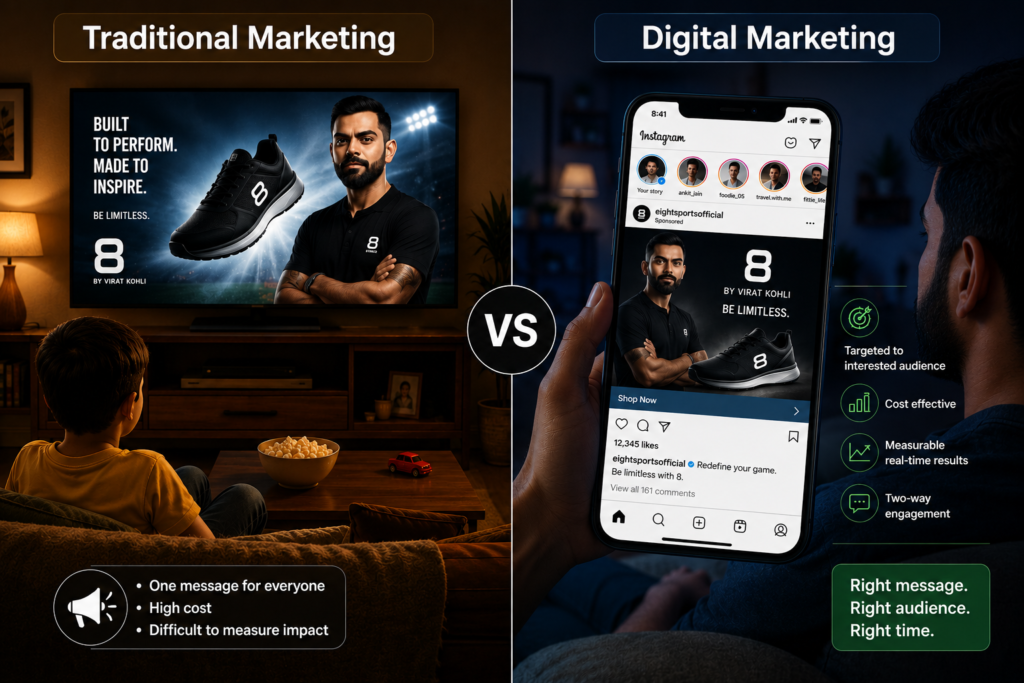
Have You Ever Wondered Why We Rarely See New Brands Advertising on TV Anymore?
Think back 15 or 20 years.
Whenever a company launched a new product, where did we usually see its advertisements?
- Television
- Newspapers
- Radio
- Magazines
- Billboards
That was the only way brands could reach millions of people.
Fast forward to today.
A startup with just ₹500 can launch a Facebook or Google Ads campaign and reach thousands of highly targeted customers within hours.
Brands now compete on:
- YouTube
- Influencer platforms
This raises an interesting question.
Did Traditional Marketing stop working?
Or…
Did customer behavior change so dramatically that businesses had no choice but to evolve?
The answer is more fascinating than most people realize.
Companies didn’t abandon Traditional Marketing because it failed.
They shifted because customers changed how they discover, research, and buy products.
As customer attention moved online,
marketing naturally followed.
Table of Contents
- Chapter 1: Traditional Marketing vs Digital Marketing: The Biggest Marketing Transformation in Business History
- Chapter 1. 1: Why Did Companies Depend on Traditional Marketing for So Many Years?
- Chapter 2: Traditional Marketing vs Digital Marketing: Business Problems That Changed Marketing Forever
- Chapter 3: How Digital Marketing Solved Traditional Marketing Problems
- Chapter 4: Traditional Marketing vs Digital Marketing: Side-by-Side Comparison
Chapter 1: Traditional Marketing vs Digital Marketing: The Biggest Marketing Transformation in Business History
Marketing has always had one simple goal.
Connect the right product with the right customer at the right time.
What changed wasn’t the purpose.
What changed was how companies achieved it.
For decades,
Traditional Marketing dominated the business world.
Television commercials influenced millions.
Newspapers introduced new brands.
Radio promoted local businesses.
Billboards built brand awareness.
These channels helped companies become household names.
Brands like:
- Coca-Cola
- Pepsi
- Nestlé
- Colgate
- Surf Excel
grew using Traditional Marketing long before smartphones or social media existed.
However,
as technology evolved,
consumer behavior changed.
People stopped waiting for tomorrow’s newspaper.
Instead,
they searched Google.
They watched YouTube.
They followed influencers.
They read online reviews.
They compared prices instantly.
Businesses realized something important.
Marketing must follow customer attention.
That realization sparked one of the biggest transformations in business history.
What Is Traditional Marketing?
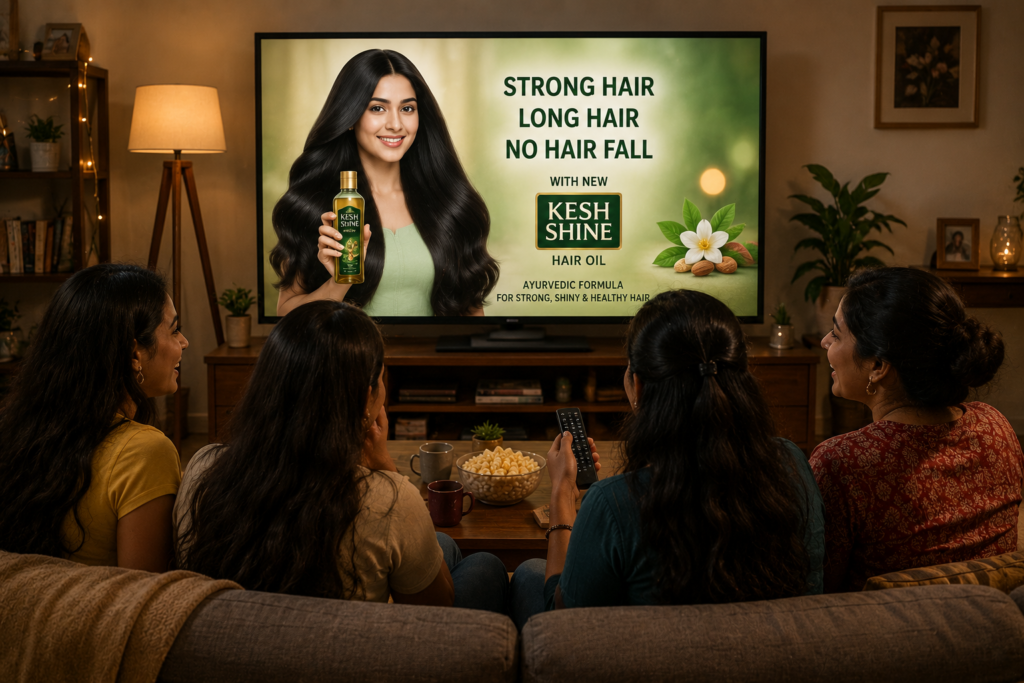
Definition:
Traditional Marketing is the promotion of products or services through offline channels such as television, newspapers, magazines, radio, billboards, brochures, direct mail, and events.
Its primary objective is to create awareness among a broad audience.
Unlike digital channels,
Traditional Marketing generally communicates the same message to everyone.
Common Examples of Traditional Marketing
- Television commercials
- Newspaper advertisements
- Radio advertising
- Magazine advertisements
- Billboards
- Flyers
- Brochures
- Direct mail
- Trade shows
- Product exhibitions
How Traditional Marketing Worked
Imagine it’s 2005.
A company launches a new shampoo.
To reach customers,
its marketing team buys:
- TV commercials during prime-time shows.
- Newspaper advertisements.
- Radio promotions.
- Outdoor billboards.
Millions of people see the campaign.
Some become customers.
Many don’t.
But the company pays for reaching everyone.
That was considered normal.
What Is Digital Marketing?
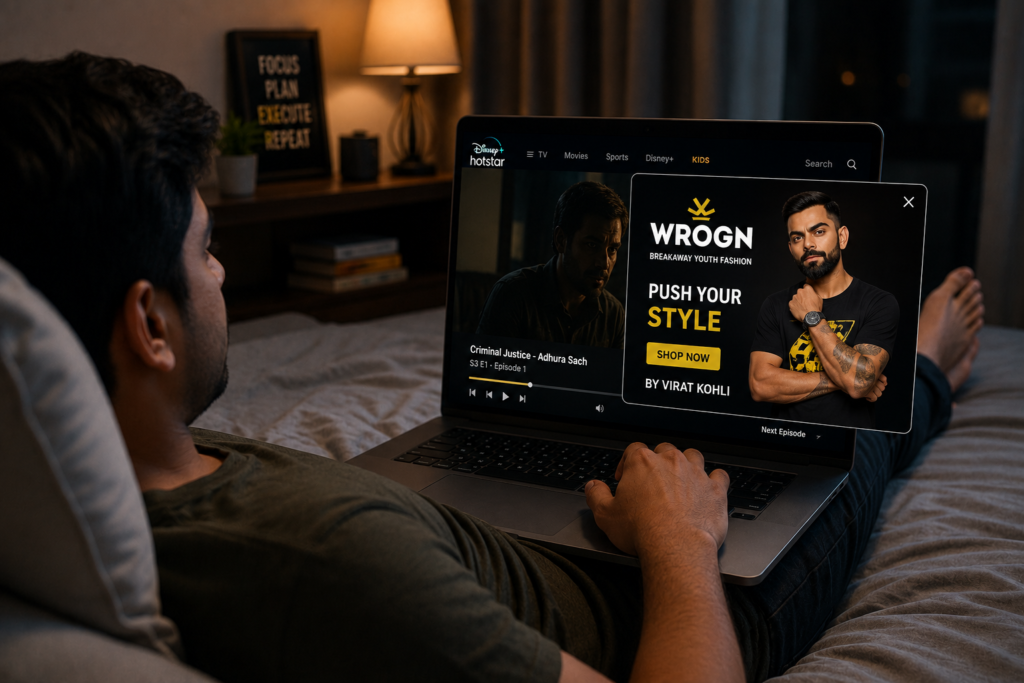
Definition:
Digital Marketing is the promotion of products or services through internet-based channels such as search engines, websites, social media, email, mobile apps, online videos, and digital advertisements.
Unlike Traditional Marketing,
Digital Marketing allows businesses to reach specific audiences,
measure campaign performance,
and optimize results in real time.
Common Examples of Digital Marketing
- Google Ads
- Facebook Ads
- Instagram Marketing
- LinkedIn Marketing
- YouTube Advertising
- SEO
- Email Marketing
- Content Marketing
- Influencer Marketing
- Affiliate Marketing
A Simple Example
Imagine you own a furniture store in Hyderabad.
Traditional Marketing
You publish a newspaper advertisement.
People across different cities read it.
Many have no intention of buying furniture.
Your advertisement reaches everyone,
but only a small percentage are potential customers.
Digital Marketing
Now imagine running a Google Ads campaign.
You target:
- Hyderabad
- Age 28 to 55
- Recently searched “wooden sofa”
- Interested in home interiors
Suddenly,
almost everyone seeing your advertisement is a potential customer.
That’s the power of Digital Marketing.
Chapter 1. 1: Why Did Companies Depend on Traditional Marketing for So Many Years?
Many people wonder,
“If Digital Marketing is so effective, why didn’t companies use it from the beginning?”
The answer is simple.
Because Digital Marketing didn’t exist.
Before the internet,
Traditional Marketing wasn’t one option among many.
It was the only practical option.
Companies had limited choices.
If they wanted people to know about a product,
they had to use mass media.
Examples include:
- Television
- Newspapers
- Radio
- Outdoor advertising
Those channels reached millions,
making them extremely valuable.
During that period,
consumer attention also lived in those places.
Families watched television together every evening.
Morning newspapers were part of daily life.
Radio accompanied people while driving.
Marketing followed where people spent their time.
The Biggest Shift Wasn’t in Marketing
Many people believe marketers created Digital Marketing.
That’s not entirely true.
Customers created Digital Marketing.
As internet access expanded,
people gradually changed how they searched for information.
Instead of asking neighbors,
they searched Google.
Instead of reading printed product brochures,
they watched YouTube reviews.
Instead of trusting advertisements,
they trusted online ratings and customer reviews.
Businesses noticed something important.
Their customers were spending less time with traditional media
and more time online.
As a result,
marketing strategies evolved.
This wasn’t simply a technological shift.
It was a consumer behavior shift.
Marketing Term We Should Know:
1. Consumer Behavior
Definition
Consumer Behavior is the study of how individuals discover, evaluate, purchase, use, and respond to products and services.
Understanding consumer behavior helps businesses create marketing campaigns that match customer needs and preferences.
Example
Twenty years ago,
someone wanting to buy a television might visit several stores before making a decision.
Today,
many people:
- Search Google
- Watch YouTube reviews
- Compare prices online
- Read customer ratings
- Order from an eCommerce website
The buying journey has completely changed.
2. Consumer Journey
Definition
The Consumer Journey (or Customer Journey) refers to the complete path a customer follows before, during, and after purchasing a product or service.
A typical journey includes:
- Awareness
- Consideration
- Decision
- Purchase
- Loyalty
- Advocacy
Traditional Marketing mainly influenced the awareness stage.
Digital Marketing influences every stage of the customer journey.
3. Brand Awareness
Definition
Brand Awareness measures how easily customers recognize and remember a brand.
Traditional Marketing excelled at creating mass brand awareness.
Television commercials,
billboards,
and newspaper advertisements helped brands become familiar household names.
Examples include:
- Amul
- Coca-Cola
- Asian Paints
- LIC
- Airtel
Even today,
these brands benefit from decades of strong brand awareness.
Chapter 2: Traditional Marketing vs Digital Marketing: Business Problems That Changed Marketing Forever
Traditional Marketing built some of the world’s most recognizable brands.
But behind every successful television commercial, newspaper advertisement, or billboard campaign, businesses faced several hidden challenges.
Initially, companies accepted these challenges because they had no better alternative.
However, as technology advanced and consumers moved online, Digital Marketing emerged as a solution to many of these long-standing problems.
Let’s explore the biggest business challenges that pushed companies toward Digital Marketing.
1. Traditional Marketing Had High Advertising Costs
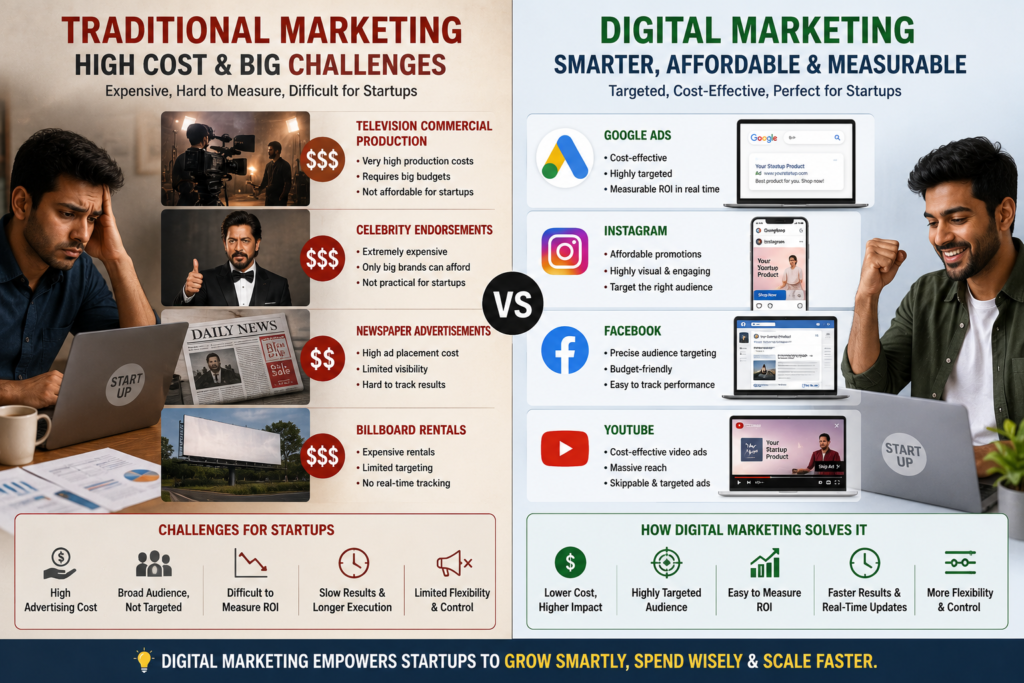
The Challenge
One of the biggest limitations of Traditional Marketing was its high upfront investment.
Businesses often needed substantial budgets before launching a campaign.
Common expenses included:
- Television commercial production
- Celebrity endorsements
- Newspaper advertisements
- Magazine placements
- Billboard rentals
- Radio advertising
- Printing brochures and flyers
For small businesses and startups, these costs were often unaffordable.
Example
Imagine opening a new restaurant in Hyderabad.
Advertising on a national TV channel would cost lakhs of rupees, even though your customers live within a few kilometers of your restaurant.
Most of that advertising budget would be wasted.
How Digital Marketing Solved It
Today, businesses can launch campaigns with flexible budgets.
A startup can advertise on:
- Google Ads
- YouTube
with budgets as low as a few hundred rupees per day.
Instead of paying for millions of uninterested viewers,
companies now pay only to reach relevant audiences.
Cost Efficiency
Cost Efficiency refers to achieving better marketing results while spending less money.
Digital Marketing significantly improves cost efficiency by allowing businesses to target specific audiences instead of paying for broad mass exposure.
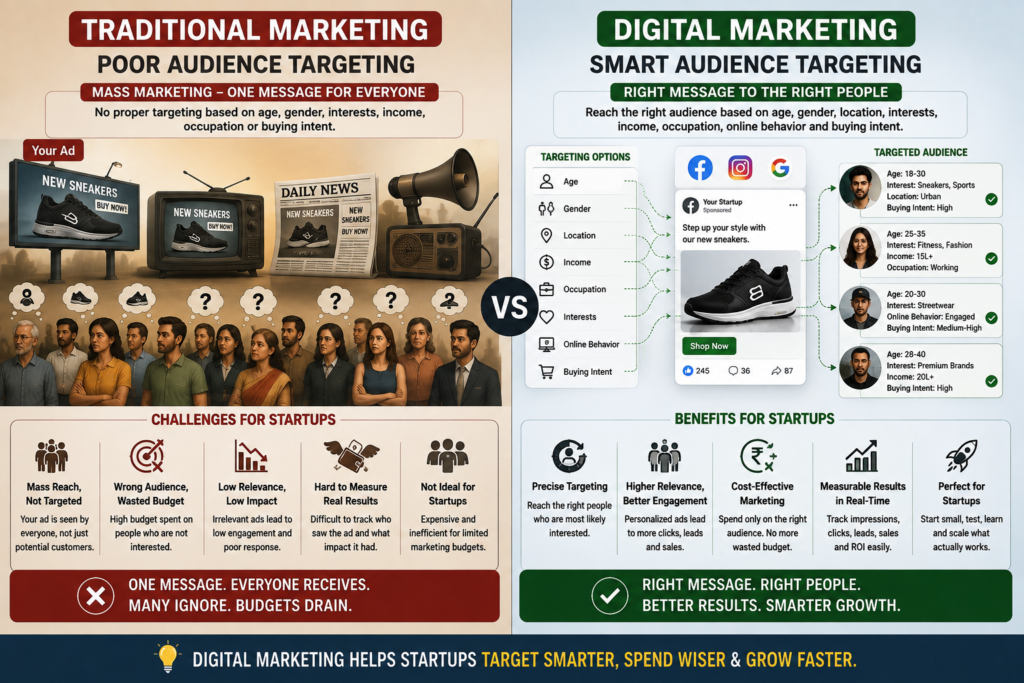
2. Traditional Marketing Had Poor Audience Targeting
The Challenge
Traditional Marketing followed a Mass Marketing approach.
Mass Marketing:
Mass Marketing is a strategy where the same advertisement is shown to a broad audience regardless of age, interests, income, or buying intent.
This worked well when competition was low.
However,
it became increasingly inefficient as markets became crowded.
Example
A luxury SUV advertisement aired during a cricket match reaches:
- Students
- Teenagers
- Families
- Senior citizens
Only a small percentage are actually planning to buy an SUV.
Yet the company pays to reach everyone.
How Digital Marketing Solved It
Digital Marketing introduced Audience Targeting.
Audience Targeting:
Audience Targeting is the practice of showing advertisements only to people who are most likely to become customers based on demographics, interests, behaviors, or purchase intent.
Companies can target users based on:
- Age
- Gender
- Location
- Income
- Occupation
- Interests
- Previous purchases
- Online behavior
This dramatically reduces wasted advertising spend.
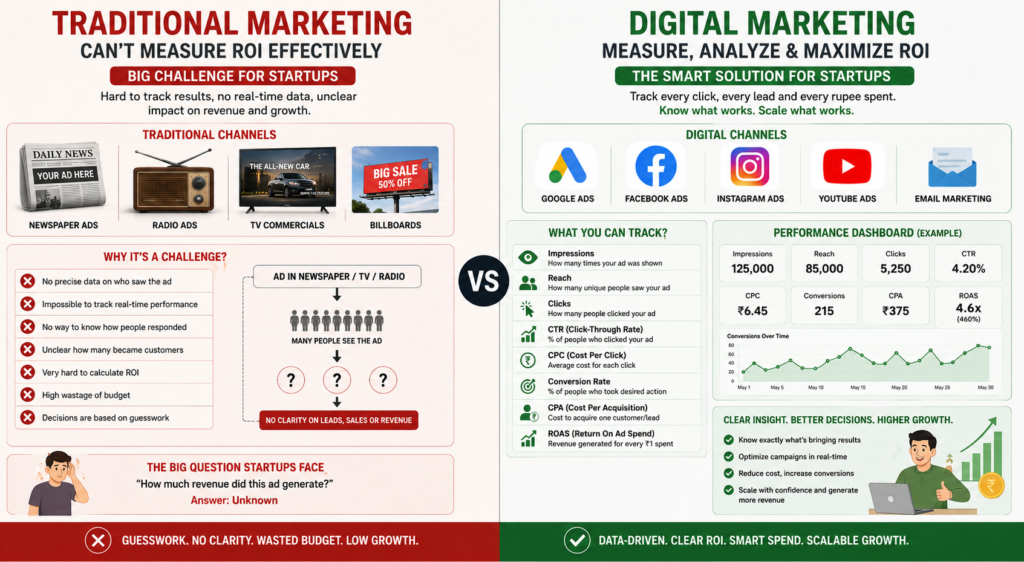
3. Traditional Marketing Couldn’t Measure ROI Accurately
This version is stronger for SEO because it naturally includes important keywords like ROI, impressions, CTR, CPC, CPA, ROAS, Digital Marketing, Traditional Marketing, campaign performance, and data-driven marketing, while still emphasizing the key takeaway rather than describing the visual.
The Challenge
Imagine spending ₹2 crore on a television campaign.
A month later,
your CEO asks:
“How many customers purchased because of this advertisement?”
The honest answer was often:
“We don’t know.”
Businesses relied on estimates instead of accurate data.
How Digital Marketing Solved It
Modern marketing platforms provide detailed analytics.
Marketers can measure:
- Impressions
- Reach
- Clicks
- Click-Through Rate (CTR)
- Cost Per Click (CPC)
- Conversion Rate
- Cost Per Acquisition (CPA)
- Return on Ad Spend (ROAS)
Every marketing decision becomes measurable.
ROI:
Return on Investment (ROI) measures whether the revenue generated from a marketing campaign justifies the money spent.
The more accurately companies can measure ROI, the better they can optimize future campaigns.
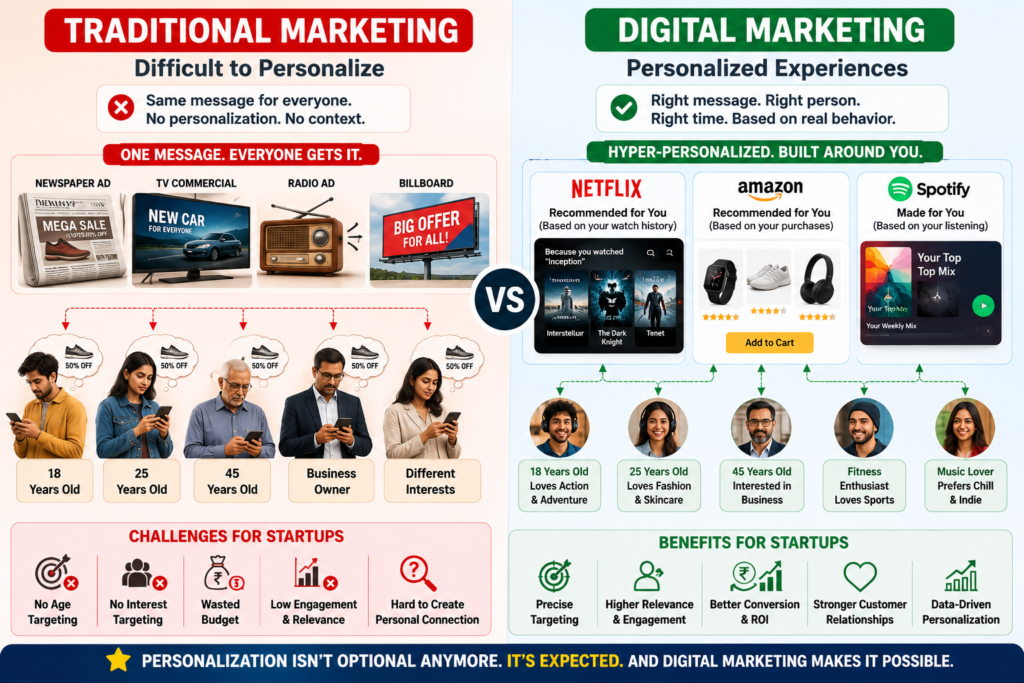
4. Traditional Marketing Was Difficult to Personalize
The Challenge
Traditional advertisements delivered the same message to everyone.
Whether you were:
- 18 years old
- 45 years old
- A parent
- A student
everyone watched the exact same commercial.
Consumers have different needs,
yet businesses had limited ability to personalize their messaging.
How Digital Marketing Solved It
Digital platforms personalize marketing experiences.
Examples include:
Netflix recommends shows based on viewing history.
Amazon suggests products based on previous purchases.
Spotify creates personalized playlists and yearly listening summaries.
Personalization improves engagement because customers receive content that matches their interests.
Personalization:
Personalization is the process of delivering customized content, advertisements, or recommendations based on an individual’s preferences, behavior, or purchase history.
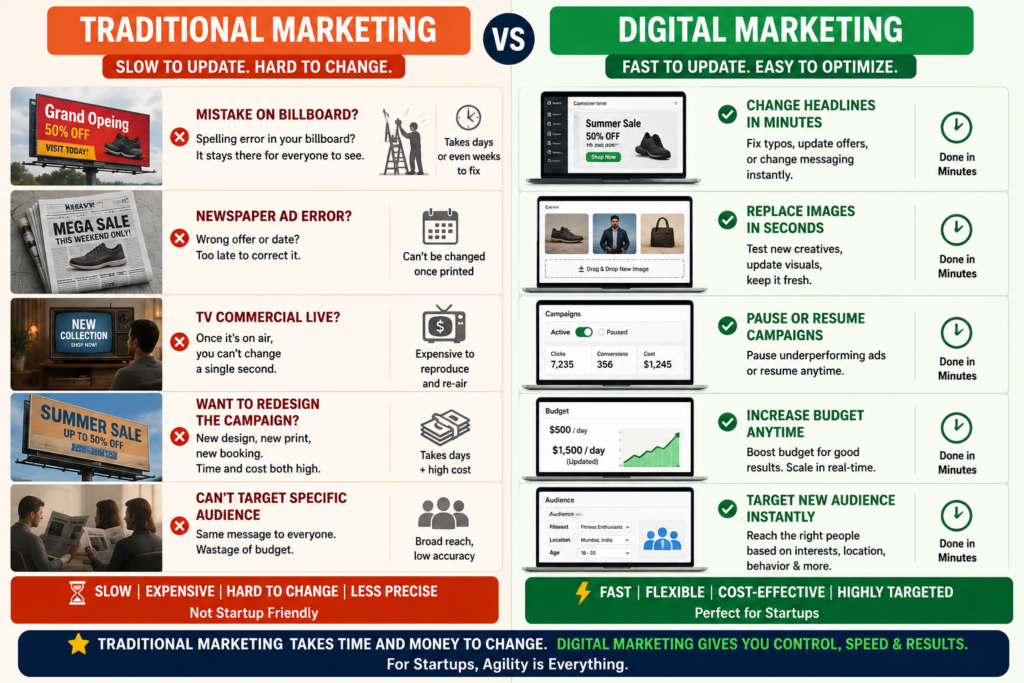
5. Traditional Marketing Was Slow to Update
The Challenge
Once a newspaper advertisement was printed,
or a billboard was installed,
making changes became expensive.
Correcting mistakes often required redesigning and republishing the entire campaign.
How Digital Marketing Solved It
Digital advertisements can be updated within minutes.
Businesses can instantly:
- Change headlines
- Replace images
- Pause campaigns
- Increase budgets
- Target new audiences
This flexibility allows marketers to respond quickly to market changes.
Marketing Agility:
Marketing Agility refers to a company’s ability to quickly adapt campaigns based on customer behavior, trends, or business goals.
Digital Marketing significantly improves marketing agility.
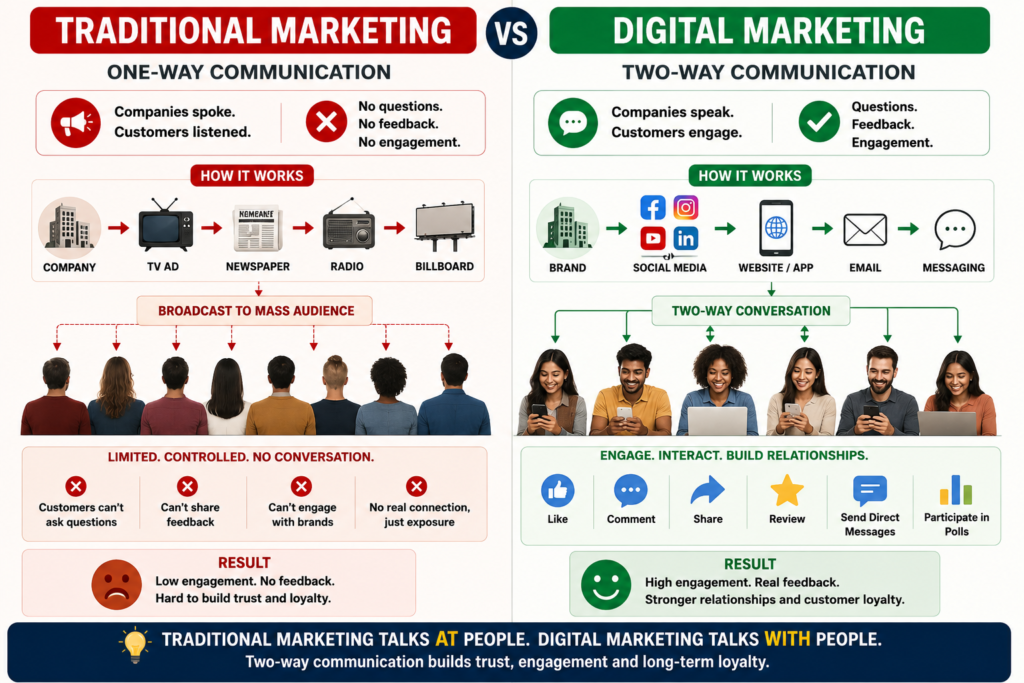
6. Traditional Marketing Offered One-Way Communication
The Challenge
Traditional Marketing focused on broadcasting messages.
Companies spoke.
Customers listened.
Interaction was extremely limited.
Consumers couldn’t instantly ask questions,
share feedback,
or engage with brands.
How Digital Marketing Solved It
Digital Marketing transformed advertising into conversations.
Customers can now:
- Comment
- Share
- Review
- Like
- Send direct messages
- Participate in polls
- Create user-generated content
This strengthened relationships between brands and customers.
Customer Engagement:
Customer Engagement measures how actively customers interact with a brand across different touchpoints.
Higher engagement often leads to stronger customer loyalty and better business outcomes.
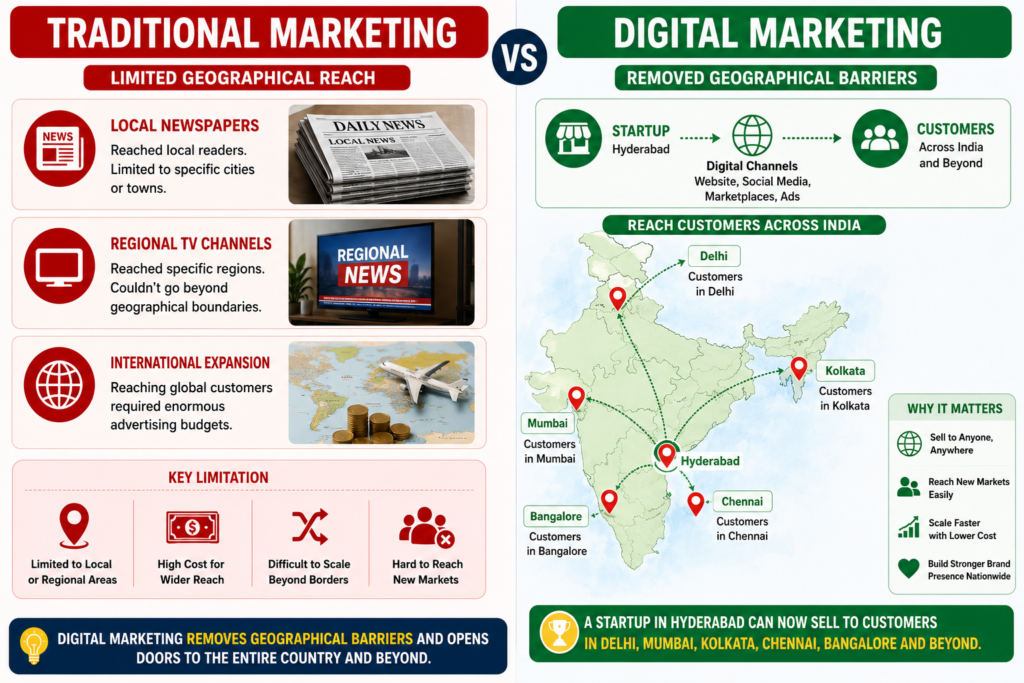
7. Traditional Marketing Had Limited Geographic Reach
The Challenge
Local newspapers reached local readers.
Regional TV channels reached specific regions.
International expansion required enormous advertising budgets.
This made scaling difficult for growing businesses.
How Digital Marketing Solved It
Digital Marketing removed geographical barriers.
A startup in Hyderabad can sell products to customers in:
- Delhi
- Mumbai
- Dubai
- Singapore
- London
- New York
without opening physical stores in those cities.
This global accessibility has transformed business growth.
Global Reach:
Global Reach refers to a company’s ability to connect with customers across different countries and regions using digital channels.
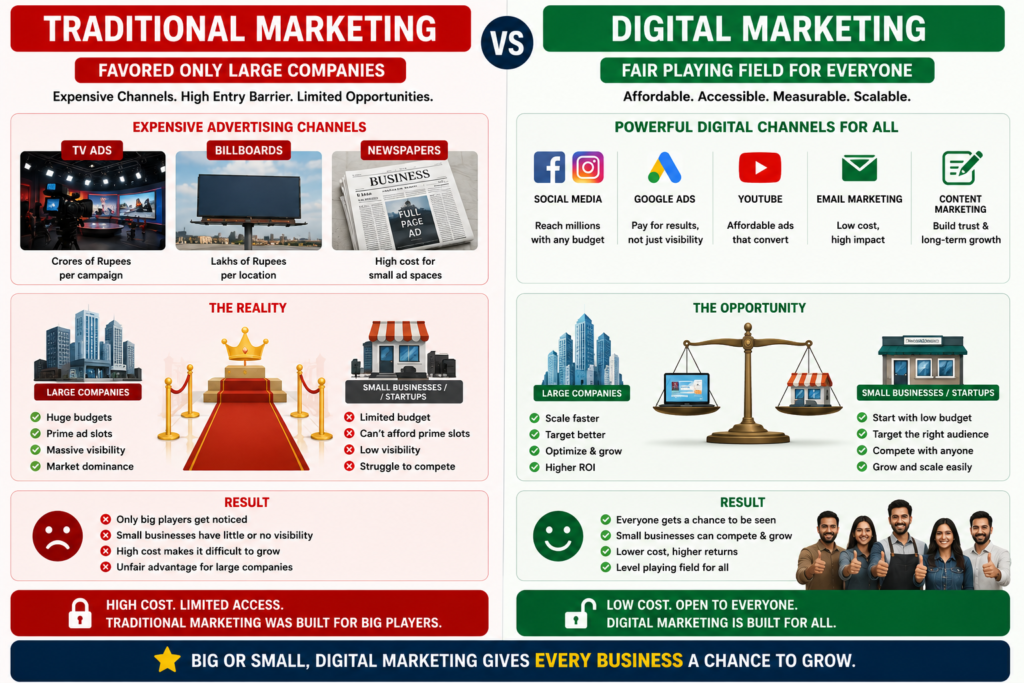
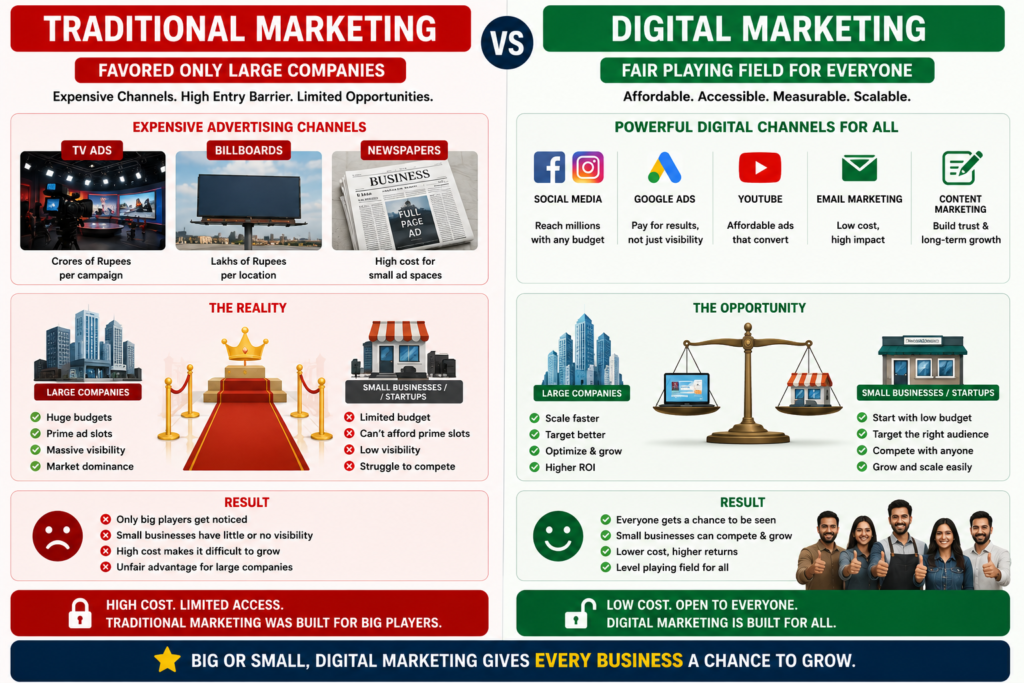
8. Traditional Marketing Favored Large Companies
The Challenge
Large corporations dominated television,
newspapers,
and billboards because they had larger advertising budgets.
Small businesses struggled to compete.
This created an uneven playing field.
How Digital Marketing Solved It
Digital Marketing democratized advertising.
Democratization of Marketing:
The Democratization of Marketing means businesses of all sizes can compete using affordable digital platforms and data-driven strategies.
Today,
a local startup can successfully compete against multinational companies by creating relevant content and targeting the right audience.
9. Traditional Marketing Could Not Support Real-Time Marketing
The Challenge
Imagine India winning the Cricket World Cup.
Traditional advertisers had to wait for the next newspaper edition or scheduled television slots.
By then,
the excitement had already faded.
How Digital Marketing Solved It
Brands now participate in live conversations.
Examples include:
- Zomato tweeting during cricket matches.
- Blinkit promoting snacks during IPL games.
- Swiggy recommending tea and Maggi during rainy weather.
- Food delivery apps promoting ice cream during heatwaves.
This is called Real-Time Marketing.
Real-Time Marketing:
Real-Time Marketing is the practice of creating marketing campaigns that respond immediately to current events, trends, festivals, weather, sports, or breaking news to stay relevant and increase engagement.
10. Traditional Marketing Struggled with Growing Competition
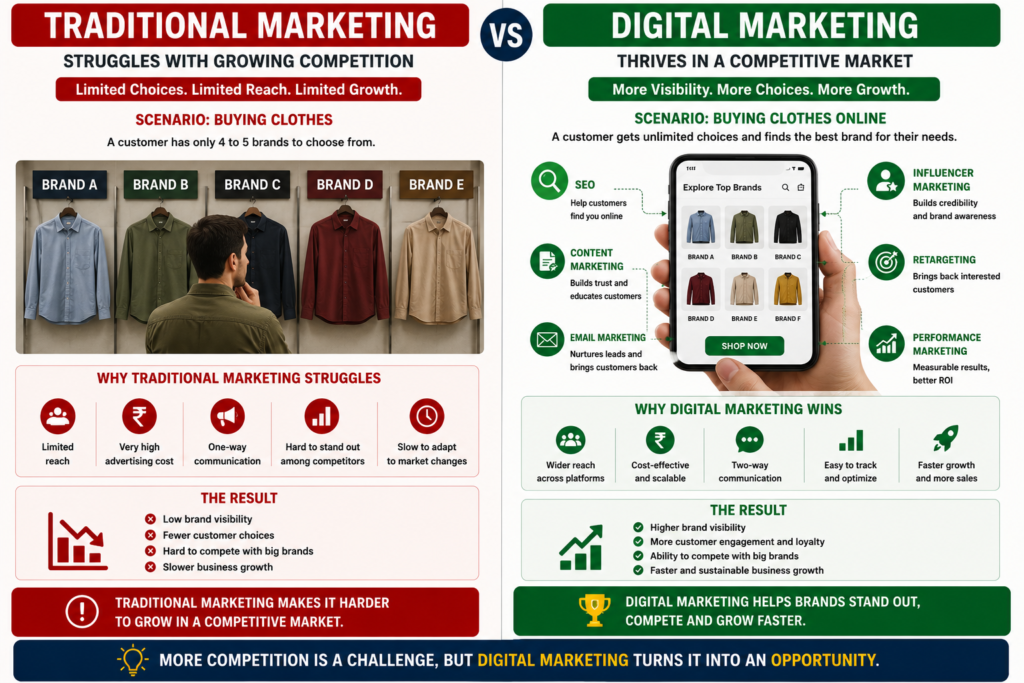
The Challenge
In the past,
many industries had only a handful of competitors.
Today,
customers have countless choices.
For example,
instead of choosing between three or four clothing brands,
customers can shop from hundreds of global and local brands online.
Businesses needed smarter ways to stand out.
How Digital Marketing Solved It
Digital Marketing introduced strategies such as:
- Search Engine Optimization (SEO)
- Content Marketing
- Influencer Marketing
- Email Marketing
- Retargeting
- Performance Marketing
These strategies help brands attract customers throughout their buying journey rather than relying on a single advertisement.
Performance Marketing:
Performance Marketing is a digital marketing strategy where advertisers pay based on measurable actions such as clicks, leads, app installs, or sales instead of paying simply for displaying advertisements.
Key Takeaway:
The shift from Traditional Marketing to Digital Marketing wasn’t driven by technology alone.
It was driven by business needs.
Companies wanted to:
- Reduce advertising costs.
- Reach the right customers.
- Measure campaign performance.
- Personalize customer experiences.
- Respond quickly to market changes.
- Compete effectively in increasingly crowded markets.
Digital Marketing provided solutions to these challenges, making it an essential part of modern business strategy.
Chapter 3: How Digital Marketing Solved Traditional Marketing Problems
By the late 2000s, businesses realized something remarkable.
Digital Marketing wasn’t simply another advertising channel.
It introduced an entirely new way of understanding, reaching, and serving customers.
Instead of guessing what customers wanted,
companies could now analyze customer behavior,
measure campaign performance,
and improve marketing continuously.
Let’s explore the strategies that transformed modern marketing.
1. Inbound Marketing: Let Customers Find You Instead of Chasing Them
One of the biggest shifts in marketing philosophy was the move from interrupting customers to attracting customers.
Traditional Marketing interrupted people while they were:
- Watching television
- Reading newspapers
- Listening to the radio
Digital Marketing introduced Inbound Marketing, where customers voluntarily discover brands while searching for information.
Inbound Marketing:
Inbound Marketing is a strategy that attracts potential customers by creating valuable content that solves their problems instead of directly promoting products.
Instead of saying,
“Buy our product.”
Businesses now educate customers first.
Examples include:
- Blog articles
- YouTube tutorials
- Free eBooks
- Podcasts
- Webinars
Real-World Example
HubSpot became one of the world’s leading CRM companies by publishing thousands of educational marketing blogs before selling its software.
Customers trusted the brand because it consistently delivered value.
Lesson: Helpful content builds trust before it builds sales.
2. Search Engine Optimization (SEO): Helping Customers Discover Your Business
Imagine opening the world’s best bakery.
If nobody knows it exists,
customers won’t visit.
The same applies online.
That’s where SEO becomes essential.
Search Engine Optimization (SEO):
Search Engine Optimization (SEO) is the process of improving a website so that it appears higher in search engine results for relevant keywords.
The objective isn’t simply to rank on Google.
The objective is to become visible exactly when customers are searching for solutions.
Example
Someone searches:
“Best running shoes under ₹5,000”
If Nike’s product page appears among the top results,
Nike has an opportunity to earn that customer’s attention.
SEO brings customers without paying for every click.
3. Content Marketing: Selling Through Education
Modern consumers dislike aggressive advertisements.
They prefer information.
This led to the rise of Content Marketing.
Content Marketing:
Content Marketing is the strategic creation and distribution of valuable, relevant, and consistent content to attract, educate, and retain a clearly defined audience.
Content can include:
- Blogs
- Videos
- Infographics
- Podcasts
- Case studies
- Newsletters
- Social media posts
Unlike advertisements,
content focuses on solving customer problems rather than directly selling products.
Real-World Example
Think about our own website, CareerKhaana.
When we publish articles explaining marketing strategies, consumer psychology, or business concepts, you’re practicing Content Marketing.
Instead of saying,
“Visit my website.”
You educate readers first.
Trust follows.
Traffic follows.
Eventually, opportunities follow.
4. Performance Marketing: Every Rupee Can Be Measured
Traditional Marketing often relied on assumptions.
Digital Marketing introduced accountability.
Performance Marketing:
Performance Marketing is a strategy where advertisers pay based on measurable actions such as clicks, leads, purchases, or app installs.
Instead of asking,
“Did our advertisement work?”
Businesses can now answer with data.
Marketers monitor:
- Click-Through Rate (CTR)
- Cost Per Click (CPC)
- Conversion Rate
- Cost Per Acquisition (CPA)
- Return on Ad Spend (ROAS)
Every campaign becomes measurable and optimizable.
Real-World Example
An online clothing store spends ₹10,000 on Google Ads.
The campaign generates:
- 200 website visitors
- 30 purchases
- ₹75,000 in revenue
The marketing team can clearly evaluate whether the campaign was profitable.
5. Email Marketing: Building Long-Term Customer Relationships
Many people think email marketing is outdated.
In reality,
it’s still one of the highest ROI marketing channels.
Email Marketing
Email Marketing is the practice of sending personalized emails to prospects and customers to build relationships, educate audiences, and encourage purchases.
Businesses use email for:
- Welcome messages
- Product launches
- Discounts
- Newsletters
- Order confirmations
- Customer retention
Unlike social media,
companies own their email lists.
This makes email one of the most valuable digital assets.
Example
Amazon regularly sends personalized emails featuring:
- Recently viewed products
- Price drops
- Personalized recommendations
- Festival offers
These emails encourage repeat purchases.
6. Omnichannel Marketing: Creating a Seamless Customer Experience
Modern customers rarely purchase immediately.
They move across multiple platforms before making a decision.
Omnichannel Marketing:
Omnichannel Marketing is a strategy that delivers a consistent customer experience across multiple channels, both online and offline.
A customer might:
- Discover a product on Instagram.
- Read reviews on Google.
- Watch a YouTube review.
- Visit the website.
- Purchase using the mobile app.
- Receive follow-up emails.
Every touchpoint feels connected.
Real-World Example
Nike combines:
- Physical stores
- Mobile app
- Website
- Email campaigns
- Social media
- Fitness apps
Customers experience one unified brand regardless of where they interact.
7. Data-Driven Marketing: Making Decisions Based on Facts
Traditional marketers often relied on intuition and experience.
Digital marketers rely on data.
Data-Driven Marketing:
Data-Driven Marketing is the practice of using customer data and analytics to improve marketing decisions.
Businesses analyze:
- Customer demographics
- Website traffic
- Purchase history
- Engagement
- Conversion rates
- Customer lifetime value
This helps marketers continuously improve campaign performance.
Example
If analytics show that visitors abandon their shopping cart before checkout,
companies can redesign the checkout process or offer limited-time discounts.
Instead of guessing,
they solve actual customer problems.
8. Marketing Automation: Working Smarter, Not Harder
Imagine manually sending welcome emails to thousands of customers every day.
Impossible.
Automation changed everything.
Marketing Automation:
Marketing Automation uses software to automatically perform repetitive marketing tasks based on customer actions.
Examples include:
- Welcome emails
- Birthday offers
- Cart abandonment reminders
- Lead nurturing
- Product recommendations
Automation saves time while improving customer experiences.
Real-World Example
If you add shoes to your cart on an eCommerce website but don’t complete the purchase,
you may receive:
“Still thinking about these shoes? Complete your purchase today and enjoy 10% off.”
That message is automatically triggered.
9. Artificial Intelligence (AI): The Next Marketing Revolution
Artificial Intelligence is reshaping Digital Marketing.
Instead of simply showing advertisements,
AI predicts what customers are most likely to want.
AI Marketing:
AI Marketing uses artificial intelligence and machine learning to analyze customer behavior, personalize experiences, and automate marketing decisions.
AI helps businesses:
- Recommend products
- Predict customer preferences
- Optimize advertising
- Generate content
- Improve customer support through chatbots
Example
Netflix doesn’t randomly recommend movies.
Its recommendation engine analyzes:
- Viewing history
- Genres
- Ratings
- Watch time
- Similar user preferences
This personalization keeps users engaged.
Real-World Case Studies: Digital Marketing in Action
Amazon
Amazon combines:
- AI recommendations
- Email Marketing
- Personalization
- Performance Marketing
Every customer sees different product suggestions based on browsing and purchase history.
Marketing Lesson: Personalization increases conversion rates and customer satisfaction.
Netflix
Netflix uses:
- AI-powered recommendations
- Personalized thumbnails
- Email campaigns
- Social media engagement
The platform adapts the experience for every subscriber.
Marketing Lesson: Relevance keeps customers loyal.
Nike
Nike doesn’t simply sell shoes.
It builds a digital ecosystem through:
- Nike App
- Nike Run Club
- Social media campaigns
- Influencer partnerships
- Fitness challenges
Marketing Lesson: Create a community, not just customers.
Coca-Cola
Coca-Cola blends Traditional and Digital Marketing.
Television commercials create emotional storytelling.
Social media campaigns encourage customer participation through hashtags, contests, and user-generated content.
Marketing Lesson: The strongest brands integrate both worlds.
Zomato
Zomato has become famous for:
- Real-Time Marketing
- Humorous notifications
- Festival campaigns
- Cricket-related content
- Trending memes
The brand stays relevant by joining conversations people are already having.
Swiggy
Swiggy adapts its marketing based on:
- Rainy weather
- Festivals
- IPL matches
- Time of day
- Local events
Instead of generic promotions,
customers receive highly contextual recommendations.
Marketing Lesson: Relevance beats interruption.
Chapter 4: Traditional Marketing vs Digital Marketing: Side-by-Side Comparison
Although Digital Marketing has transformed the business landscape, it doesn’t mean Traditional Marketing has become irrelevant.
Both approaches have unique strengths and limitations.
The most successful companies today don’t choose one over the other—they combine both strategically.
Here’s a practical comparison.
| Feature | Traditional Marketing | Digital Marketing |
|---|---|---|
| Medium | TV, Newspapers, Radio, Billboards | Google, Social Media, Websites, Email, Apps |
| Audience | Broad Mass Audience | Highly Targeted Audience |
| Cost | High Initial Investment | Flexible Budget |
| ROI Measurement | Difficult | Real-Time Analytics |
| Personalization | Limited | Highly Personalized |
| Campaign Updates | Slow | Instant |
| Customer Interaction | One-Way | Two-Way |
| Geographic Reach | Mostly Local or Regional | Global |
| A/B Testing | Expensive | Easy |
| Speed | Days or Weeks | Minutes |
| Performance Tracking | Limited | Detailed |
| Best For | Brand Awareness | Lead Generation & Sales |
Is Traditional Marketing Dead?
One of the biggest misconceptions in marketing is that Traditional Marketing has disappeared.
The answer is:
Absolutely not.
Traditional Marketing still plays an important role, especially for building trust, mass awareness, and emotional storytelling.
Large brands continue investing billions in:
- Television commercials
- Outdoor billboards
- Sports sponsorships
- Newspapers
- Magazines
- Live events
Why?
Because these channels still reach millions of people and create memorable brand experiences.
Example
Think about the IPL (Indian Premier League).
Millions of viewers watch IPL matches on television and streaming platforms.
Companies like:
- Coca-Cola
- Dream11
- Tata
- PhonePe
- CEAT
- JioStar
still spend enormous amounts on television sponsorships because the audience is massive.
However,
they don’t stop there.
At the same time, they run:
- Instagram campaigns
- YouTube advertisements
- Google Search Ads
- Influencer collaborations
- Social media contests
This combination creates a much stronger marketing impact.
The Rise of Integrated Marketing
Businesses today don’t think in terms of:
Traditional Marketing or Digital Marketing.
Instead, they focus on Integrated Marketing.
Integrated Marketing:
Integrated Marketing is the practice of combining multiple marketing channels to deliver a consistent brand message and customer experience.
Instead of treating each platform separately,
all marketing activities work together.
Example
A customer might:
✔ Watch a TV advertisement.
↓
✔ Search Google for the product.
↓
✔ Visit the company’s website.
↓
✔ Read customer reviews.
↓
✔ Follow the brand on Instagram.
↓
✔ Receive a discount email.
↓
✔ Purchase through the mobile app.
Every interaction supports the next one.
This creates a seamless customer journey.
Omnichannel Customer Experience
An Omnichannel Customer Experience ensures customers receive a consistent experience across every online and offline touchpoint.
Examples include:
- Website
- Mobile app
- Retail store
- Social media
- Customer support
Customers don’t think in channels.
They think in experiences.
Which Marketing Strategy Should Businesses Choose?
The answer depends on the business objective.
Choose Traditional Marketing When You Want To:
- Build nationwide brand awareness
- Reach a broad audience
- Create emotional storytelling
- Launch products during major events
- Build long-term brand recognition
Choose Digital Marketing When You Want To:
- Generate leads
- Increase online sales
- Target specific audiences
- Measure campaign performance
- Improve ROI
- Personalize customer experiences
- Test different advertising creatives
The Best Strategy?
The smartest businesses combine both.
For example,
A smartphone company launches a new device.
Traditional Marketing creates excitement through:
- Television commercials
- Billboards
- Product launch events
Digital Marketing then drives action through:
- Google Ads
- YouTube reviews
- Influencer videos
- Instagram Reels
- Email campaigns
- Retargeting ads
One builds awareness.
The other converts interest into sales.
Marketing Mix
The Marketing Mix refers to the combination of different marketing channels and tactics a business uses to achieve its objectives.
Modern companies no longer rely on a single channel.
Instead,
they create a balanced mix of Traditional and Digital Marketing based on:
- Budget
- Target audience
- Industry
- Customer behavior
- Business goals
The Future of Marketing
Marketing will continue evolving as technology changes.
Some emerging trends include:
Artificial Intelligence (AI)
AI helps brands personalize customer experiences, predict buying behavior, and automate campaigns.
Voice Search
People increasingly search using voice assistants like Alexa, Siri, and Google Assistant.
Businesses now optimize content for conversational search queries.
Augmented Reality (AR)
Customers can virtually try products before purchasing.
Examples include:
- IKEA furniture placement
- Virtual makeup try-ons
- Eyeglass fitting apps
Hyper-Personalization
Instead of showing one advertisement to everyone,
AI will create unique experiences for individual customers based on real-time behavior.
Privacy-First Marketing
As users become more concerned about data privacy,
businesses must focus on transparent, ethical, and permission-based marketing.
Frequently Asked Questions (FAQs)
1. What is the main difference between Traditional Marketing and Digital Marketing?
Traditional Marketing uses offline channels like television, newspapers, radio, and billboards to reach a broad audience. Digital Marketing uses online platforms such as search engines, social media, email, websites, and mobile apps to target specific audiences and measure campaign performance in real time.
2. Why did companies shift from Traditional Marketing to Digital Marketing?
Companies shifted because Digital Marketing offers better audience targeting, measurable ROI, lower costs, personalization, real-time optimization, and two-way customer engagement.
3. Is Traditional Marketing still effective?
Yes. Traditional Marketing remains highly effective for mass brand awareness, emotional storytelling, local promotions, and major sponsorship events like the IPL or the Olympics. Many global brands continue to invest in it.
4. Is Digital Marketing cheaper than Traditional Marketing?
In many cases, yes. Digital Marketing allows businesses to start with smaller budgets and scale campaigns based on performance. However, costs can become significant in highly competitive industries or large-scale campaigns.
5. Can small businesses compete with large brands using Digital Marketing?
Absolutely. Digital Marketing provides affordable tools such as SEO, Content Marketing, Social Media Marketing, and targeted advertising that help startups and local businesses reach their ideal customers without massive advertising budgets.
6. Should businesses completely replace Traditional Marketing?
No. The most successful businesses combine Traditional and Digital Marketing. Traditional Marketing builds awareness and trust, while Digital Marketing strengthens engagement, generates leads, and drives measurable conversions.
7. What are some examples of companies that successfully combine both marketing approaches?
Companies like Nike, Coca-Cola, Apple, Amazon, Tata, Swiggy, and Zomato use television commercials, sponsorships, outdoor advertising, and events alongside SEO, social media, influencer marketing, email campaigns, and AI-powered personalization.
Final Key Insights
Before we conclude, here are the most important lessons from this marketing transformation:
- Marketing follows customer attention. As consumers moved online, businesses adapted their strategies.
- Traditional Marketing built iconic brands. It excelled at creating trust and large-scale awareness.
- Digital Marketing solved long-standing business challenges by offering precise targeting, measurable ROI, personalization, and agility.
- Data became one of marketing’s greatest assets. Modern decisions rely on analytics rather than assumptions.
- Customers now expect personalized experiences. AI, automation, and data-driven marketing help brands meet those expectations.
- Integrated Marketing is the future. Combining Traditional and Digital Marketing creates stronger customer experiences than relying on either approach alone.
- Technology will continue to reshape marketing, but one principle will remain constant: understanding customer needs is the foundation of every successful marketing strategy.
Conclusion
The debate around Traditional Marketing vs Digital Marketing isn’t about choosing a winner.
Traditional Marketing laid the foundation for modern advertising by building trust, recognition, and emotional connections. Digital Marketing expanded those capabilities with data, personalization, speed, and measurable performance.
The most successful brands don’t ask, “Which one is better?” Instead, they ask, “How can we use both to create the best customer experience?”
As consumer behavior continues to evolve, marketing will evolve with it. Businesses that understand their audience, embrace new technologies, and integrate both traditional and digital channels will be better positioned to build lasting relationships, drive sustainable growth, and remain competitive in an ever-changing marketplace.
Remember: Marketing channels may change, but the goal never does—delivering the right message to the right customer at the right time.