Why Do People Really Buy Products?
Imagine you’re walking into a supermarket to buy toothpaste.
You see two brands placed side by side.
One costs ₹80.
The other costs ₹280.
Both promise cleaner teeth.
Both contain similar ingredients.
Yet millions of customers willingly choose the expensive one.
Now think about another examples.
- Why do people pay ₹900 for Nike shoes when another brand offers similar-looking shoes for ₹400?
- Why do people choose Uber instead of waiting for an auto on the street?
If you answered,
- “Because the product is better.”
- You’re only seeing half the picture.
The real answer lies in one of the most powerful marketing frameworks ever created:
Customers don’t buy products. They hire products to get a job done.
This simple idea has helped companies like Apple, Amazon, Uber, Netflix, McDonald’s, Canva, Airbnb, Spotify, and thousands of startups create products customers genuinely love.
It’s called the Jobs To Be Done Framework (JTBD).
Table of Contents
- Chapter 1: What Is the Jobs To Be Done (JTBD)?
- Chapter 2: Why the Jobs To Be Done Framework Is Different from Traditional Marketing
- Chapter 3.1 : Functional Jobs vs Emotional Jobs vs Social Jobs
- Chapter 4: How Companies Use the Jobs To Be Done Framework
- Chapter 5: 15 Real-World Jobs To Be Done Framework Examples
- Chapter 6: Jobs To Be Done Framework vs Customer Persona
- Chapter 7: How AI Is Transforming the Jobs To Be Done Framework
Chapter 1: What Is the Jobs To Be Done (JTBD)?
The Jobs To Be Done Framework (JTBD) is a customer-centric marketing and innovation framework that helps businesses understand why customers buy a product or service.
Instead of focusing on customer demographics, age, income, or product features, the Jobs To Be Done Framework focuses on the progress customers want to make in a specific situation.
In simple words,
Customers don't buy products. They hire products to solve problems, complete tasks, or achieve desired outcomes.
Think about buying an Umbrella.
People don’t purchase an Umbrella because they enjoy collecting Umbrellas.
They buy it because they want to stay dry during the rain.
The Umbrella is simply hired to perform a job.
This small shift changes everything.
Instead of asking,
“How can we sell more products?”
Businesses start asking,
“What job is our customer trying to accomplish?”
Companies that answer this question correctly create products people continue using for years.
This small shift in thinking completely changes how businesses should market their products.
Instead of promoting product features, successful brands focus on helping customers accomplish their desired outcome.
Chapter 1.1: The Core Idea Behind the Jobs To Be Done Framework
Most businesses believe customers purchase products because of:
- Better features
- Lower prices
- Attractive packaging
- Advanced technology
While these factors matter, they aren’t the primary reason people buy.
Customers purchase products because they want to improve their lives.
The product is only a tool.
The real goal is progress.
For example,
A customer doesn’t buy a Power Drill because they love Drills.
They buy it because they want to make a hole in the Wall.
But even that isn’t the final answer.
Why do they want the hole?
To hang a family photograph.
Ultimately,
They aren’t buying a drill.
They are buying the feeling of seeing their family’s memories displayed on the wall.
This famous example perfectly illustrates the Jobs To Be Done Framework.
Products are temporary.
Jobs remain constant.
Technology changes.
Customer needs don’t.
Who Created the Jobs To Be Done Framework?
Although the concept has existed for decades, the Jobs To Be Done Framework became widely recognized through the work of Clayton Christensen, a Harvard Business School professor and author of ‘‘The Innovator’s Dilemma”.
Christensen believed companies often failed because they focused too much on improving products instead of understanding why customers purchased them.
Several experts contributed to the evolution of JTBD.
Clayton Christensen
Popularized the concept and introduced the famous “customers hire products” philosophy.
Tony Ulwick
Developed Outcome-Driven Innovation (ODI), helping companies identify unmet customer needs through measurable outcomes.
Bob Moesta
Worked alongside Christensen and specialized in customer interviews to understand why people switch from one product to another.
Today, companies worldwide use the Jobs To Be Done Framework to build products, improve marketing campaigns, and create better customer experiences.
Chapter 2: Why the Jobs To Be Done Framework Is Different from Traditional Marketing

Traditional marketing often focuses on questions like:
- Who is the customer?
- How old are they?
- What’s their income?
- Where do they live?
- What are their hobbies?
These questions create customer personas.
Personas are useful.
But they don’t explain why someone buys.
Imagine these two people:
Customer A
- 22 years old
- College student
- Lives in Hyderabad
Customer B
- 48 years old
- Business owner
- Lives in Mumbai
They appear completely different.
Yet both may subscribe to Spotify Premium for exactly the same reason.
Their job is:
“I want uninterrupted music while working.”
Different people.
Same job.
This is why the Jobs To Be Done Framework focuses on customer motivation rather than customer identity.
The Famous McDonald’s Milkshake Story
One of the most celebrated examples of the Jobs To Be Done Framework comes from McDonald’s.
McDonald‘s wanted to sell more Milkshakes.
Initially, they believed customers wanted:
- More flavors
- Lower prices
- Bigger cups
- Better ingredients
None of these significantly increased sales.
So researchers observed customers purchasing milkshakes.
They noticed something surprising.
Most buyers purchased milkshakes early in the morning.
Why?
Because many of them were commuting to work.
The Milkshake wasn’t competing against another dessert.
It was competing against Bananas, Bagels, Coffee, and Breakfast Sandwiches.
Customers hired the Milkshake because it was:
- Easy to hold while driving.
- Filling enough to last until lunch.
- Less messy than a banana.
- More enjoyable during a long commute.
The real job wasn’t:
“I want a delicious Milkshake.”
The real job was:
“Help me stay full and entertained during my morning commute.”
Once McDonald’s understood the customer’s job, they improved the product around that need instead of randomly adding new flavors.
This became one of the most influential case studies in modern marketing.
Chapter 3: The JTBD Formula

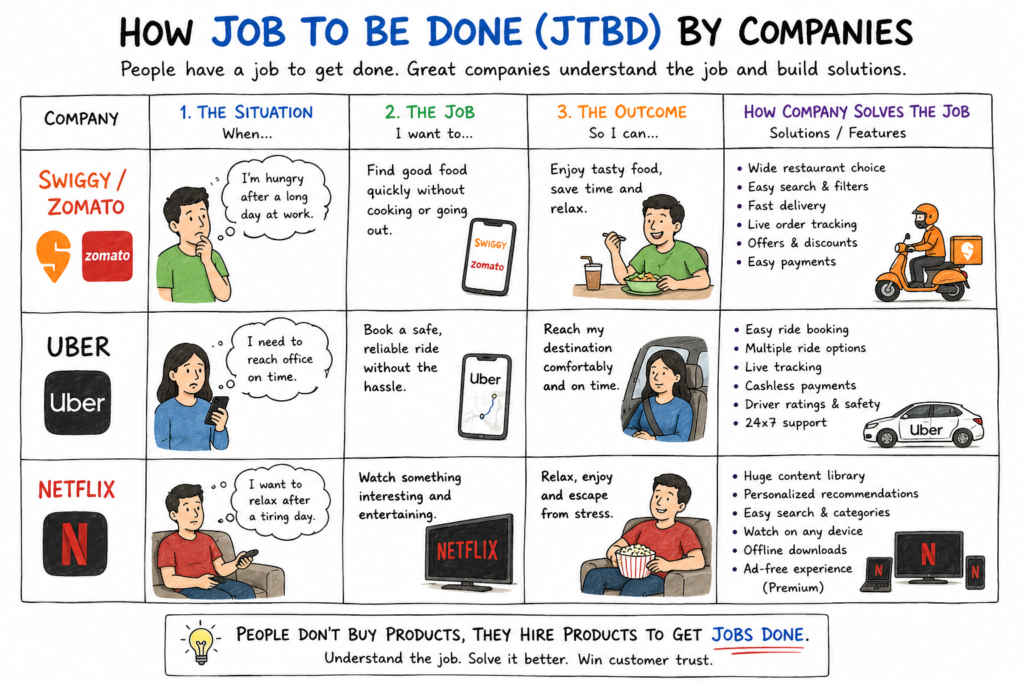
One of the easiest ways to discover a customer’s job is by using the JTBD formula.
When…
I want to…
So I can…
Example 1
When I’m running late for work,
I want to book an Uber,
So I can reach my office on time without stress.
Example 2
When I’m hungry after work,
I want to order food from Swiggy,
So I can save time instead of cooking.
Chapter 3.1 : Functional Jobs vs Emotional Jobs vs Social Jobs
The Jobs To Be Done Framework goes beyond solving practical problems. Every purchase is influenced by one or more of these three customer jobs.
Understanding them helps businesses create products, advertisements, and customer experiences that resonate on a deeper level.
Functional Jobs
Functional jobs are the practical tasks customers want to accomplish.
Examples
- Uber helps people travel from one place to another.
- Grammarly helps users write without grammar mistakes.
- Google Maps helps people find the fastest route.
- Canva helps users create professional designs quickly.
Customers choose these products because they help complete a task more efficiently.
Emotional Jobs
Customers also want products that make them feel a certain way.
Examples
- Apple makes customers feel creative and premium.
- Nike inspires confidence and motivation.
- Spotify helps people relax after a stressful day.
- Headspace helps users feel calm and focused.
Many buying decisions are emotional before they become logical.
3. Social Jobs
Sometimes customers buy products because of how they want others to perceive them.
Examples
- Driving a Tesla shows environmental awareness and innovation.
- Wearing a Rolex symbolizes success.
- Carrying a Louis Vuitton bag reflects luxury.
- Owning the latest iPhone signals modernity.
Great brands often satisfy all three jobs simultaneously.
Chapter 4: How Companies Use the Jobs To Be Done Framework
Successful companies don’t build products first.
They first understand what customers are trying to accomplish, then design products that help them complete that job better than existing alternatives.
Let’s see how some of the world’s biggest brands use the Jobs To Be Done Framework.
1. Uber

People don’t hire Uber because they enjoy booking rides.
They hire Uber because they need reliable transportation.
Customer Job
Help me reach my destination safely, quickly, and without hassle.
Uber continuously improves features like live tracking, estimated arrival times, cashless payments, and driver ratings because each feature helps customers complete the same job more efficiently.
2. Netflix

Netflix doesn’t compete by simply offering thousands of movies.
Instead, it solves a much bigger customer need.
Customer Job
Help me relax and enjoy entertainment whenever I have free time.
This is why Netflix invests heavily in AI-powered recommendations instead of simply adding more content.
3. Amazon

Amazon understands customers don’t enjoy shopping.
They enjoy receiving products quickly with minimum effort.
Customer Job
Help me buy what I need as quickly and conveniently as possible.
Features like Prime Delivery, One-Click Ordering, and personalized recommendations exist because they reduce friction.
4. Swiggy/Zomato

Swiggy doesn’t sell food.
Restaurants sell food.
Swiggy helps customers solve a different problem.
Customer Job
Help me enjoy restaurant-quality food without cooking.
That’s why features like real-time delivery tracking, offers, scheduled deliveries, and restaurant recommendations matter.
Chapter 5: 15 Real-World Jobs To Be Done Framework Examples
Here are some of the best examples of the Jobs To Be Done Framework.
| Brand | Customer Job |
|---|---|
| Uber | Reach destinations conveniently. |
| Netflix | Escape boredom and relax. |
| Spotify | Listen to personalized music anywhere. |
| Canva | Create designs without professional skills. |
| Apple Watch | Monitor health effortlessly. |
| Amazon Prime | Receive products quickly. |
| Swiggy | Enjoy food without cooking. |
| Zomato | Discover restaurants nearby. |
| Google Maps | Find the fastest route. |
| Grammarly | Write confidently. |
| ChatGPT | Generate ideas and solve problems faster. |
| Airbnb | Find affordable accommodations worldwide. |
| IKEA | Furnish homes affordably. |
| Tesla | Drive sustainably while enjoying technology. |
| Dyson | Clean homes more efficiently. |
Notice something interesting.
Every product solves a different customer job.
That’s exactly why these companies dominate their industries.
Chapter 6: Jobs To Be Done Framework vs Customer Persona
Many marketers confuse personas with JTBD.
They serve different purposes.
| Customer Persona | Jobs To Be Done Framework |
|---|---|
| Focuses on who buys | Focuses on why they buy |
| Age, gender, location | Situation and desired outcome |
| Static information | Dynamic motivation |
| Helps target audiences | Helps build better products |
Think of it this way.
Personas tell you who your customer is.
JTBD tells you why they chose you.
The strongest marketing strategies combine both.
Jobs To Be Done Framework vs Customer Pain Points
Pain points explain problems.
JTBD explains progress.
Example
Pain Point
“My laptop battery dies quickly.”
JTBD
“I want to work all day without carrying a charger.”
Pain points help identify frustration.
The Jobs To Be Done Framework helps identify the desired outcome.
Common Mistakes Businesses Make
Many businesses misunderstand the Jobs To Be Done Framework.
Mistake 1
Talking about product features instead of customer outcomes.
Mistake 2
Assuming every customer has the same job.
Different situations create different motivations.
Mistake 3
Depending only on demographics.
Age doesn’t explain buying behavior.
Mistake 4
Ignoring emotional motivations.
People often buy based on feelings and justify with logic.
Mistake 5
Trying to sell products instead of solving customer problems.
Businesses that solve meaningful problems build stronger customer loyalty.
Chapter 7: How AI Is Transforming the Jobs To Be Done Framework
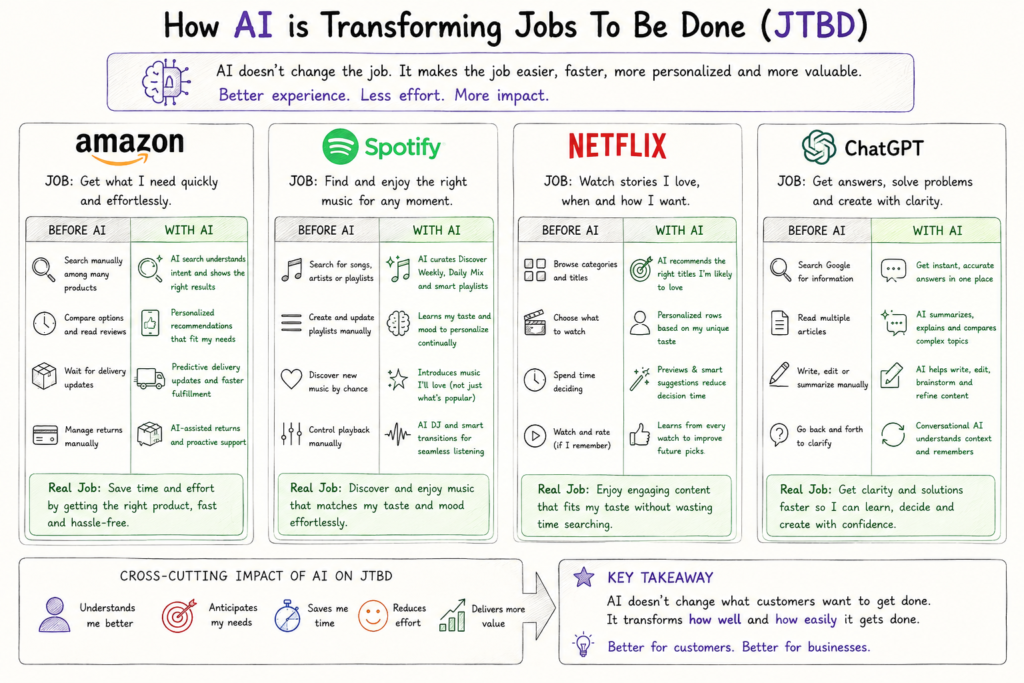
Artificial Intelligence is making the Jobs To Be Done Framework even more powerful.
Previously, businesses relied on customer interviews and surveys.
Today, AI can analyze millions of interactions to identify customer needs instantly.
Imagine visiting Amazon.
Before searching, Amazon already recommends products based on your previous purchases.
Spotify creates playlists matching your mood.
Netflix predicts what you’ll watch next.
ChatGPT helps users complete tasks based on their intent rather than just keywords.
In the future, companies won’t simply understand customer jobs.
They’ll predict them before customers even realize what they need.
Businesses that combine AI with the Jobs To Be Done Framework will create highly personalized products, advertisements, and customer experiences.
Key Takeaways
- Customers don’t buy products. They hire products to solve problems.
- The Jobs To Be Done Framework focuses on customer motivation rather than demographics.
- Successful businesses market outcomes instead of features.
- Every purchase includes functional, emotional, or social jobs.
- Companies like Uber, Amazon, Netflix, Canva, and Apple succeed because they understand customer jobs.
- AI is making JTBD more accurate by predicting customer needs in real time.
Frequently Asked Questions (FAQs)
1. What is the Jobs To Be Done Framework?
The Jobs To Be Done Framework is a customer-centric approach that explains why people buy products. It helps businesses understand the progress customers want to make rather than focusing only on demographics.
2. Who created the Jobs To Be Done Framework?
The concept was popularized by Clayton Christensen, with significant contributions from Tony Ulwick and Bob Moesta.
3. Why is the Jobs To Be Done Framework important?
It helps businesses build better products, improve marketing messages, increase customer satisfaction, and discover new innovation opportunities.
4. Which companies use the Jobs To Be Done Framework?
Many successful companies apply JTBD principles, including Amazon, Apple, Netflix, Uber, Airbnb, Spotify, Canva, Swiggy, and McDonald’s.
5. Is JTBD only useful for startups?
No. The Jobs To Be Done Framework is valuable for startups, small businesses, large enterprises, marketers, product managers, designers, and entrepreneurs looking to understand customer behavior better.
Conclusion
The Jobs To Be Done Framework changes the way businesses think about customers. Instead of asking, “How can we sell more products?”, it encourages companies to ask, “What job is the customer trying to accomplish?”
This simple shift has helped brands like Uber, Amazon, Netflix, Canva, and Apple create products that customers repeatedly choose because they solve meaningful problems.
As artificial intelligence continues to transform marketing, understanding customer jobs will become even more important. Businesses that combine the Jobs To Be Done Framework with AI-driven insights will be better equipped to predict customer needs, deliver personalized experiences, and build long-term loyalty.
The next time you’re creating a product, writing an advertisement, or planning a marketing campaign, remember this simple principle:
People don’t buy products. They hire products to get a job done.
Understanding that job is often the difference between a product that struggles and a brand that customers can’t live without.
Have you ever thought about why you bought your favorite product?
Share your example in the comments below.
You might be surprised to discover that you weren’t buying the product itself. You were hiring it to solve an important job in your life.