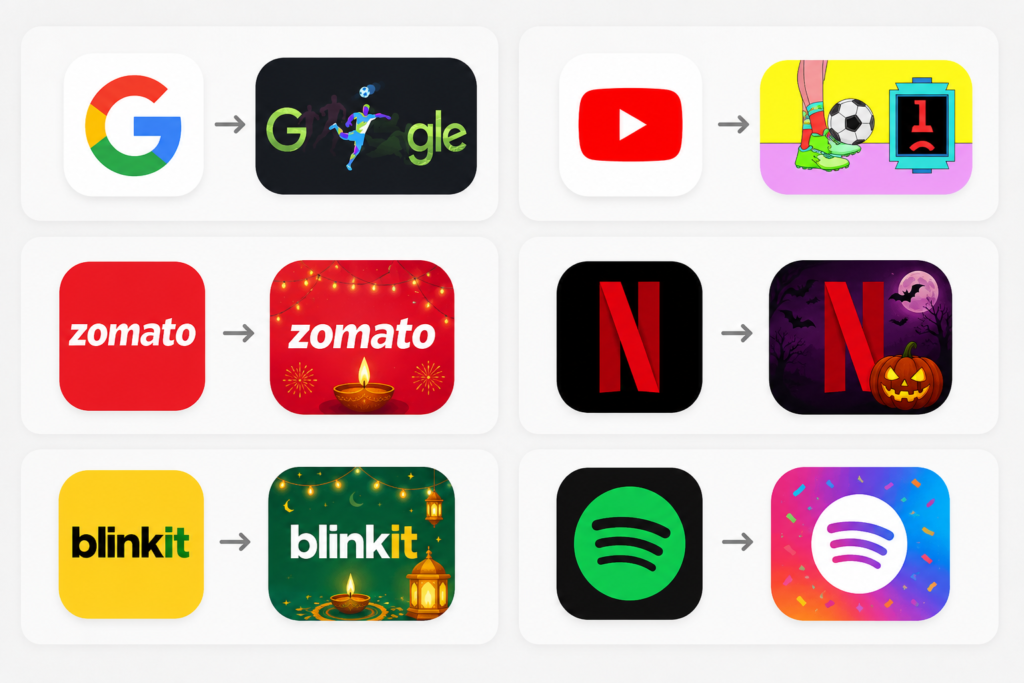
Have You Ever Wondered Why Apps Suddenly Change Their Logos During Big Events?
Yesterday, I opened Google.
Its colorful logo had suddenly transformed into a football animation.
A few minutes later, I opened YouTube.
Even its logo looked different, celebrating the same football tournament.
During Prime Day, Amazon completely changes its homepage.
Every December, Spotify transforms into Spotify Wrapped.
During Diwali, Instagram introduces festive effects and themed features.
LinkedIn celebrates your work anniversary.
Netflix redesigns its homepage whenever a blockbuster series launches.
At first glance, these seem like ordinary design updates.
But here’s the question that most people never ask.
Do companies actually pay Google, YouTube, or other platforms to change their logos?
Or…
If nobody is paying them, why would billion-dollar companies spend time, money, and resources changing something that disappears after just a few days?
The answer is far more fascinating than we might expect.
These aren’t random design experiments.
They are carefully planned marketing strategies designed to capture our attention, increase engagement, create emotional connections, and make brands feel like they’re participating in the same moments we’re experiencing.
Interestingly, many of these campaigns don’t rely on traditional advertising at all.
Instead, the product itself becomes the marketing campaign.
Once we understand the psychology behind these temporary changes, we’ll never look at Google Doodles, YouTube themes, Amazon’s homepage, or Spotify Wrapped the same way again.
Chapter 1A: Event Marketing: Why Apps Change Their Logos, Icons & Home Screens During Big Events
Do Companies Pay Platforms to Change Their Logos?
This is probably the biggest misconception people have.
Many assume:
Google must be getting paid to replace its logo during the Olympics.
Or…
YouTube probably charges brands to display football-themed logos.
The reality is much simpler.
Most of the time, the answer is no.
Google doesn’t pay Google.
YouTube doesn’t pay YouTube.
Amazon doesn’t pay Amazon.
Netflix doesn’t pay Netflix.
Spotify doesn’t pay Spotify.
These companies are simply using platforms they already own.
In marketing, this is known as Owned Media.
Instead of purchasing advertising space from another company, they redesign their own products to match important moments happening around the world.
Think of it like decorating your own house during Diwali or Christmas.
You don’t pay someone for permission to decorate your living room.
You simply decorate it because it enhances the experience for everyone visiting your home.
Companies think exactly the same way about their digital products.
Their websites, mobile apps, and homepages are digital spaces they completely control.
That allows them to update logos, icons, banners, colors, and layouts whenever they believe it will create a better customer experience.
Then Why Do Companies Change Their Logos?
This is where the real marketing strategy begins.
Most people think companies change logos because they look attractive.
In reality,
the logo itself isn’t the objective.
The logo is only the trigger.
The real objective is to influence how people think, feel, and interact with the product.
A temporary logo change can create:
- More attention
- More curiosity
- Higher engagement
- Longer session duration
- Better content discovery
- Increased brand recall
- Stronger emotional connection
- More conversations on social media
In other words,
companies aren’t trying to redesign their logo.
They’re trying to redesign your experience.
Imagine This…
Suppose you’ve opened YouTube almost every day for the last three years.
You already know exactly how the homepage looks.
Your brain has become so familiar with it that you hardly notice the logo anymore.
Then one morning…
You open YouTube.
The familiar logo has suddenly changed.
Football graphics appear.
Special playlists are featured.
The homepage feels different.
Without even realizing it, your brain immediately asks:
“Something has changed. What’s happening today?”
That tiny moment of curiosity is incredibly valuable.
It captures your attention before you’ve even watched a single video.
The Logo Isn’t the Marketing. The Experience Is.
One of the biggest misconceptions in marketing is believing that companies change logos simply for decoration.
That’s rarely the case.
The logo is just the first thing you notice.
What companies are actually changing is the entire experience around a major event.
During a football tournament, YouTube isn’t trying to become a football company.
Instead, it’s telling millions of football fans:
“We’re celebrating this moment with you.”
That subtle emotional connection makes the platform feel more relevant, timely, and engaging.
This is one reason why modern marketing has shifted from interrupting customers with advertisements to creating experiences that customers naturally enjoy.
What Do Companies Actually Measure?
If companies invest time and money into temporary logo changes, how do they know whether those changes actually worked?
They don’t simply rely on compliments.
They measure results.
Some of the most important metrics include:
User Engagement
Did people interact more with the platform?
Session Duration
Did users spend more time on the app?
Click-Through Rate (CTR)
Did more people click featured content?
Daily Active Users (DAU)
Did more users return during the campaign?
Video Watch Time
Did users consume more content than usual?
Search Volume
Did more people search for the event or related topics?
Social Media Mentions
Were people talking about the campaign online?
Brand Recall
Will people remember the brand after the event ends?
A Simple Marketing Formula
Most people see this:
Temporary Logo ChangeMarketers see this:
Temporary Logo Change

↓

Attention

↓

Curiosity

↓

Exploration

↓

Longer Session Duration

↓

Higher Engagement

↓

Stronger Brand Recall

↓

Better Customer Experience
That’s why these temporary changes are much more powerful than they appear.
They don’t just change how an app looks.
They change how users interact with it.
Chapter: 1B Marketing Strategies Behind Temporary Logo Changes
By now, we know that companies don’t change their logos just because they look attractive.
Every temporary logo, homepage redesign, or app interface update is backed by one or more marketing strategies.
Interestingly, these strategies don’t work independently.
Most successful campaigns combine several principles at the same time.
Let’s understand each one with a simple definition and a real-world example.
1. Event Marketing (The Foundation of This Blog)
Definition
Event Marketing is a strategy where companies align their products, branding, campaigns, or customer experiences with major events, festivals, sports tournaments, holidays, or global celebrations to increase relevance and engagement.
Simply put,
instead of asking,
“What should we promote today?”
companies ask,
“What is the world talking about today?”
Real-World Example
During the FIFA World Cup,
YouTube temporarily redesigns its logo with football-themed graphics and promotes football playlists.
Google releases football-themed Doodles.
Amazon redesigns its homepage during Prime Day.
These companies aren’t selling football.
They’re participating in an event that millions of people are already excited about.
Why It Works
People are already emotionally invested in the event.
The brand simply joins the conversation.
2. Real-Time Marketing
Definition
Real-Time Marketing is the practice of responding quickly to current events, trends, or conversations while people are actively discussing them.
Timing is everything.
If you react too late,
the opportunity disappears.
Real-World Example
During an IPL match,
Zomato posts:
“India needs six runs.”
“You need six samosas.”
The brand becomes part of the live conversation.
Why It Works
People are already paying attention.
The brand doesn’t create attention.
It borrows attention from the moment.
Event Marketing vs Real-Time Marketing
Many marketers confuse these two concepts.
Here’s the difference.
| Event Marketing | Real-Time Marketing |
|---|---|
| Planned in advance | Reacts immediately |
| Focuses on festivals, sports, launches | Focuses on live events and trending moments |
| Can run for weeks | Often lasts only hours or days |
Example:
Google planning an Olympic Doodle months in advance is Event Marketing.
Zomato reacting to a last-ball six during an IPL match is Real-Time Marketing.
3. Contextual Marketing
Definition
Contextual Marketing means delivering content, recommendations, or experiences based on what people are currently doing, feeling, watching, or celebrating.
Instead of showing the same message to everyone,
companies personalize it according to the situation.
Real-World Example
It’s raining outside.
Swiggy sends a notification:
“Perfect weather for hot biryani.”
Or Blinkit recommends:
- Coffee
- Maggi
- Pakoras
The weather becomes part of the marketing.
Why It Works
The message feels natural because it matches the customer’s current context.
4. Experience Marketing
Definition
Experience Marketing focuses on making customers experience the brand instead of simply watching advertisements.
Rather than saying,
“Look at our product.”
companies encourage customers to interact with it.
Real-World Example
Spotify Wrapped.
Users don’t simply watch an advertisement.
They experience:
- Their favorite songs
- Listening personality
- Top artists
- Total listening minutes
Then they share it with friends.
Why It Works
People remember experiences far longer than advertisements.
5. Cultural Marketing
Definition
Cultural Marketing is when brands participate in festivals, traditions, national celebrations, or culturally significant moments that people emotionally connect with.
Real-World Example
Google creates special Doodles for:
- Diwali
- Holi
- Independence Day
- International Women’s Day
The goal isn’t to sell products.
It’s to show that the brand celebrates the same moments as its users.
Why It Works
People appreciate brands that understand their culture.
6. Owned Media Marketing
Definition
Owned Media Marketing is the use of platforms a company owns, such as its website, app, email newsletter, or social media accounts, to communicate directly with customers.
Unlike paid advertising,
there’s no need to purchase advertising space.
Real-World Example
Netflix changes its homepage.
Amazon redesigns its app.
YouTube updates its logo.
Since these are their own platforms,
they can redesign them whenever they want.
Why It Works
Owned media gives companies complete creative control while reducing advertising costs.
7. Brand Association
Definition
Brand Association is the process of connecting a brand with positive emotions, memorable events, or meaningful experiences in consumers’ minds.
The objective isn’t immediate sales.
It’s long-term memory.
Real-World Example
Years later,
many people still remember Google’s Olympic Doodles.
When they think about the Olympics,
Google often comes to mind as well.
That’s successful brand association.
Why It Works
People don’t only remember products.
They remember how brands made them feel.
8. Product Experience Marketing
This is one of the newest and most powerful strategies used by technology companies.
Definition
Product Experience Marketing uses the product itself as the marketing campaign instead of relying only on advertisements.
The product becomes the advertisement.
Real-World Example
When Netflix launches a new season of Stranger Things,
the homepage changes.
Characters appear throughout the interface.
Recommendations revolve around the show.
The campaign isn’t happening outside Netflix.
It’s happening inside Netflix.
Similarly,
YouTube’s football-themed homepage transforms the platform itself into part of the campaign.
Why It Works
Customers don’t feel interrupted by advertising.
Instead,
they naturally discover content while using the product.
The Secret Most People Never Notice
Here’s something fascinating.
When you open Google,
you probably notice the logo.
When you open YouTube,
you notice the football graphics.
When Spotify Wrapped arrives,
you notice the colorful animations.
But those visuals aren’t the campaign.
They’re simply the entry point.
The real campaign is happening underneath.
Every temporary visual change is designed to influence:
- What you notice
- What you click
- What you watch
- How long you stay
- What you remember
- What you share
- How you feel about the brand
That’s why companies continue investing in these experiences year after year.
Because they’re not changing interfaces.
They’re shaping customer behavior.
One Campaign. Multiple Marketing Strategies.
One of the biggest misconceptions in marketing is believing that a campaign uses only one strategy.
In reality,
a single campaign often combines multiple strategies simultaneously.
Take Google’s Olympic Doodle as an example.
| Marketing Strategy | How Google Uses It |
|---|---|
| Event Marketing | Celebrates the Olympics |
| Cultural Marketing | Joins a global cultural event |
| Owned Media Marketing | Uses Google’s own homepage |
| Experience Marketing | Makes the homepage interactive |
| Brand Association | Connects Google with a memorable event |
| Product Experience Marketing | Turns the search homepage into the campaign |
This is why the world’s biggest brands don’t think in terms of one strategy at a time.
They build layered experiences where several marketing principles work together to create a memorable moment.
Chapter 2: The Hidden Psychology Behind Event Marketing
By now, we’ve uncovered what marketing strategies companies use.
But here’s something even more fascinating.
Marketing strategies alone don’t make these campaigns successful.
If they did, every temporary logo change would become viral.
The real reason these campaigns work lies inside human psychology.
Companies like Google, YouTube, Spotify, Amazon, Netflix, and Instagram aren’t just changing their interfaces.
They’re designing experiences that match how the human brain naturally pays attention, remembers information, and makes decisions.
Let’s uncover the psychology behind these seemingly simple changes.
1. Selective Attention
Definition
Selective Attention is the brain’s ability to focus on something that stands out while ignoring everything else.
Our brain constantly filters thousands of visual elements every day.
To avoid overload, it ignores familiar things.
That’s why you probably don’t notice the YouTube logo anymore.
You’ve seen it thousands of times.
Real-World Example
Imagine walking into your office every morning.
For months,
everything looks exactly the same.
One day,
someone paints the entrance bright red.
What’s the first thing you’ll notice?
The entrance.
Not because it’s better.
Because it’s different.
Similarly,
when Google changes its logo,
your brain immediately notices.
Why Companies Use It
Temporary logo changes break routine.
They immediately grab attention without displaying a traditional advertisement.
2. Novelty Effect
Definition
The Novelty Effect is our natural tendency to pay more attention to something new or unexpected.
Humans are curious by nature.
Anything unfamiliar automatically becomes interesting.
Real-World Example
Spotify Wrapped appears only once every year.
If Spotify showed Wrapped every week,
people would quickly stop caring.
Its rarity makes it exciting.
Another example.
Google Doodles don’t appear every day.
That’s exactly why people notice them.
Why Companies Use It
Novel experiences increase:
- Curiosity
- Exploration
- Sharing
- Engagement
Newness creates attention.
3. Pattern Interrupt
Definition
A Pattern Interrupt occurs when something unexpectedly breaks our normal expectations, forcing our brain to pay attention.
Our brain loves patterns.
When a pattern suddenly changes,
our attention immediately shifts.
Real-World Example
Every morning,
you expect YouTube’s logo to look exactly the same.
Today,
it’s decorated with football graphics.
Your brain immediately asks:
“Why is it different today?”
That’s a Pattern Interrupt.
Why Companies Use It
Pattern Interrupts stop users from operating on autopilot.
Instead,
they become curious.
Curiosity leads to exploration.
4. Mere Exposure Effect
Definition
The Mere Exposure Effect suggests that people tend to develop a preference for things they see repeatedly.
The more positive interactions people have with a brand,
the more familiar and trustworthy it feels.
Real-World Example
Every year,
Google creates Olympic Doodles.
Every year,
people smile,
search,
and interact with them.
Over time,
Google becomes associated with memorable global moments.
Why Companies Use It
Repeated positive experiences strengthen:
- Trust
- Familiarity
- Brand preference
Without directly selling anything.
5. Emotional Contagion
Definition
Emotional Contagion is the tendency for people to absorb and mirror the emotions of others or the environment around them.
Brands often leverage emotions that already exist.
Real-World Example
Millions of football fans feel excited during the FIFA World Cup.
When YouTube changes its interface to celebrate football,
some of that excitement transfers to YouTube itself.
The platform feels more energetic and connected to the event.
Why Companies Use It
Brands don’t create the emotion.
They join the emotion that’s already happening.
6. Contextual Priming
Definition
Contextual Priming occurs when the surrounding environment influences how we think, feel, and behave.
Small visual cues can shape our expectations.
Real-World Example
You open Amazon during Prime Day.
The homepage displays:
- Countdown timers
- Large discounts
- Limited-time offers
- Bright promotional banners
Before reading anything,
your brain already expects:
“Today is a special shopping day.”
The environment prepares your mind.
Why Companies Use It
Context influences decisions before customers consciously realize it.
7. Peak-End Rule
Definition
The Peak-End Rule states that people remember experiences primarily based on:
- The most emotional moment.
- The ending.
Rather than remembering every detail.
Real-World Example
Spotify Wrapped summarizes your entire year of listening.
Instead of remembering thousands of songs,
you remember one exciting annual experience.
That’s why people eagerly wait for Wrapped every December.
Why Companies Use It
Creating one unforgettable experience often has more impact than dozens of ordinary interactions.
8. Curiosity Gap
Definition
The Curiosity Gap is created when people know part of the story but feel compelled to discover the rest.
Real-World Example
You open Google.
The logo has changed.
You immediately wonder:
“What’s today’s Doodle about?”
Without realizing it,
you’ve already engaged with Google’s homepage.
Why Companies Use It
Curiosity naturally encourages exploration without feeling like advertising.
The Psychology Behind a Simple Logo Change
Let’s connect everything we’ve learned.
When Google changes its logo,
this is what happens inside your brain.
Google Changes Its Logo

↓

Selective Attention

↓

Novelty Effect

↓

Pattern Interrupt

↓

Curiosity

↓

Exploration

↓

Longer Time on Platform

↓

Better Brand Recall

↓

Positive Emotional Association
Notice something interesting.
The logo itself doesn’t create business value.
Your psychological response does.
Why Traditional Ads Don’t Always Achieve This
Imagine opening YouTube.
Scenario A
A football-themed homepage welcomes you.
Scenario B
A large football banner advertisement interrupts your experience.
Which feels more natural?
Most people would choose Scenario A.
Why?
Because the homepage becomes part of the experience.
It doesn’t interrupt it.
That’s why companies increasingly invest in experience-driven marketing instead of relying solely on display advertising.
Marketing Is No Longer Just About Selling
Twenty years ago,
marketing was largely about:
- Television commercials
- Newspaper advertisements
- Billboards
- Radio promotions
Today,
the world’s biggest brands compete differently.
They compete by designing memorable experiences.
Sometimes,
those experiences last only a few days.
But the memories they create can last for years.
Google Doodles.
Spotify Wrapped.
Amazon Prime Day.
YouTube Football Themes.
These aren’t just design updates.
They’re carefully engineered experiences built on marketing strategy and human psychology.
Key Takeaway
The next time you notice an app suddenly changing its logo, icon, homepage, or colors during a festival, sports tournament, or global event,
don’t ask:
“Why did they change the logo?”
Instead, ask:
“What emotion, behavior, or memory is this brand trying to create?”
More often than not,
you’ll discover that the logo isn’t the campaign.
Your experience is.
Chapter 3: Real-World Examples of Event Marketing Used by the World’s Biggest Brands
Until now, we’ve understood:
- Why companies change their logos.
- Why they don’t pay anyone to redesign their own platforms.
- The marketing strategies behind these changes.
- The psychology that makes them so effective.
Now let’s see how some of the world’s biggest brands actually apply these concepts.
One thing you’ll notice is that no successful campaign relies on a single marketing strategy.
Instead,
brands combine multiple strategies together to create one memorable customer experience.
1. Google Doodles
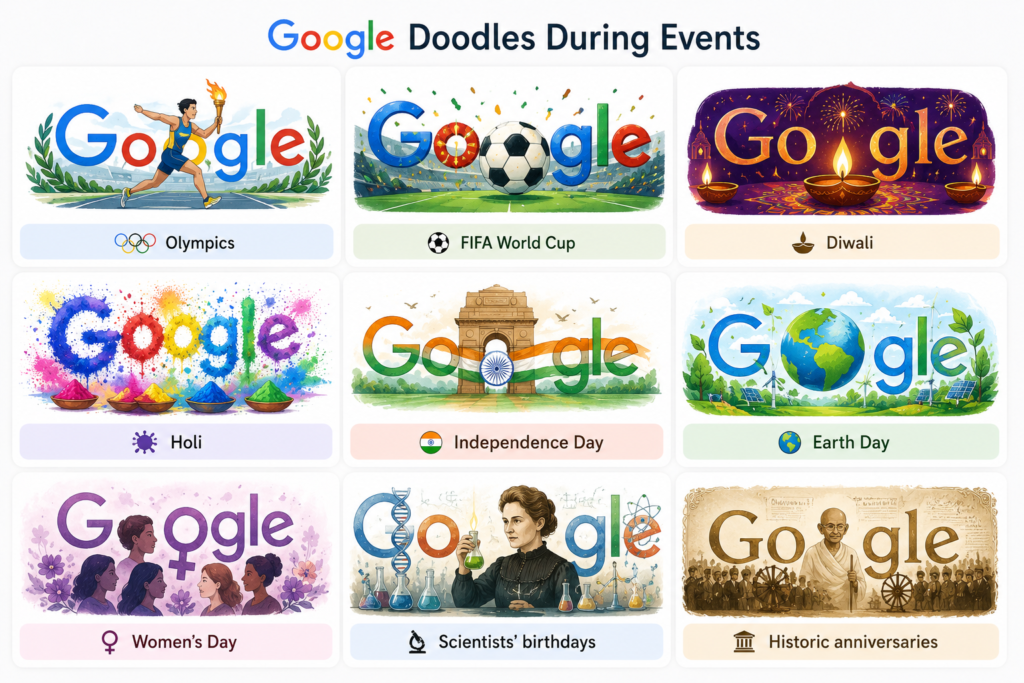
One of the oldest and most recognizable examples of Event Marketing is Google Doodles.
Instead of showing the same Google logo every day,
Google temporarily redesigns it to celebrate:
- Olympics
- FIFA World Cup
- Diwali
- Holi
- Independence Day
- Earth Day
- Women’s Day
- Scientists’ birthdays
- Historic anniversaries
Millions of users see these Doodles before they even perform a search.
Marketing Strategies Used
✔ Event Marketing
✔ Cultural Marketing
✔ Experience Marketing
✔ Owned Media Marketing
✔ Brand Association
Psychology Used
✔ Novelty Effect
✔ Selective Attention
✔ Curiosity Gap
✔ Mere Exposure Effect
Business Objective
Google wants people to feel that it isn’t just a search engine.
It participates in global moments just like its users.
That creates stronger emotional attachment.
2. YouTube Football Theme
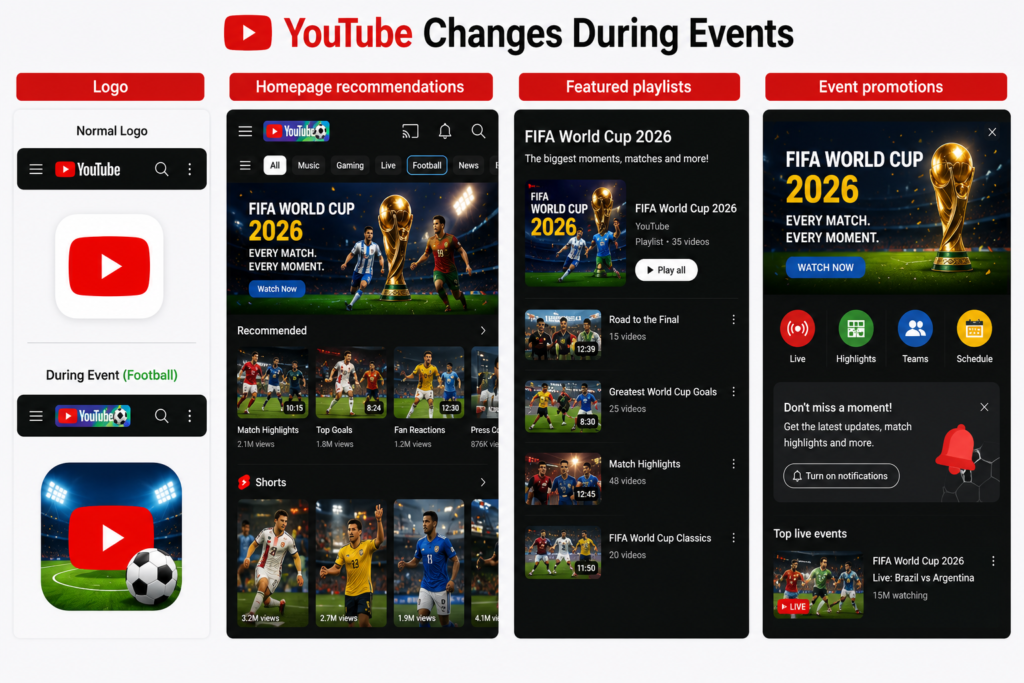
During major football tournaments,
YouTube often changes:
- Logo
- Homepage recommendations
- Featured playlists
- Event promotions
Instead of asking users to watch football,
YouTube makes football feel like the center of the platform.
Marketing Strategies Used
✔ Event Marketing
✔ Contextual Marketing
✔ Product Experience Marketing
✔ Owned Media Marketing
Psychology Used
✔ Pattern Interrupt
✔ Emotional Contagion
✔ Selective Attention
Business Objective
Increase:
- Football video consumption
- Session duration
- Content discovery
- Viewer engagement
3. Spotify Wrapped
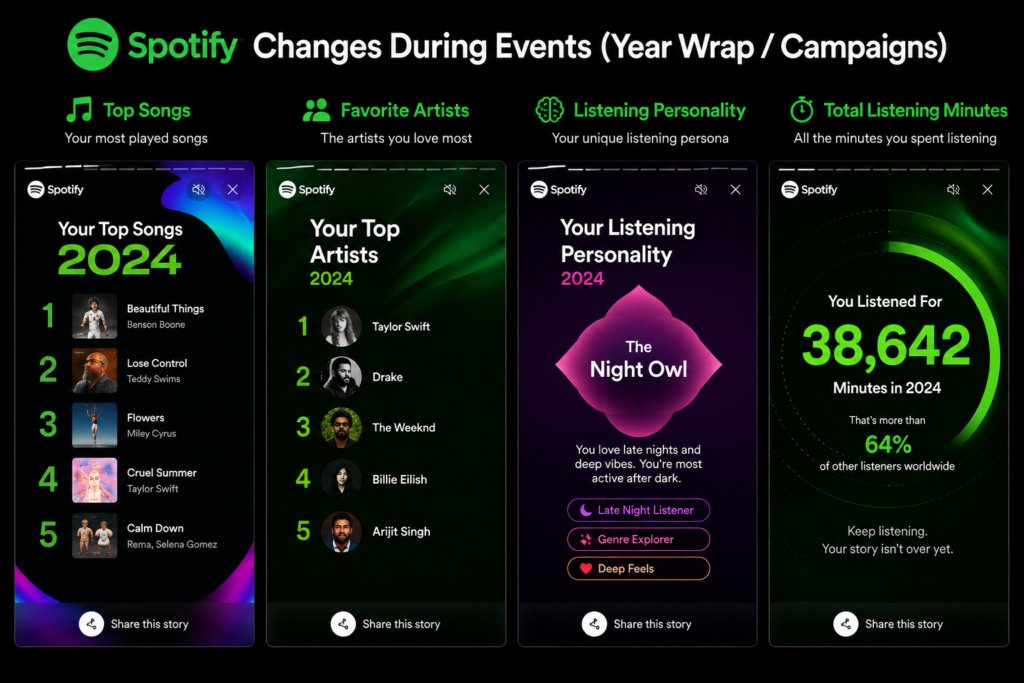
Perhaps one of the greatest marketing campaigns ever created.
Every December,
Spotify gives every user a personalized summary including:
- Top songs
- Favorite artists
- Listening personality
- Total listening minutes
People voluntarily share these reports across social media.
Spotify gains millions of free impressions.
Marketing Strategies Used
✔ Personalization Marketing
✔ Experience Marketing
✔ Viral Marketing
✔ Social Proof
Psychology Used
✔ Peak-End Rule
✔ Novelty Effect
✔ Self-Identity Theory
✔ Emotional Contagion
Business Objective
Increase:
- Social sharing
- Brand awareness
- Customer loyalty
- User retention
4. Amazon Prime Day
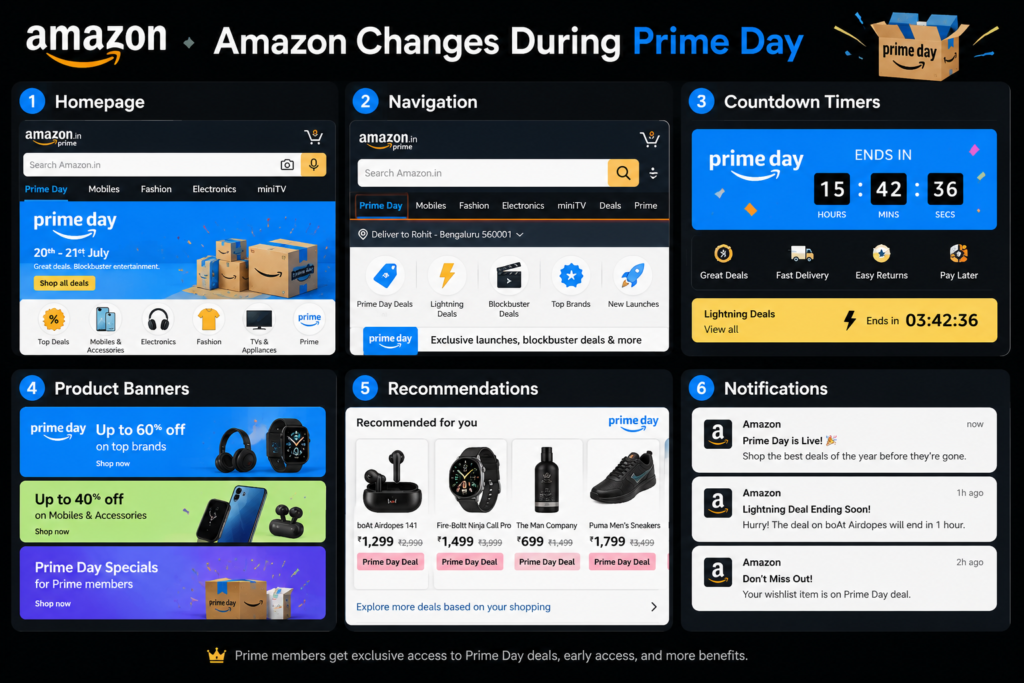
Prime Day isn’t just a discount event.
Amazon redesigns almost everything.
Examples include:
- Homepage
- Navigation
- Countdown timers
- Product banners
- Recommendations
- Notifications
The entire platform feels like one massive event.
Marketing Strategies Used
✔ Event Marketing
✔ Urgency Marketing
✔ Scarcity Marketing
✔ Experience Marketing
Psychology Used
✔ Fear of Missing Out (FOMO)
✔ Contextual Priming
✔ Scarcity Effect
Business Objective
Increase:
- Sales
- Average order value
- Prime memberships
5. Flipkart Big Billion Days
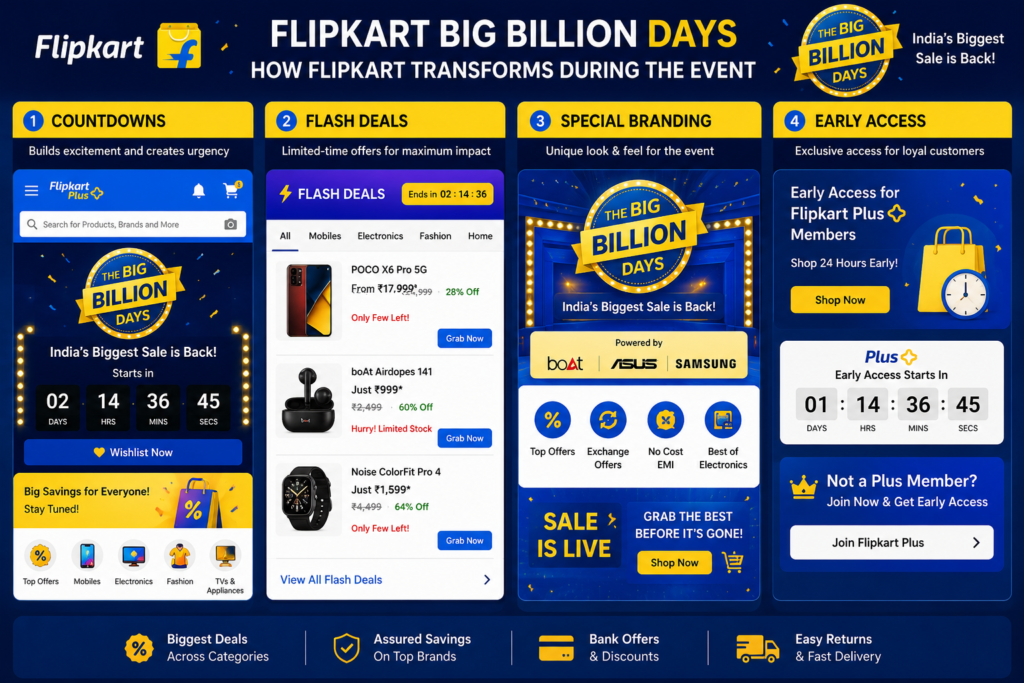
Similar to Amazon,
Flipkart transforms its app during Big Billion Days.
Customers see:
- Countdowns
- Flash deals
- Special branding
- Early access
Everything communicates:
Something big is happening.
Marketing Strategies Used
✔ Seasonal Marketing
✔ Event Marketing
✔ Urgency Marketing
Psychology Used
✔ Scarcity
✔ Social Proof
✔ FOMO
Business Objective
Increase:
- App visits
- Purchases
- Time spent shopping
6. Netflix
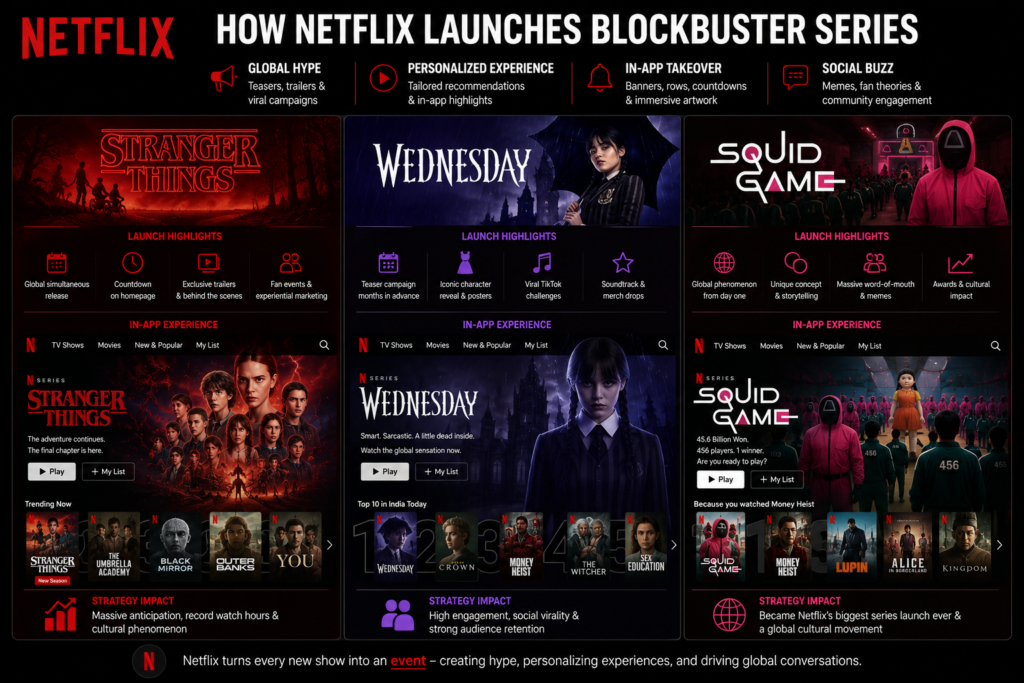
Whenever Netflix launches a blockbuster series,
its homepage changes.
Examples include:
- Stranger Things
- Wednesday
- Squid Game
Characters dominate the interface.
Recommendations revolve around the latest release.
Marketing Strategies Used
✔ Product Experience Marketing
✔ Experience Marketing
✔ Content Marketing
Psychology Used
✔ Mere Exposure Effect
✔ Curiosity Gap
✔ Social Proof
Business Objective
Increase:
- Episode completion
- Watch time
- Subscriber retention
7. Swiggy
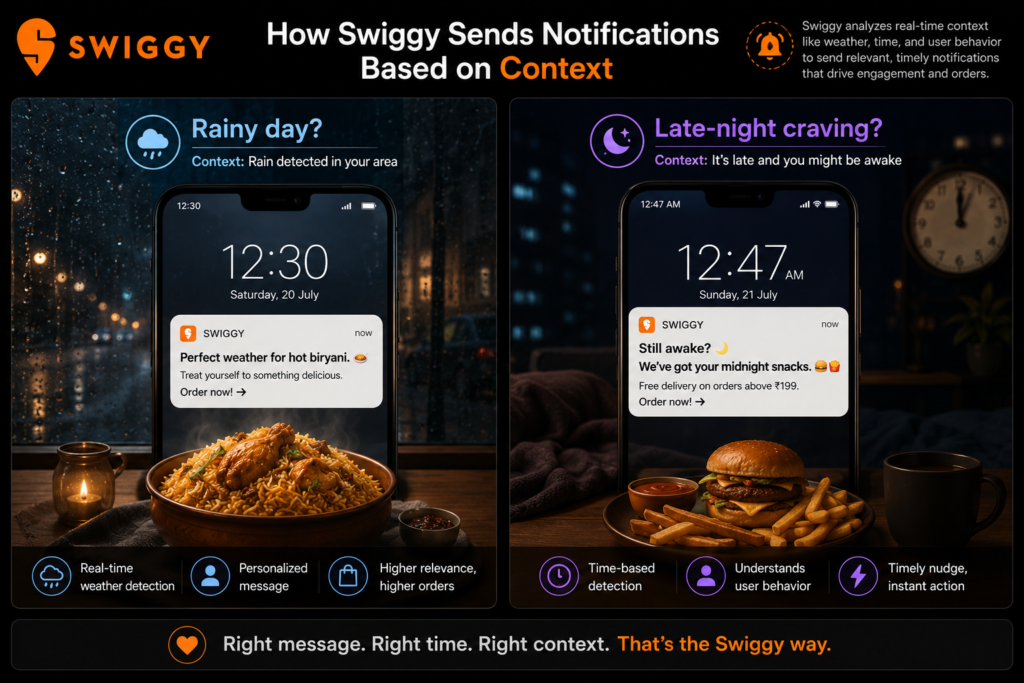
Swiggy doesn’t send random notifications.
Instead,
they often depend on context.
Examples:
Rainy day?
“Perfect weather for hot biryani.”
Late-night craving?
“Still awake? We’ve got your midnight snacks.”
Marketing Strategies Used
✔ Contextual Marketing
✔ Moment Marketing
✔ Behavioral Marketing
Psychology Used
✔ Contextual Priming
✔ Emotional Triggers
✔ Availability Heuristic
Business Objective
Increase:
- Food orders
- App opens
- Conversion rates
8. Zomato
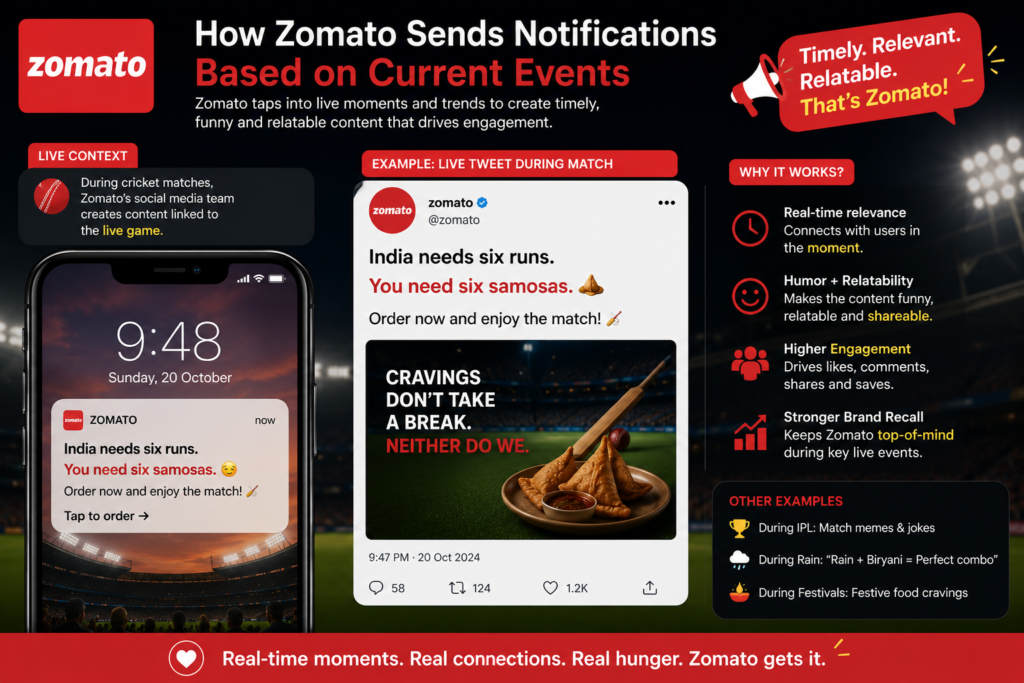
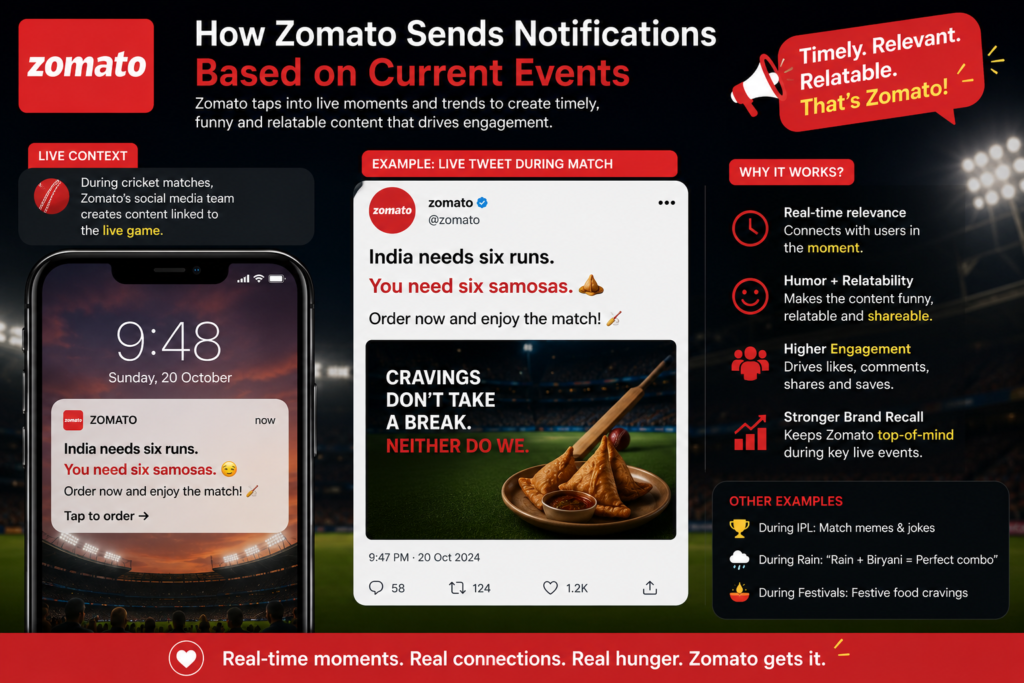
Zomato is famous for connecting food with current events.
During cricket matches,
its social media team posts humorous content linked to the live game.
Example:
“India needs six runs.”
“You need six samosas.”
Marketing Strategies Used
✔ Real-Time Marketing
✔ Moment Marketing
✔ Humor Marketing
Psychology Used
✔ Emotional Contagion
✔ Social Sharing
✔ Humor Effect
Business Objective
Increase:
- Brand awareness
- Shares
- Customer engagement
9. Blinkit
Blinkit changes recommendations based on what’s happening around us.
Examples:
IPL?
Snacks dominate.
Heavy rain?
Tea and Maggi appear first.
Summer?
Ice cream moves to the homepage.
Marketing Strategies Used
✔ Contextual Marketing
✔ Seasonal Marketing
✔ Experience Marketing
Psychology Used
✔ Contextual Priming
✔ Availability Heuristic
✔ Selective Attention
Business Objective
Increase:
- Faster purchasing decisions
- Higher conversion rates
- More impulse purchases
One Campaign. Many Strategies.
Here’s what many people don’t realize.
When Google changes its logo,
it isn’t using just Event Marketing.
It combines several strategies simultaneously.
| Company | Event Marketing | Real-Time Marketing | Contextual Marketing | Experience Marketing | Product Experience Marketing |
|---|---|---|---|---|---|
| ✅ | ❌ | ✅ | ✅ | ✅ | |
| YouTube | ✅ | ❌ | ✅ | ✅ | ✅ |
| Spotify | ❌ | ❌ | ✅ | ✅ | ✅ |
| Amazon | ✅ | ❌ | ✅ | ✅ | ✅ |
| Netflix | ❌ | ❌ | ✅ | ✅ | ✅ |
| ✅ | ❌ | ✅ | ✅ | ❌ | |
| Swiggy | ❌ | ✅ | ✅ | ❌ | ❌ |
| Zomato | ❌ | ✅ | ✅ | ❌ | ❌ |
| Blinkit | ❌ | ✅ | ✅ | ✅ | ❌ |
| ❌ | ❌ | ✅ | ✅ | ❌ |
This is why modern marketing is rarely about choosing one strategy.
The most successful brands layer multiple marketing principles together to create experiences that feel timely, relevant, and memorable.
Chapter 4: What Businesses Can Learn from Event Marketing
1. Join Conversations Instead of Creating Them
One of the biggest mistakes businesses make is trying to force people to talk about their products.
Successful brands do the opposite.
They join conversations that are already happening.
Example:
Instead of posting:
Buy our sports shoes.
A shoe brand could post during the Olympics:
Every champion started with one small step.
Suddenly,
the message feels more relevant
2. Small Changes Can Create Big Impact
Many small businesses believe marketing always requires huge budgets.
Not true.
Sometimes,
changing just one element can dramatically increase engagement.
Examples:
- Updating your website banner for Independence Day.
- Changing your social media cover photo during the IPL.
- Creating Diwali-themed packaging.
- Designing a Christmas email template.
The investment is small.
The impact can be surprisingly large.
3. Make Your Product Part of the Event
The biggest brands don’t simply advertise during events.
They redesign the experience itself.
Ask yourself:
Instead of saying,
Happy Diwali.
Could your product actually feel festive?
Instead of announcing the Cricket World Cup,
could your app reflect it?
Customers remember experiences more than greetings.
4. Consistency Builds Brand Memory
Google has created Doodles for decades.
Spotify Wrapped returns every year.
Amazon Prime Day happens annually.
Customers begin expecting these experiences.
Eventually,
the event itself becomes associated with the brand.
That’s long-term branding.
5. Marketing Isn’t About Selling Every Time
One of the biggest lessons from this article is this:
Not every campaign needs to generate immediate sales.
Sometimes,
the objective is:
- Better brand recall
- Higher engagement
- Positive emotions
- Stronger customer relationships
Sales often follow later.
Event Marketing Isn’t Just for Big Brands
Many people think:
“Only Google or Amazon can do this.”
That’s not true.
Let’s imagine a few examples.
Example 1
A local bakery.
Instead of posting:
Fresh cakes available.
During Christmas:
The bakery decorates its website, introduces festive packaging, and shares behind-the-scenes videos of holiday baking.
Example 2
A gym.
Instead of advertising memberships every day,
during New Year,
it launches a 30-Day Fitness Challenge with progress tracking and motivational content.
Common Myths About Event Marketing
Myth 1
“Companies must pay platforms to change logos.”
False.
Companies redesign platforms they already own.
That’s Owned Media Marketing.
Myth 2
“Changing a logo automatically increases sales.”
Not necessarily.
The primary goal is often:
- Engagement
- Brand awareness
- Emotional connection
- User experience
Sales may increase later, but they’re not always the immediate objective.
Myth 3
“Only large companies can use Event Marketing.”
False.
Even a neighborhood café can redesign its menu during festivals.
The strategy scales to businesses of every size.
Myth 4
“It’s only about changing logos.”
Completely false.
The logo is simply the most visible change.
Companies also modify:
- Homepages
- App icons
- Product recommendations
- Notifications
- Emails
- Landing pages
- User interfaces
- Packaging
- Store decorations
Event Marketing is much broader than a temporary logo.
Frequently Asked Questions
What is Event Marketing?
Event Marketing is a strategy where businesses align their branding, campaigns, or customer experiences with important events, festivals, sports tournaments, or cultural moments to increase relevance and engagement.
Why do apps change their logos during festivals or sports events?
Apps change their logos and interfaces to capture attention, create emotional connections, improve user engagement, and participate in moments that matter to their audience.
Do companies pay Google or YouTube to change their logos?
No.
Companies like Google and YouTube redesign their own platforms because they own them.
This is an example of Owned Media Marketing.
Is changing a logo considered marketing?
Yes.
When the change supports a larger business objective such as increasing engagement, improving brand recall, or participating in cultural moments, it becomes part of a broader marketing strategy.
Which companies use Event Marketing?
Many global brands use Event Marketing, including:
- YouTube
- Amazon
- Spotify
- Netflix
- Swiggy
- Zomato
- Blinkit
Can small businesses use Event Marketing?
Absolutely.
Even a small business can redesign its website, create festival-themed campaigns, update packaging, or launch seasonal experiences to connect with customers.
Final Thoughts
The next time you open Google and notice a special Doodle,
or see YouTube celebrating a football tournament,
or watch Amazon transform its homepage for Prime Day,
don’t think,
“They changed the logo.”
Instead, think,
“They’re changing my experience.”
That small shift in perspective reveals something remarkable.
Modern marketing is no longer just about advertisements.
It’s about becoming part of people’s lives.
The world’s best marketers understand that attention is earned, not demanded.
Rather than interrupting customers,
they participate in the same celebrations, sports events, festivals, and cultural moments that their audiences already care about.
That’s why these campaigns feel natural instead of promotional.
The logo isn’t trying to sell you something.
It’s inviting you into a shared experience.
And that’s exactly what makes Event Marketing so powerful.
What We Can Learn as Consumers
As consumers, understanding Event Marketing helps us see digital experiences more clearly.
The next time an app changes its logo, homepage, or interface, pause for a moment and ask:
- Why is the company making this change today?
- Which event or cultural moment is it connecting to?
- What emotion is it trying to evoke?
- Is it encouraging me to explore, stay longer, or share something?
These questions reveal that many of the experiences we enjoy every day are carefully designed, not random.
Recognizing these strategies doesn’t make them less effective.
Instead, it helps us become more informed users and more thoughtful consumers.
Key Takeaways
Before you leave, remember these eight lessons:
- Event Marketing helps brands stay relevant by connecting with major events and cultural moments.
- Most companies do not pay platforms to change their own logos because they control their owned media.
- Temporary logo changes are designed to attract attention, not just decorate an interface.
- Successful campaigns combine multiple strategies such as Contextual Marketing, Experience Marketing, and Brand Association.
- Human psychology, including the Novelty Effect, Pattern Interrupt, and Selective Attention, plays a major role in why these campaigns succeed.
- The best brands create experiences that people remember, not just advertisements they forget.
- Businesses of every size can apply Event Marketing without needing massive budgets.
- The next time an app looks different, remember: the logo is just the beginning, the real marketing is the experience behind it.