
Most People Think Push Notifications Exist Simply to Send Updates.
That’s only part of the story.
Have you ever noticed what happens after installing a new app?
Before you’ve even explored its features, a pop-up appears asking:
“Allow Notifications?”
Whether it’s Instagram…
LinkedIn…
Swiggy…
Zomato…
Amazon…
Duolingo…
Spotify…
or even your banking app…
Almost every application wants one thing before anything else.
Our permission to send notifications.
At first glance, it seems harmless.
After all,
notifications help us stay informed.
They tell us:
- Your order has been delivered.
- Your cab has arrived.
- Your friend sent a message.
- Your meeting starts in 15 minutes.
- Your package is out for delivery.
These notifications genuinely improve our daily lives.
But then another type of notification appears.
“Only 2 hours left!”
“Your cart is waiting.”
“We miss you.”
“Someone viewed your profile.”
“Your friend just posted.”
“You’ve maintained your streak for 99 days.”
Suddenly,
you find yourself opening an app you never intended to use.
Coincidence?
Not at all.
Every notification you receive has been carefully designed using marketing, psychology, behavioral science, and data.
Behind every vibration…
Every sound…
Every red notification badge…
Every reminder…
There’s a business strategy.
The objective isn’t simply to inform you.
It’s to bring you back.
Because every time you reopen an app,
the company gets another opportunity to:
- Build a habit.
- Increase engagement.
- Strengthen customer loyalty.
- Recommend products.
- Show advertisements.
- Generate revenue.
This is why understanding the Marketing Psychology Behind Push Notifications has become more important than ever.
Today’s biggest companies aren’t competing only through better products.
They’re competing for something far more valuable.
Your attention.
And the lock screen of your smartphone has become one of the most competitive advertising spaces in the world.
Table of Contents
- Chapter 1: Marketing Psychology Behind Push Notifications, Why Every App Wants Notification Permission
- Chapter 2: Marketing Psychology Behind Push Notifications, The Business Strategy
- Chapter 3: Marketing Psychology Behind Push Notifications, The Consumer Psychology
- Chapter 4: Marketing Psychology Behind Push Notifications, Real-World Case Studies
- Chapter 5: How AI Is Transforming the Marketing Psychology Behind Push Notifications
- Chapter 6: What Businesses and Consumers Can Learn from the Marketing Psychology Behind Push Notifications
- Chapter 7: The Future of Push Notifications and the Attention Economy
- Frequently Asked Questions (FAQs)
Chapter 1: Marketing Psychology Behind Push Notifications, Why Every App Wants Notification Permission
Imagine Living Without Notifications
Let’s travel back about 20 years.
Before smartphones became an essential part of our lives,
communication looked very different.
If someone wanted to contact you,
they had limited options.
- Phone calls
- SMS
- Emails
- Newspapers
- Television advertisements
Businesses faced a major challenge.
Once a customer left their store or website,
there was no easy way to bring them back.
Imagine visiting a clothing store.
You buy a shirt.
You leave.
The business has no direct way to remind you:
“We’ve launched a new collection.”
“Flat 30% off this weekend.”
“We’ve restocked your favorite product.”
They had to wait until you returned on your own.
Marketing was largely one-way communication.
Businesses spoke.
Customers listened.
There was very little interaction afterward.
Then Smartphones Changed Everything
The introduction of smartphones didn’t just change communication.
It completely transformed marketing.
For the first time,
businesses could communicate directly with customers,
anytime,
anywhere.
Your phone became more than a communication device.
It became a direct connection between companies and consumers.
Today,
a business no longer waits for you to visit its website.
It comes to you.
Through notifications.
This completely changed customer engagement.
Instead of hoping customers remembered the app,
companies could remind customers exactly when they wanted.
What Exactly Is a Push Notification?
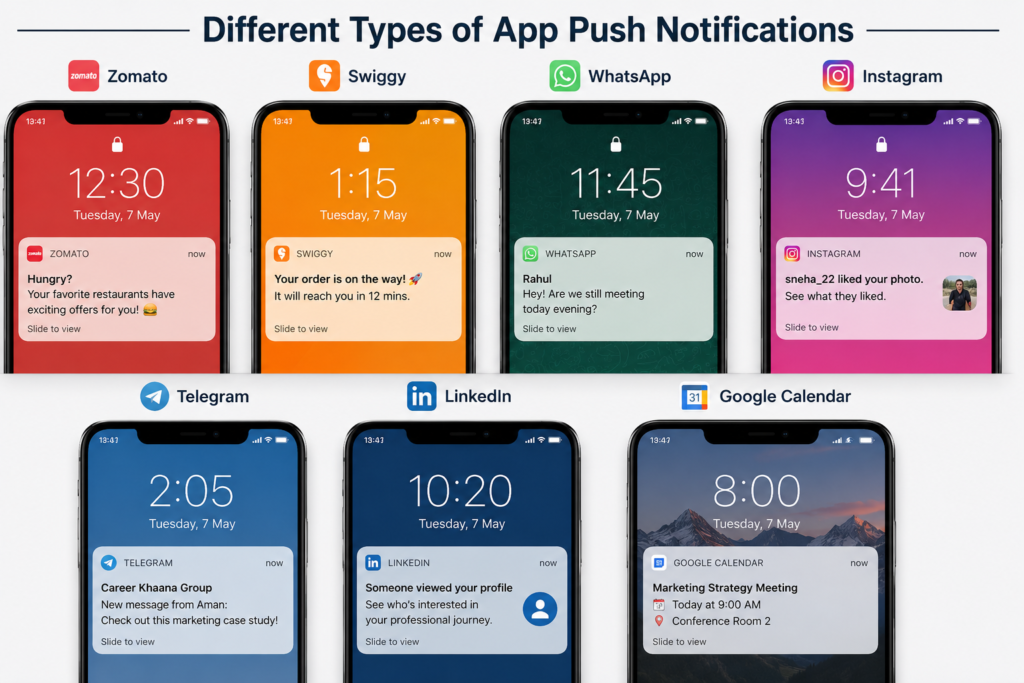
A push notification is a short message sent directly from an app to your device, even when the app isn’t open.
Unlike emails,
you don’t have to check your inbox.
Unlike advertisements,
you don’t have to search for them.
They simply appear.
Examples include:
📦 “Your Amazon order has been delivered.”
🍕 “Your Swiggy order is arriving in 8 minutes.”
🎵 “Your favorite artist just released a new song.”
💼 “A recruiter viewed your LinkedIn profile.”
📅 “Your meeting starts in 15 minutes.”
Some notifications are genuinely useful.
Others are designed to encourage you to return to the app.
Understanding the difference is the first step toward understanding notification psychology.
Why Does Every App Ask for Notification Permission?
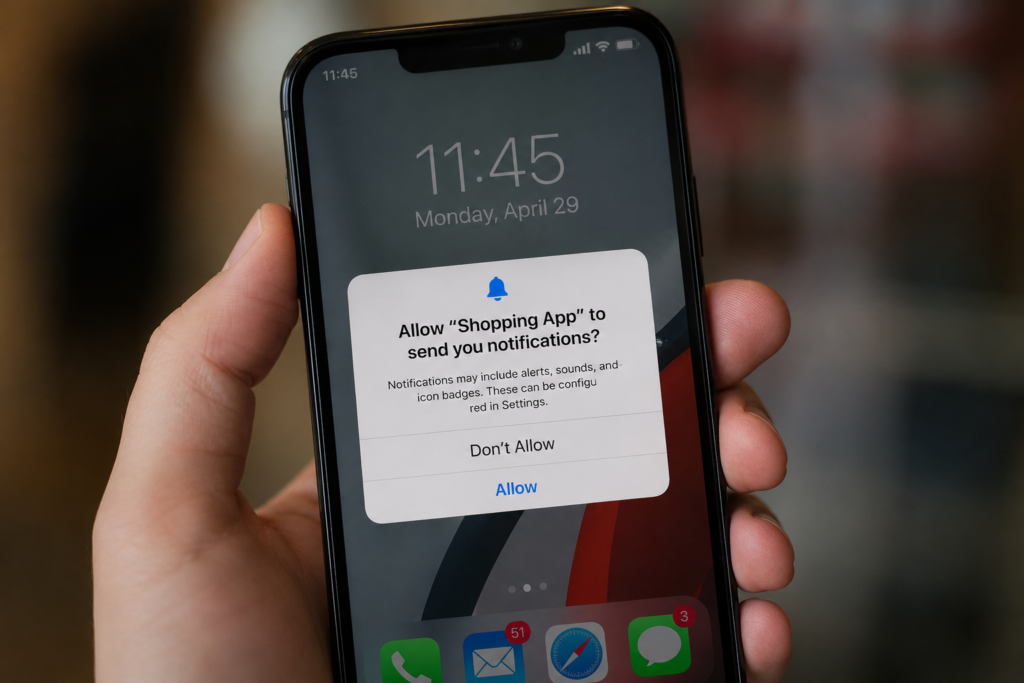
Most apps ask for notification permission within the first few seconds after installation.
Why don’t they wait?
Because they understand one simple truth.
If you leave without enabling notifications,
bringing you back becomes much harder.
Think of notification permission as receiving a key to your front door.
Without permission,
the app has no simple way to remind you it exists.
With permission,
it can reconnect with you whenever the timing is right.
That single tap on “Allow”
is far more valuable than most users realize.
Notifications Are Not the Product
Most people assume notifications exist to share information.
In reality,
information is only one purpose.
The larger purpose is maintaining a relationship.
Imagine opening a restaurant.
Would you rather:
Wait and hope customers remember your restaurant?
Or
Send them a reminder every Friday evening when they’re deciding what to eat?
Businesses prefer the second option.
Notifications reduce the chance that customers forget.
In marketing,
this is called Top-of-Mind Awareness.
The brands people remember first often receive the first opportunity to earn their business.
Why Attention Has Become the World’s Most Valuable Currency
In the past,
companies competed for shelf space in supermarkets.
Today,
they compete for something much smaller.
Your smartphone screen.
Think about how many apps are installed on your phone.
Probably over 50.
Now ask yourself:
How many apps do you actually open every day?
Maybe ten.
Maybe even fewer.
Every company wants to be one of those ten.
That’s why today’s competition isn’t only about building better apps.
It’s about earning your attention.
Because attention leads to engagement.
Engagement leads to habits.
Habits lead to loyalty.
And loyalty drives long-term business growth.
Notifications vs Traditional Advertising
Imagine seeing a billboard while driving.
You glance at it for three seconds.
Then it’s gone.
Now compare that with a notification on your phone.
It appears on your lock screen.
It vibrates.
It makes a sound.
It waits until you notice it.
It’s personal.
It’s immediate.
It’s interactive.
Unlike traditional advertising,
notifications create a direct conversation between a brand and a customer.
That’s why businesses value them so highly.
The Smartphone Lock Screen Has Become Premium Real Estate
Think of your smartphone as a busy city.
Every app wants the best location.
That location is your lock screen.
Whenever a notification appears,
it competes against:
- Family messages
- Friends
- Work emails
- Calendar reminders
- News updates
- Banking alerts
- Social media
Winning that competition is incredibly valuable.
Because if you tap,
the company gets another chance to engage with you.
One notification may seem insignificant.
Millions of notifications can transform an entire business.
Why This Matters to You
You might be wondering,
“Why should I care about notification psychology?”
Because every day,
hundreds of companies compete for your attention.
Some notifications genuinely help you.
Others are carefully designed to trigger curiosity,
create urgency,
or encourage habits.
Understanding these strategies doesn’t mean you should disable every notification.
It means you’ll recognize why they appear and make more intentional decisions about how you respond.
That awareness is one of the most valuable skills in today’s digital world.
Key Takeaways
- Push notifications are far more than simple updates. They are one of the most effective customer engagement tools in modern marketing.
- Notification permission gives companies a direct communication channel to reach customers even when the app is closed.
- Businesses use notifications to build habits, improve retention, increase engagement, and stay top of mind.
- In the digital economy, attention has become one of the most valuable resources, making the smartphone lock screen a highly competitive space.
- Understanding the Marketing Psychology Behind Push Notifications helps consumers recognize how brands compete for attention and make more mindful choices.
Chapter 2: Marketing Psychology Behind Push Notifications, The Business Strategy
Push notifications are not just digital alerts.
They are one of the most powerful communication channels between businesses and customers.
But this raises another question.
If notifications are so important, why do companies invest millions in customer engagement platforms, AI-driven notification systems, and CRM software?
Wouldn’t emails or advertisements be enough?
The answer lies in one simple truth.
Acquiring customers is expensive.
Keeping customers is far more profitable.
The business strategy behind push notifications and why they have become one of the highest-return marketing investments in the digital world.
Notifications Are More Than Messages
Many people believe notifications exist to communicate information.
Businesses see them differently.
They see notifications as opportunities.
Every notification creates another chance to:
- Bring customers back.
- Encourage purchases.
- Increase engagement.
- Build habits.
- Strengthen loyalty.
- Improve customer lifetime value.
Think of a notification as a friendly knock on your digital door.
Whether you answer depends on how relevant that knock feels.
Customer Acquisition Cost (CAC)
One of the biggest challenges every company faces is finding new customers.
This cost is called Customer Acquisition Cost (CAC).
What Is Customer Acquisition Cost?
Customer Acquisition Cost is the total amount a company spends to acquire one new customer.
It includes:
- Google Ads
- Facebook Ads
- Influencer campaigns
- Television advertisements
- Referral bonuses
- Cashback offers
- Sales teams
- Promotional campaigns
Imagine a shopping app spends ₹800 to acquire one customer.
If that customer:
Downloads the app.
Uses it once.
Never returns.
The business loses money.
This is exactly why notifications are valuable.
Instead of constantly paying to acquire new customers,
companies focus on bringing existing customers back.
Real-World Example
Suppose Amazon wants you to buy again.
It has two choices.
Option A
Show you advertisements on Google.
Hope you click.
Hope you visit Amazon.
Hope you buy something.
Option B
Send a notification saying:
“Your wishlist item is now 30% off.”
One notification.
One tap.
Much lower marketing cost.
This is why push notifications significantly reduce customer acquisition expenses.
Business Lesson
The cheapest customer is often the one who already knows your business.
Retention is usually less expensive than acquisition.
Consumer Lesson
Whenever you receive a notification,
remember,
it’s not always about sharing information.
Sometimes it’s a cost-effective way for businesses to encourage another visit.
Customer Retention
Imagine two restaurants.
Restaurant A serves excellent food.
Restaurant B serves excellent food and remembers:
- Your favorite table.
- Your preferred dish.
- Your birthday.
- Your dietary preferences.
Which restaurant are you more likely to revisit?
Most people choose Restaurant B.
Not because the food is dramatically different.
Because the relationship feels personal.
This is called Customer Retention.
Why Retention Matters More Than Acquisition
Imagine filling a bucket with water.
Acquiring customers is like pouring water into the bucket.
Retention is making sure the bucket doesn’t leak.
If customers keep leaving,
the business must spend even more money finding replacements.
Push notifications help reduce those leaks.
They remind customers:
“We’re still here.”
Common Retention Notifications
- We miss you.
- It’s been a while.
- Complete your profile.
- Your subscription expires tomorrow.
- Continue where you left off.
Notice something?
These messages rarely try to sell immediately.
Their first goal is simply to bring you back.
Consumer Lesson
Not every reminder deserves your attention.
Before opening an app,
ask yourself:
“Was I already planning to use this,
or did the notification create the urge?”
Customer Lifetime Value (LTV)
If CAC measures how much it costs to acquire customers,
Customer Lifetime Value (LTV) measures how valuable those customers become over time.
What Is Customer Lifetime Value?
Customer Lifetime Value is the total revenue a business expects to earn from one customer during the entire relationship.
Engagement Marketing
Not every notification tries to sell something.
Many simply encourage interaction.
This is called Engagement Marketing.
Examples include:
- Someone liked your photo.
- You have new followers.
- Complete today’s lesson.
- Your weekly report is ready.
The goal isn’t immediate revenue.
The goal is increasing activity.
Because more engagement often leads to stronger habits.
Business Lesson
Engaged users are far more likely to become loyal customers.
Consumer Lesson
Ask yourself,
“Is this notification truly useful,
or is it simply encouraging me to spend more time inside the app?”
CRM Marketing
Businesses don’t send the same notification to everyone.
Instead,
they use Customer Relationship Management (CRM) systems.
CRM platforms analyze customer behavior,
including:
- Purchase history.
- Browsing activity.
- Favorite products.
- Location.
- Time of activity.
- Interests.
This allows businesses to send personalized notifications.
Example
Customer A frequently orders pizza.
Customer B usually orders biryani.
Sending both customers the same message makes little sense.
Instead,
each receives recommendations based on previous behavior.
This improves relevance.
Relevant notifications perform better than generic ones.
Lifecycle Marketing
Customers don’t remain the same forever.
Someone who downloaded an app yesterday behaves differently from someone who has used it for five years.
That’s why companies use Lifecycle Marketing.
New Users
Welcome notifications.
Setup reminders.
Tutorials.
Active Users
Feature updates.
Recommendations.
Rewards.
Inactive Users
We miss you.
Exclusive discounts.
Come back offers.
Every stage requires different communication.
Re-engagement Campaigns
Imagine uninstalling an app mentally,
without actually deleting it.
It sits unused for months.
Businesses notice this.
Instead of giving up,
they launch Re-engagement Campaigns.
Examples:
“Your reward expires today.”
“It’s been 30 days since your last visit.”
“We’ve added exciting new features.”
These notifications attempt to restart the customer relationship.
Business Lesson
Sometimes,
winning back an old customer is easier than acquiring a new one.
Consumer Lesson
Re-engagement messages are often persuasive.
Before returning,
consider whether the app genuinely adds value to your life.
Why Push Notifications Are an Investment, Not an Expense
Many people think businesses spend money sending notifications.
Actually,
companies view notifications as investments.
Why?
Because one successful notification can generate:
- A purchase.
- A booking.
- A subscription renewal.
- A referral.
- Increased engagement.
- Stronger customer loyalty.
The return can far exceed the cost of sending the message.
That’s why companies carefully test:
- Timing.
- Wording.
- Emojis.
- Personalization.
- Frequency.
- Audience segments.
Every small improvement can influence millions of users.
The Hidden Formula Behind Notification Marketing
Every successful notification follows a similar journey.
Notification Sent
        ↓
User Notices
        ↓
User Opens App
        ↓
User Takes Action
        ↓
Positive Experience
        ↓
Repeat Usage
        ↓
Habit Formation
        ↓
Customer Retention
        ↓
Higher Customer Lifetime Value
Notice something important.
The goal isn’t merely to get someone to tap a notification.
The real objective is to create long-term customer relationships.
Key Takeaways
- Push notifications are a strategic marketing tool, not just a communication feature.
- Businesses use notifications to reduce Customer Acquisition Cost (CAC) by bringing existing customers back instead of constantly acquiring new ones.
- Customer Retention and Customer Lifetime Value (LTV) are major reasons companies invest in notification marketing.
- Engagement Marketing, CRM Marketing, Lifecycle Marketing, and Re-engagement Campaigns help businesses deliver personalized experiences.
- Successful notifications focus on building long-term relationships rather than generating one-time sales.
- Consumers who understand these strategies can better manage their attention and make more intentional choices about which notifications deserve their time.
Chapter 3: Marketing Psychology Behind Push Notifications, The Consumer Psychology
They help businesses:
- Retain customers.
- Increase engagement.
- Improve Customer Lifetime Value (LTV).
- Reduce Customer Acquisition Cost (CAC).
But here’s an important question.
If millions of people know companies are trying to grab their attention, why do push notifications still work?
Why do we instantly check our phone after hearing a notification sound?
Why is it difficult to ignore a small red notification badge?
Why do “Only 2 hours left!” messages create urgency?
The answer isn’t technology.
It’s psychology.
The world’s biggest companies don’t simply understand software.
They understand human behavior.
Every successful notification is designed around how the brain naturally thinks, reacts, and forms habits.
Let’s uncover the psychology behind it.
1. The Habit Loop: How Notifications Become Daily Habits
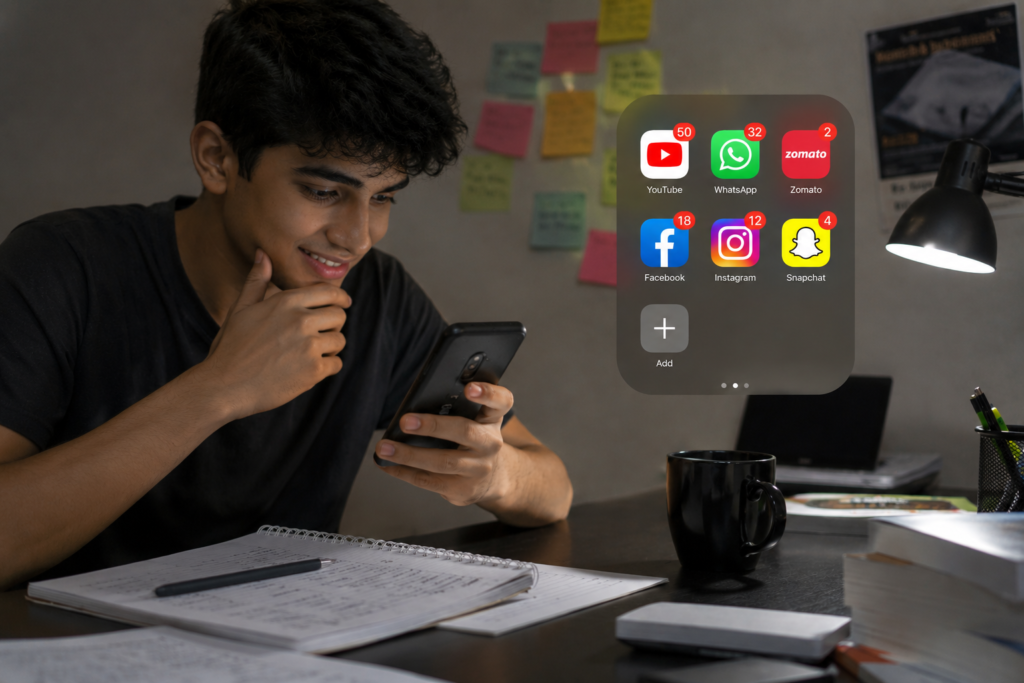
Imagine you’re working on your laptop.
Suddenly…
Buzz!
Without thinking,
you unlock your phone.
Check the notification.
Return to work.
This happens dozens of times every day.
Have you ever wondered why?
Psychologist Charles Duhigg, in The Power of Habit, explains that every habit follows a simple cycle.
The Habit Loop
Cue
↓
Routine
↓
Reward
Let’s apply it to notifications.
Cue
A notification sound or vibration.
↓
Routine
Open the app.
↓
Reward
A new message.
A discount.
A like.
A delivery update.
Something interesting.
Your brain begins connecting the notification with the possibility of a reward.
Eventually,
checking notifications becomes automatic.
You stop deciding.
You simply react.
Real Example
Duolingo sends:
“Don’t lose your 45-day streak.”
Cue.
↓
Open the app.
↓
Complete one lesson.
↓
Feel accomplished.
Repeat this for months,
and language learning becomes a daily habit.
Business Objective
Create consistent engagement.
Consumer Lesson
Habits save mental effort,
but they can also reduce awareness.
Instead of opening every notification automatically,
pause for two seconds.
Ask yourself:
“Is this notification important, or am I simply following a habit?”
2. Variable Rewards: Why We Can’t Resist Checking Notifications
Imagine opening your mailbox every morning.
Sometimes,
there’s an exciting letter.
Sometimes,
nothing.
Because you never know,
you keep checking.
This is called Variable Rewards.
Behavioral psychologist B.F. Skinner discovered that unpredictable rewards create stronger habits than predictable ones.
How Apps Use Variable Rewards
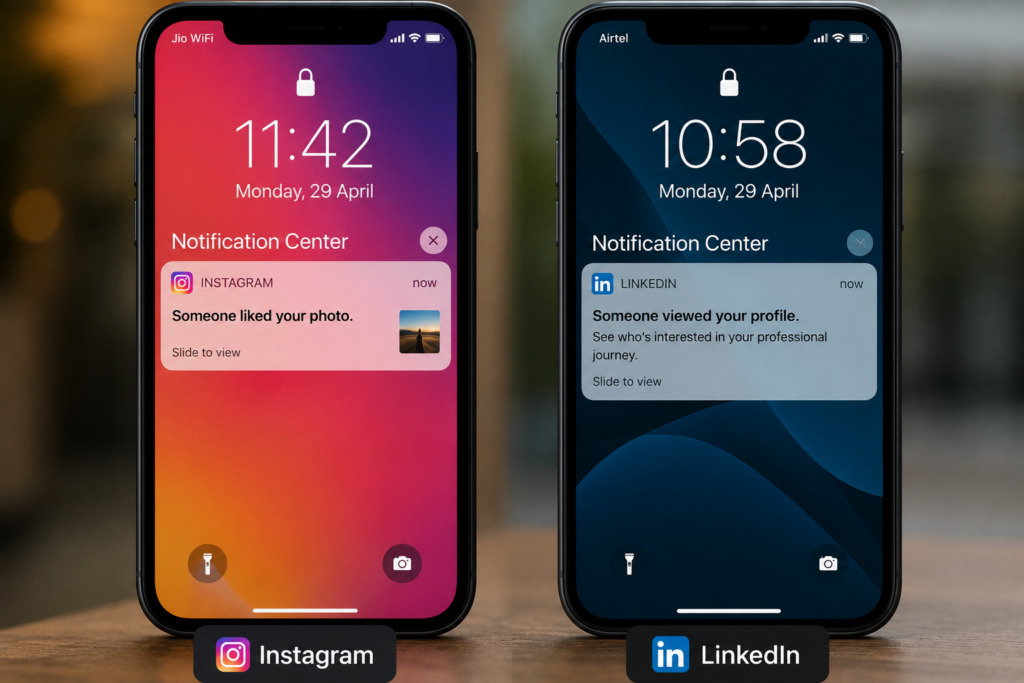
Sometimes,
someone liked your photo.
Sometimes,
nothing.
Sometimes,
a recruiter viewed your profile.
Sometimes,
just another connection request.
Amazon
Sometimes,
your wishlist item is on sale.
Sometimes,
there’s no offer.
Because the outcome is unpredictable,
your brain stays curious.
Business Objective
Increase app opens.
Consumer Lesson
Not every notification deserves immediate attention.
Companies know unpredictability keeps users engaged.
Recognizing this makes you less likely to check your phone impulsively.
3. FOMO (Fear of Missing Out)
Imagine receiving a notification saying:
“Flash Sale Ends in 30 Minutes.”
Immediately,
your brain starts asking questions.
“What if I miss a great deal?”
“What if everyone else buys it?”
“What if prices increase later?”
This feeling is called Fear of Missing Out (FOMO).
Humans naturally dislike missing opportunities.
Businesses use this carefully.
Common FOMO Notifications
- Limited Stock
- Last Chance
- Offer Ending Soon
- Only Today
- Seats Filling Fast
- Live Now
Business Objective
Increase urgency.
Encourage faster decisions.
Reduce procrastination.
Consumer Lesson
Urgency is sometimes real.
Sometimes,
it’s part of the marketing strategy.
Before acting,
ask:
“Would I still buy this if there wasn’t a countdown?”
4. The Zeigarnik Effect: Why Unfinished Tasks Stay in Our Mind
Have you noticed notifications like:
“Complete your profile.”
“You left items in your cart.”
“Finish your lesson.”
“Continue watching.”
Why do these work so well?
Because of the Zeigarnik Effect.
This psychological principle states that people remember unfinished tasks better than completed ones.
Your brain naturally seeks closure.
Example
Netflix
“Continue Watching.”
Amazon
“You left something in your cart.”
“Your profile is only 80% complete.”
Each notification reminds you about something unfinished.
Your brain wants to complete it.
Business Objective
Bring users back.
Increase completion rates.
Consumer Lesson
Not every unfinished task needs immediate completion.
Sometimes,
it’s okay to leave something unfinished.
5. Loss Aversion: Why We Hate Losing More Than We Love Winning
Imagine these two notifications.
Notification A
“Earn ₹100 cashback.”
Notification B
“Your ₹100 cashback expires tonight.”
Which one feels more urgent?
Usually,
Notification B.
Why?
Because humans dislike losing more than they enjoy gaining.
This principle is called Loss Aversion, introduced by psychologists Daniel Kahneman and Amos Tversky.
Examples
“You’ll lose your streak.”
“Your coupon expires today.”
“Reward points expire tonight.”
“Your membership ends tomorrow.”
Business Objective
Encourage immediate action.
Consumer Lesson
Expiring offers can be useful.
But don’t spend money simply to avoid “losing” a reward.
Sometimes,
the best deal is buying nothing at all.
6. The Dopamine Loop: Why Notifications Feel Exciting
Many people think notifications release dopamine.
The reality is more interesting.
The brain releases dopamine primarily in anticipation of a possible reward.
Notification.
↓
Expectation.
↓
Open App.
↓
Discover what’s inside.
That anticipation creates excitement.
Sometimes,
the notification is meaningful.
Sometimes,
it’s disappointing.
Either way,
the anticipation keeps the cycle alive.
Business Objective
Encourage repeated engagement.
Consumer Lesson
Recognize the difference between:
Need
and
Curiosity.
Not every notification requires immediate attention.
7. The Curiosity Gap: The Power of Incomplete Information
Imagine receiving:
“You won’t believe what happened…”
or
“Someone mentioned you.”
or
“Your weekly report is ready.”
Notice something?
The notification doesn’t tell you everything.
It creates curiosity.
This is called the Curiosity Gap.
Humans naturally want missing information.
Business Objective
Increase notification click-through rates.
Consumer Lesson
Curiosity is powerful.
Before opening the app,
consider whether the information is actually valuable.
8. Instant Gratification
Modern consumers expect speed.
Notifications satisfy this desire.
Examples:
“Your payment was successful.”
“Your food is arriving.”
“Your friend replied.”
Immediate feedback creates satisfaction.
It reduces uncertainty.
Business Objective
Increase positive customer experiences.
Consumer Lesson
Helpful notifications reduce stress.
Promotional notifications often increase impulse decisions.
Learn to distinguish between the two.
9. Reciprocity: Why Free Rewards Bring You Back
Imagine receiving:
“Here’s ₹100 cashback.”
or
“Congratulations! You’ve unlocked a reward.”
People naturally feel inclined to respond positively after receiving something valuable.
This is called the Reciprocity Principle.
Businesses use rewards to encourage continued engagement.
Business Objective
Increase customer loyalty.
Consumer Lesson
Free rewards are great.
Just remember,
they’re often the beginning of a longer customer relationship,
not the end of one.
10. The Attention Economy: Every Notification Is Competing for Your Time
Today’s biggest technology companies don’t compete only for customers.
They compete for attention.
Every notification competes against:
- Family messages.
- Friends.
- Work.
- News.
- Entertainment.
- Other apps.
The company that earns your attention earns another opportunity to build a relationship.
That’s why today’s economy is often called the Attention Economy.
Business Objective
Increase daily active users.
Increase screen time.
Increase engagement.
Consumer Lesson
Your attention is limited.
Treat it like money.
Spend it where it creates value.
11. Notification Fatigue: When Too Much Becomes Too Much
Imagine receiving:
40 notifications.
Every day.
Eventually,
you stop noticing them.
Or worse,
you disable notifications entirely.
This is called Notification Fatigue.
Sending more notifications doesn’t always increase engagement.
Sometimes,
it destroys it.
Business Lesson
Quality always beats quantity.
One relevant notification is better than ten irrelevant ones.
Consumer Lesson
Review your notification settings regularly.
Turn off notifications that don’t improve your life.
Protect your attention.
Why Great Companies Don’t Send More Notifications
This is one of the biggest myths in marketing.
People assume successful companies send the most notifications.
Actually,
the best companies send the right notification at the right time to the right person.
That’s why AI and personalization are becoming essential.
The future isn’t more notifications.
It’s smarter notifications.
Key Takeaways
- The Marketing Psychology Behind Push Notifications is rooted in behavioral science rather than technology alone.
- The Habit Loop explains why notifications become automatic behaviors.
- Variable Rewards keep users engaged because rewards are unpredictable.
- FOMO, Loss Aversion, and the Curiosity Gap encourage immediate action.
- The Zeigarnik Effect motivates users to complete unfinished tasks.
- Dopamine is driven more by anticipation than by the reward itself.
- The Attention Economy makes notifications one of the most valuable marketing tools available today.
- Excessive notifications lead to Notification Fatigue, making relevance and timing more important than volume.
- Consumers who understand these psychological principles can manage their attention more consciously and build healthier digital habits.
Chapter 4: Marketing Psychology Behind Push Notifications, Real-World Case Studies
First,
push notifications are one of the most powerful customer retention tools in digital marketing.
Second,
their success depends on consumer psychology rather than technology alone.
But the real question is:
How do the world’s biggest companies actually use push notifications?
Do they all send the same type of notifications?
Not at all.
Every company has a different business objective.
A food delivery app wants orders.
A social media platform wants engagement.
A shopping app wants purchases.
A learning app wants consistency.
A music app wants listening time.
Although their goals differ, they all use psychology to influence behavior.
Let’s explore some of the best real-world examples.
Case Study 1: Instagram
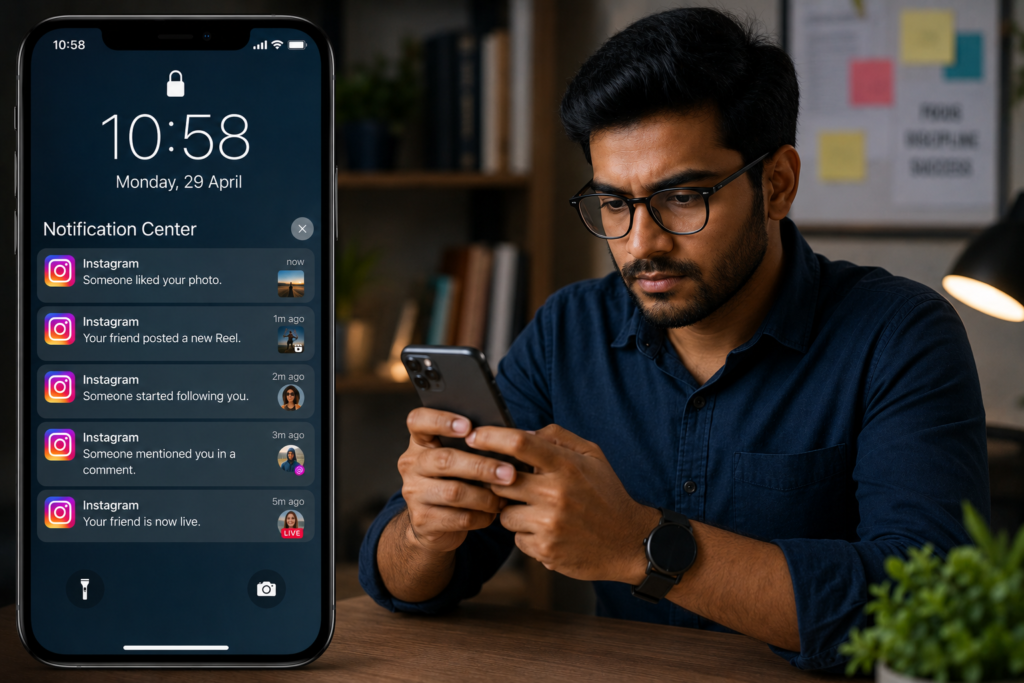
Typical Notifications
- Someone liked your photo.
- Your friend posted a new Reel.
- Someone started following you.
- Someone mentioned you in a comment.
- Your friend is now live.
Marketing Strategy
Instagram doesn’t simply notify you about activity.
It reminds you that something is happening right now.
The platform knows people don’t want to miss social interactions.
Consumer Psychology
Social Validation
Humans naturally enjoy appreciation.
Every like,
comment,
and follow
acts as positive reinforcement.
FOMO
“Your friend started a Live video.”
This notification creates urgency.
If you don’t join now,
you might miss the moment.
Variable Rewards
Sometimes you receive:
100 likes.
Sometimes,
only two.
Because every notification brings an uncertain outcome,
people keep checking.
Business Objective
Increase:
- Daily Active Users
- Session Time
- Engagement
- Advertising Revenue
Consumer Lesson
Not every notification requires an immediate response.
Consider disabling notifications for likes and follows while keeping messages enabled.
You’ll reduce distractions without losing meaningful communication.
Case Study 2: WhatsApp
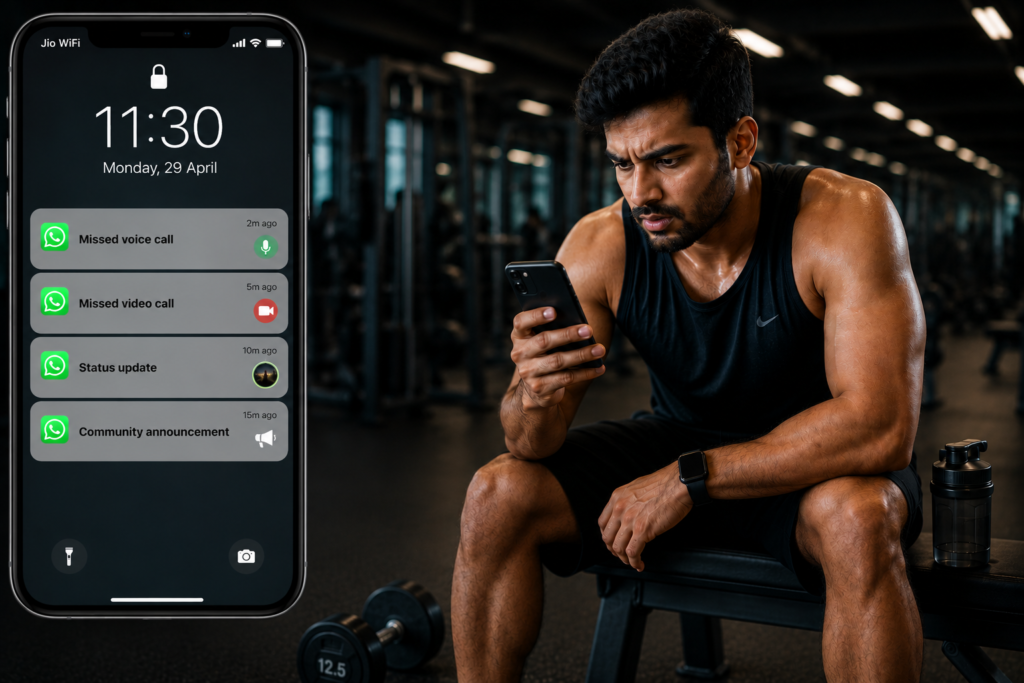
Unlike social media,
WhatsApp notifications focus primarily on communication.
Typical Notifications
- New message
- Missed voice call
- Missed video call
- Status update
- Community announcement
Marketing Strategy
WhatsApp rarely sends promotional notifications.
Its success depends on reliability.
When someone sends a message,
the notification delivers immediate value.
Consumer Psychology
Instant Gratification
Users receive immediate updates.
This reduces uncertainty.
Social Connection
People naturally prioritize communication from friends and family.
Business Objective
Increase trust.
Maintain daily usage.
Become an essential communication platform.
Consumer Lesson
This is an example of high-value notifications.
Useful notifications improve customer experience rather than interrupt it.
Case Study 3: LinkedIn
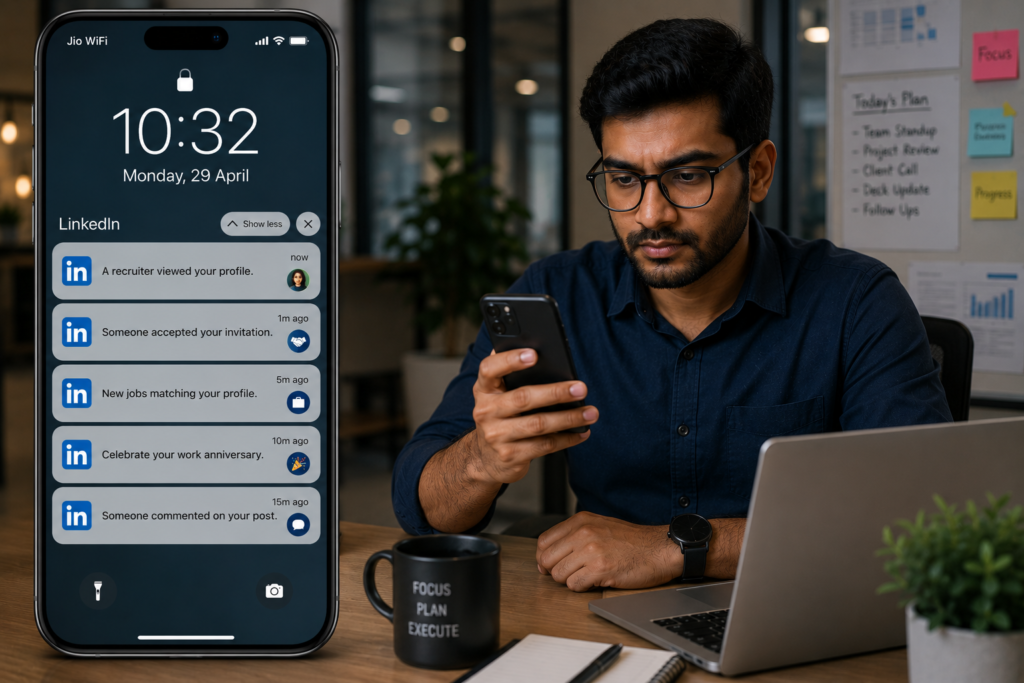
LinkedIn doesn’t simply notify users.
It encourages professional growth.
Typical Notifications
- A recruiter viewed your profile.
- Someone accepted your invitation.
- New jobs matching your profile.
- Celebrate your work anniversary.
- Someone commented on your post.
Marketing Strategy
LinkedIn personalizes notifications based on career goals.
Different users receive different recommendations.
Consumer Psychology
Curiosity Gap
Who viewed my profile?
The notification doesn’t reveal the answer.
You open the app to find out.
Career Motivation
Job alerts encourage hope.
Professional recognition encourages participation.
Business Objective
Increase:
- Job applications
- Networking
- Professional engagement
Consumer Lesson
Keep job alerts.
Reduce unnecessary social notifications.
Focus on notifications that support your career goals.
Case Study 4: Swiggy
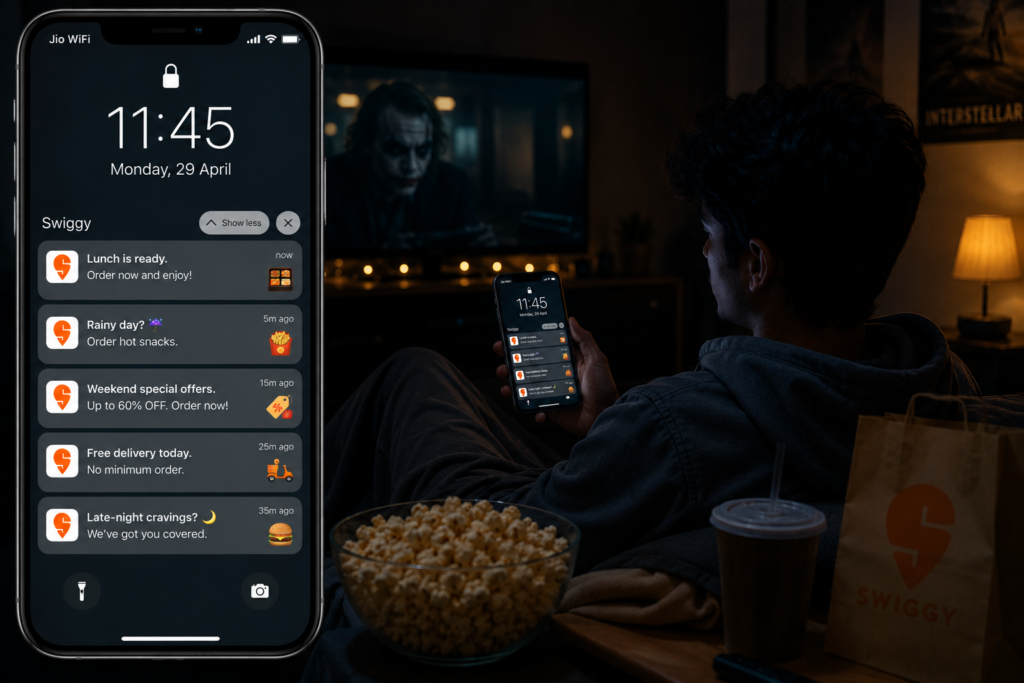
Swiggy’s notification strategy is built around timing.
Typical Notifications
- Lunch is ready.
- Rainy day? Order hot snacks.
- Weekend special offers.
- Free delivery today.
- Late-night cravings?
Marketing Strategy
Swiggy doesn’t randomly send offers.
It tries to match notifications with situations where people are more likely to order.
Consumer Psychology
Contextual Marketing
Time influences decisions.
Receiving a lunch notification at 1 PM feels far more relevant than receiving it at 10 AM.
Instant Gratification
Food arrives quickly.
The reward feels immediate.
Business Objective
Increase meal-time orders.
Improve repeat purchases.
Consumer Lesson
Ask yourself,
“Am I actually hungry,
or did the notification create the craving?”
Case Study 5: Zomato
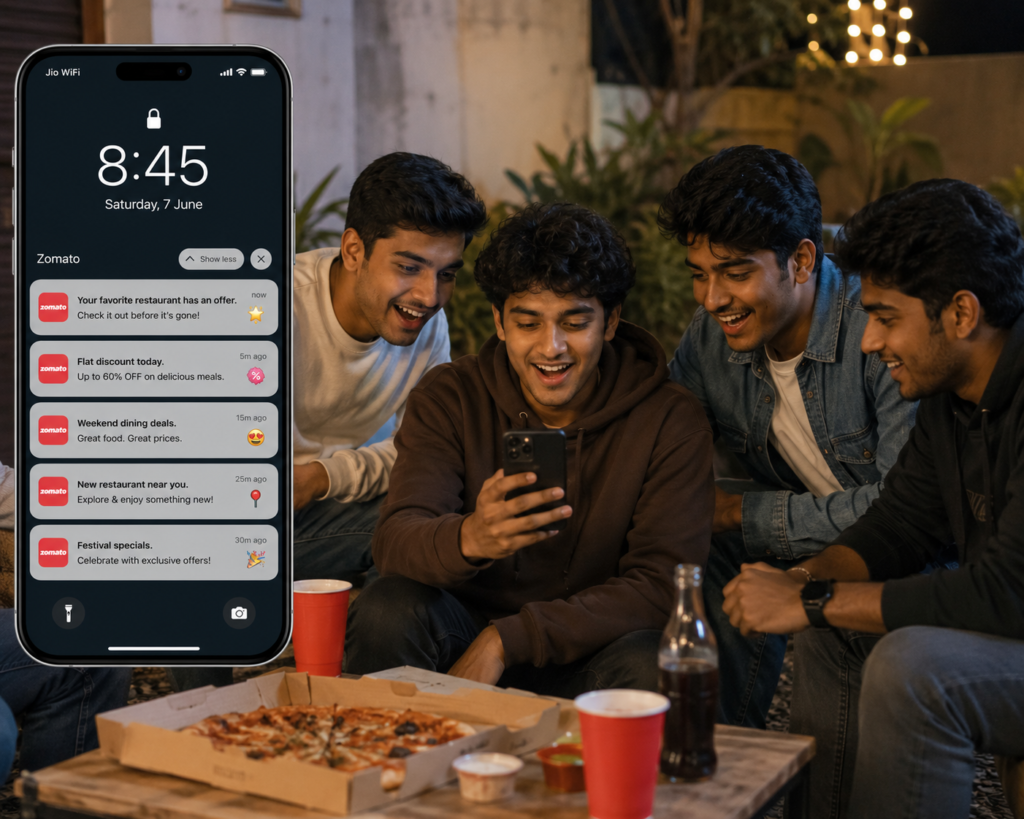
Zomato uses notifications to maintain engagement even when customers aren’t actively looking for food.
Typical Notifications
- Your favorite restaurant has an offer.
- Flat discount today.
- Weekend dining deals.
- New restaurant near you.
- Festival specials.
Marketing Strategy
Personalized recommendations.
Location-based marketing.
Festival campaigns.
Consumer Psychology
Familiarity Bias
People trust restaurants they’ve ordered from before.
Scarcity
Limited-time offers encourage quicker decisions.
Business Objective
Increase repeat orders.
Increase customer retention.
Consumer Lesson
Offers are useful,
but compare prices before ordering simply because of a notification.
Case Study 6: Amazon
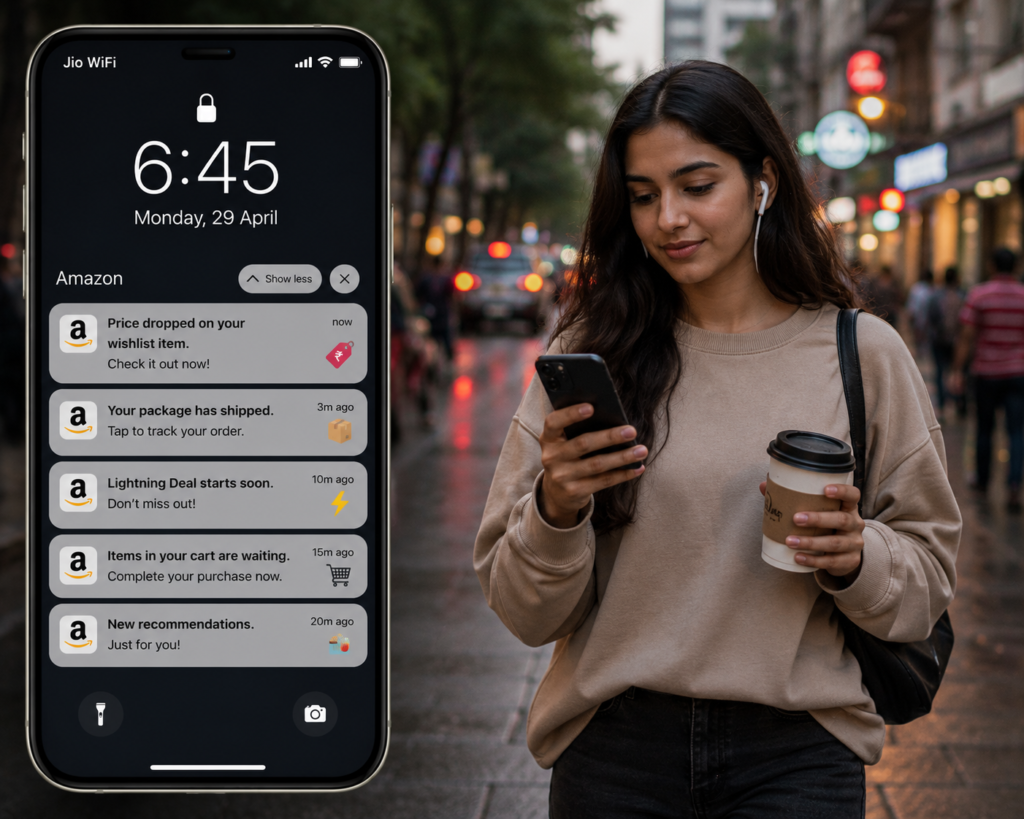
Amazon sends some of the world’s most personalized notifications.
Typical Notifications
- Price dropped on your wishlist item.
- Your package has shipped.
- Lightning Deal starts soon.
- Items in your cart are waiting.
- New recommendations.
Marketing Strategy
Lifecycle Marketing.
Cart Recovery.
Wish List Marketing.
Consumer Psychology
Zeigarnik Effect
Your cart isn’t complete.
Your brain remembers unfinished purchases.
Loss Aversion
Deal ends soon.
Price may increase.
Business Objective
Recover abandoned carts.
Increase purchases.
Encourage repeat shopping.
Consumer Lesson
A price drop doesn’t automatically make something a good purchase.
Ask:
“Would I buy this without the notification?”
Case Study 7: YouTube
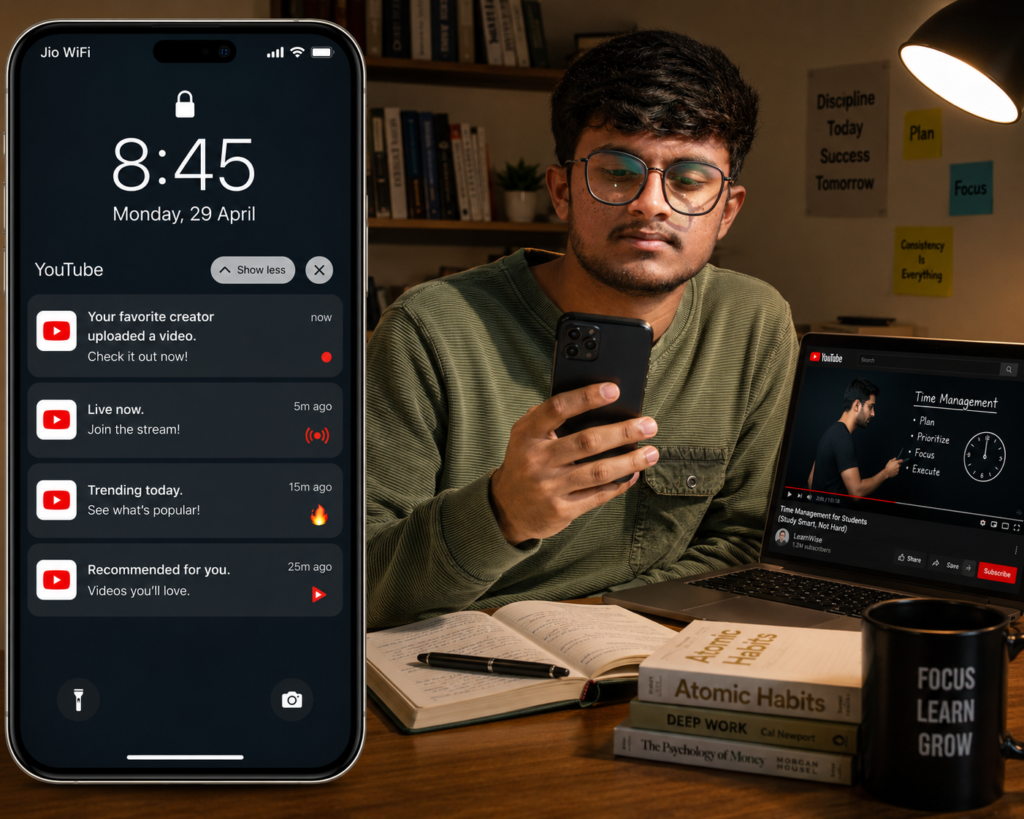
YouTube competes for attention every day.
Typical Notifications
- Your favorite creator uploaded a video.
- Live now.
- Trending today.
- Recommended for you.
Marketing Strategy
Personalized recommendations.
Content discovery.
Consumer Psychology
Curiosity Gap
“What did they upload?”
Habit Formation
Watching one video often leads to another.
Business Objective
Increase watch time.
Increase advertising revenue.
Consumer Lesson
Useful educational channels deserve notifications.
Entertainment channels may be worth limiting if they frequently interrupt your day.
Case Study 8: Spotify
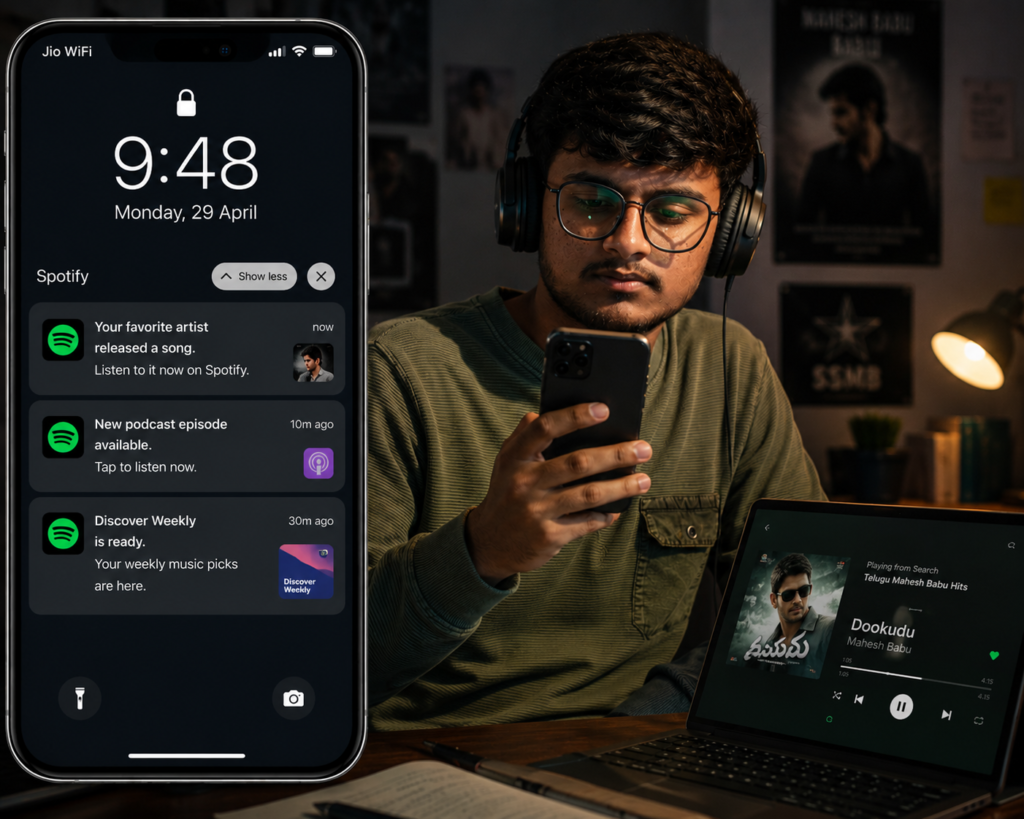
Spotify uses notifications to strengthen emotional connections.
Typical Notifications
- Your favorite artist released a song.
- New podcast episode available.
- Discover Weekly is ready.
Marketing Strategy
Personalization.
Music discovery.
Emotional engagement.
Consumer Psychology
Personal Identity
Music reflects personality.
Relevant recommendations feel meaningful.
Business Objective
Increase listening hours.
Improve subscriptions.
Consumer Lesson
This is personalization done well.
Relevant recommendations create value instead of unnecessary interruptions.
Case Study 9: Duolingo
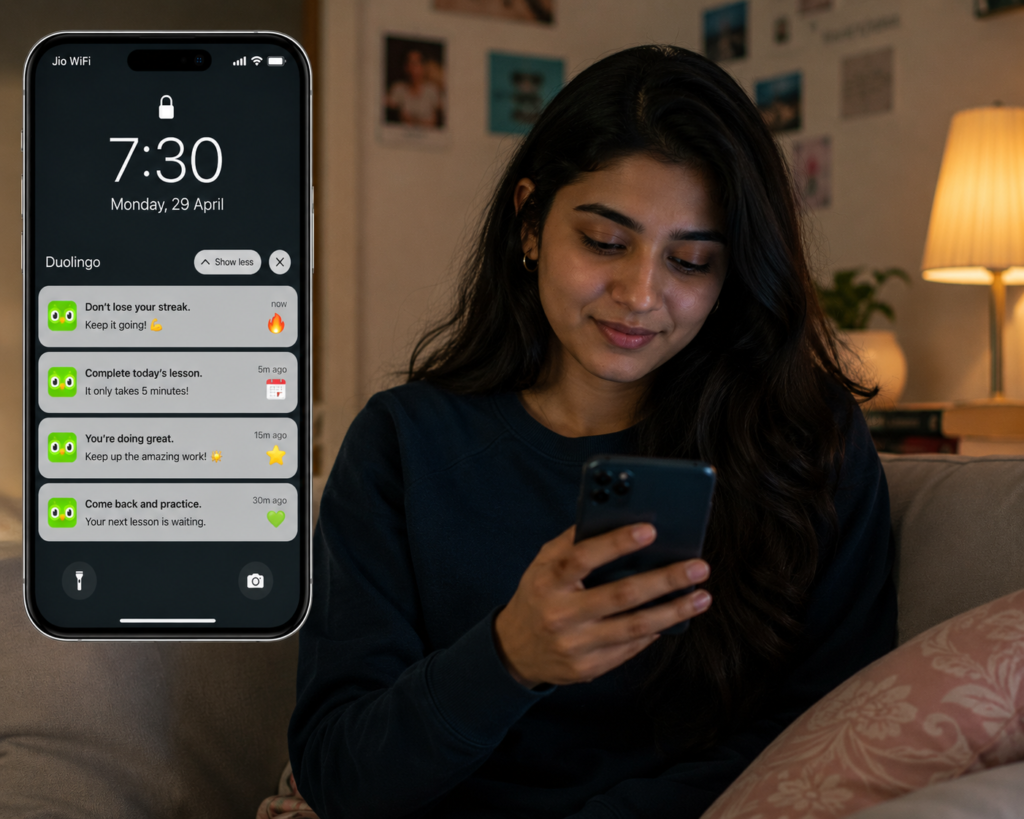
Duolingo has become famous for its notification strategy.
Typical Notifications
- Don’t lose your streak.
- Complete today’s lesson.
- You’re doing great.
- Come back and practice.
Marketing Strategy
Gamification.
Habit building.
Daily engagement.
Consumer Psychology
Loss Aversion
Nobody wants to lose a 100-day streak.
Habit Loop
Notification
↓
Lesson
↓
Achievement
↓
Repeat
Business Objective
Increase learning consistency.
Improve long-term retention.
Consumer Lesson
Duolingo demonstrates how positive reminders can encourage healthy habits when used responsibly.
Case Study 10: Google Calendar
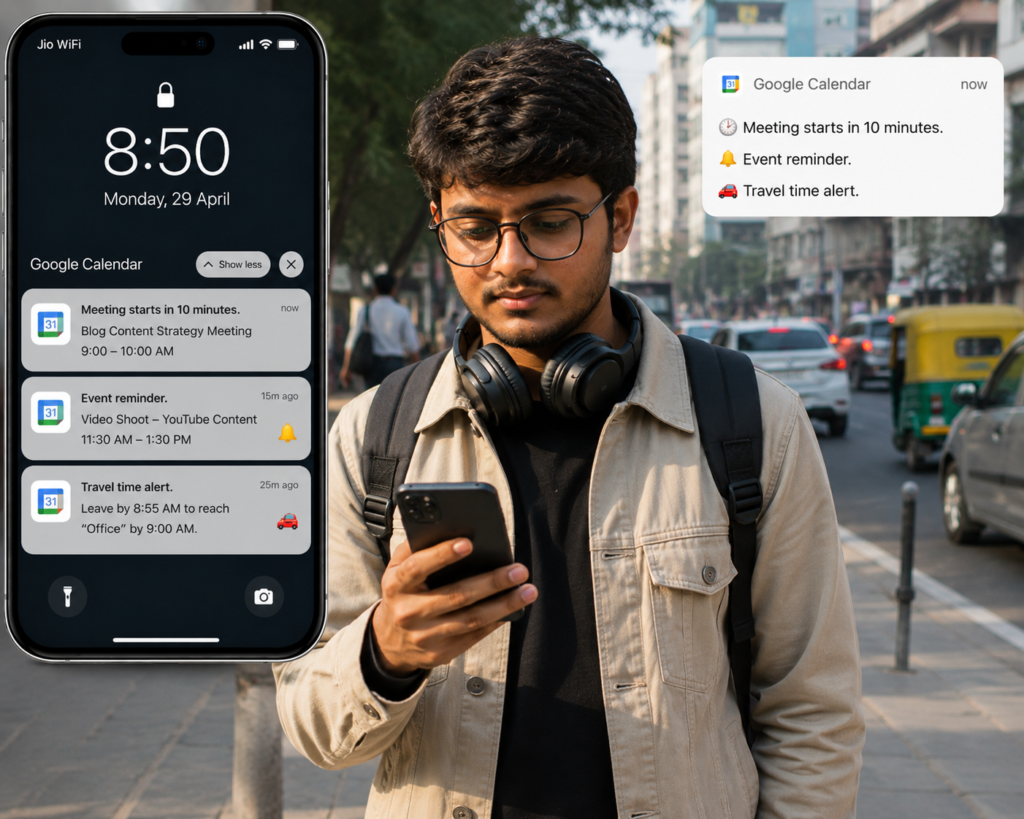
Google Calendar sends some of the most valuable notifications.
Typical Notifications
- Meeting starts in 10 minutes.
- Event reminder.
- Travel time alert.
Marketing Strategy
Utility-first communication.
No unnecessary promotions.
Consumer Psychology
Reduced Anxiety
Timely reminders reduce stress.
Trust
Useful notifications strengthen confidence in the product.
Business Objective
Become an essential daily productivity tool.
Consumer Lesson
The best notifications solve problems.
They don’t create distractions.
Comparison Table
| App | Primary Goal | Psychology Used | Business Outcome |
|---|---|---|---|
| Engagement | Social Validation, FOMO, Variable Rewards | Higher session time | |
| Communication | Instant Gratification, Social Connection | Daily active usage | |
| Professional Growth | Curiosity Gap, Motivation | More networking and job applications | |
| Swiggy | Food Orders | Contextual Marketing, Instant Gratification | Increased orders |
| Zomato | Customer Retention | Familiarity Bias, Scarcity | Repeat purchases |
| Amazon | Shopping | Zeigarnik Effect, Loss Aversion | Higher conversions |
| YouTube | Watch Time | Curiosity Gap, Habit Formation | More viewing hours |
| Spotify | Music Engagement | Personalization, Emotional Connection | Longer listening sessions |
| Duolingo | Daily Learning | Habit Loop, Gamification | Higher learning consistency |
| Google Calendar | Productivity | Trust, Utility | Long-term user loyalty |
One Common Pattern Across Every Successful App
Although these companies belong to different industries,
their notification strategies follow the same formula.
Right User
        ↓
Right Time
        ↓
Right Message
        ↓
Relevant Notification
        ↓
User Opens App
        ↓
Positive Experience
        ↓
Repeat Usage
        ↓
Habit Formation
        ↓
Customer Loyalty
Notice something interesting.
Successful companies don’t send the most notifications.
They send the most relevant notifications.
Relevance always beats frequency.
Key Takeaways
- Every successful app uses push notifications differently based on its business goals.
- Instagram relies on social validation and FOMO, while WhatsApp focuses on utility and communication.
- Swiggy and Zomato use contextual marketing, Amazon uses purchase intent, Duolingo uses gamification, and Google Calendar prioritizes trust and usefulness.
- The most effective notification strategy is not sending more messages but sending the right message to the right person at the right time.
- Consumers benefit by distinguishing between notifications that provide genuine value and those designed mainly to increase engagement.
Chapter 5: How AI Is Transforming the Marketing Psychology Behind Push Notifications
A few years ago, most push notifications followed a simple rule.
One notification.
Sent to everyone.
Whether you lived in Mumbai or Hyderabad.
Whether you were a new customer or a loyal customer.
Whether you had ordered yesterday or six months ago.
Almost everyone received the same message.
Today’s notification strategy is completely different.
Companies no longer ask:
“What notification should we send?”
Instead, they ask:
“Who should receive this notification, when should they receive it, and what message is most relevant to them?”
The answer lies in one technology.
Artificial Intelligence (AI).
AI has transformed push notifications from simple reminders into intelligent, personalized conversations.
Instead of interrupting customers,
the goal is to assist them.
Let’s explore how AI is changing the Marketing Psychology Behind Push Notifications.
From Mass Notifications to Personalized Notifications
Imagine you own a food delivery app with one million users.
In the past, your marketing team might have sent:
“Flat 30% Off Today!”
to everyone.
Sounds simple.
But here’s the problem.
Some users had already ordered lunch.
Some weren’t hungry.
Some lived in cities where the offer wasn’t available.
Many ignored the notification.
Today, AI works differently.
Instead of sending one message to everyone,
it analyzes each customer’s behavior and sends personalized notifications.
For example:
Customer A
Usually orders pizza every Friday evening.
Notification:
“Your favorite pizza restaurant has 20% off tonight.”
Customer B
Often orders coffee during rainy weather.
Notification:
“It’s raining outside. Enjoy a hot coffee with free delivery.”
Customer C
Hasn’t opened the app for 30 days.
Notification:
“We’ve missed you. Here’s an exclusive offer just for you.”
Three users.
Three different messages.
This is the power of AI-driven personalization.
AI Learns From Customer Behavior
Every interaction teaches AI something.
For example,
it can learn:
- What time you usually open an app.
- Which products you browse.
- What you purchase.
- Which notifications you ignore.
- Which notifications you open.
- Which offers you redeem.
- Which categories interest you.
Over time,
AI builds a behavioral profile.
This helps companies send notifications that feel more relevant and less random.
Business Benefit
Higher engagement.
Higher conversion rates.
Lower marketing costs.
Consumer Benefit
Instead of irrelevant messages,
you receive notifications that better match your interests.
Predictive Notifications
One of the biggest innovations in AI is prediction.
Instead of reacting to your actions,
AI tries to predict your next need.
Imagine this.
Every Saturday evening,
you usually order dinner.
After observing this pattern for several weeks,
the app sends:
“Your favorite restaurant is offering free delivery tonight.”
You didn’t search.
You didn’t open the app.
The notification arrived because AI predicted your likely behavior.
Other Examples
Google Maps
Traffic notification before your usual commute.
Spotify
A new playlist based on your listening habits.
Amazon
A reminder when a frequently purchased item is likely running out.
Calendar Apps
Leave now to arrive on time.
These notifications feel helpful because they’re based on context rather than guesswork.
Behavioral Targeting
Not every customer behaves the same way.
AI groups customers into different behavioral segments.
For example:
Frequent Users
Receive updates about new features and loyalty rewards.
Inactive Users
Receive comeback offers and reminders.
New Users
Receive onboarding tips and tutorials.
Premium Customers
Receive exclusive benefits and early access.
This is called Behavioral Targeting.
Instead of treating everyone the same,
AI adapts communication to different customer groups.
Business Objective
Increase relevance.
Improve customer satisfaction.
Reduce unnecessary notifications.
Location-Based Notifications
Have you ever walked into a shopping mall and immediately received an offer?
That’s location-based marketing.
With permission,
AI combines GPS information with customer behavior.
Examples:
📍 You’re near your favorite coffee shop.
“Enjoy 20% off today.”
📍 You’re at the airport.
“Need travel insurance?”
📍 You’re near a supermarket.
“Fresh groceries can be delivered in 10 minutes.”
These notifications feel timely because they match your current location.
Consumer Perspective
Location-based notifications can be convenient.
However,
they also rely on location permissions.
Review your app permissions regularly and share your location only with apps that genuinely need it.
Time-Based Notifications
Timing can be just as important as content.
Imagine receiving:
“Order breakfast.”
at
11:30 PM.
It makes no sense.
AI analyzes when customers are most likely to respond.
Examples:
☀️ Morning
Fitness reminders.
🍴 Lunch
Food delivery offers.
🌆 Evening
Movie tickets.
Dining.
Entertainment.
🌙 Night
Meditation apps.
Sleep reminders.
The same message can perform very differently depending on when it’s sent.
AI Reduces Notification Fatigue
Earlier,
companies believed sending more notifications meant higher engagement.
Today,
AI often does the opposite.
It reduces unnecessary notifications.
For example,
if you consistently ignore fashion offers,
AI may stop sending them.
Instead,
it focuses on categories you actually engage with.
This creates a better customer experience.
Business Lesson
Relevant notifications outperform frequent notifications.
Consumer Lesson
A quieter phone often means smarter technology working behind the scenes.
Smart Recommendations
Recommendation systems are another powerful AI application.
Examples include:
Netflix recommending movies.
Spotify suggesting music.
Amazon recommending products.
YouTube suggesting videos.
These recommendations often appear as notifications.
The goal isn’t random discovery.
It’s helping users find content they’re likely to enjoy.
The Future of Push Notifications
Push notifications are becoming more conversational.
Instead of simply saying:
“Flash Sale Today.”
Future notifications may say:
“Based on your recent searches, the running shoes you liked are now available in your size with free delivery.”
Notice the difference.
One message is generic.
The other feels personal.
AI makes this possible.
Will AI Replace Human Marketers?
No.
AI is a powerful tool,
but it doesn’t replace marketing strategy.
Humans still decide:
- Brand voice.
- Customer experience.
- Ethical boundaries.
- Marketing objectives.
- Long-term business goals.
AI helps deliver the message.
Marketers decide what message should be delivered.
The future belongs to businesses that combine human creativity with AI-driven personalization.
The Ethical Side of AI Notifications
As notifications become smarter,
an important question arises.
How much personalization is too much?
Consumers increasingly care about:
- Privacy.
- Data security.
- Transparency.
- Consent.
Responsible companies clearly explain:
- What data they collect.
- Why they collect it.
- How customers can control notifications.
Trust will become one of the biggest competitive advantages in AI-powered marketing.
Key Takeaways
- AI has transformed the Marketing Psychology Behind Push Notifications from mass messaging to personalized communication.
- Predictive notifications anticipate customer needs based on past behavior instead of waiting for users to take action.
- Behavioral targeting ensures different customer segments receive different messages based on their interests and activity.
- Location-based and time-based notifications improve relevance by delivering messages in the right context.
- AI reduces notification fatigue by sending fewer but more meaningful notifications.
- Human marketers remain essential for strategy, creativity, ethics, and customer experience, while AI enhances delivery and personalization.
- Consumers should balance convenience with privacy by reviewing permissions and making intentional decisions about how much personalization they want.
Chapter 6: What Businesses and Consumers Can Learn from the Marketing Psychology Behind Push Notifications
Throughout this article, we’ve uncovered something fascinating.
We started with a simple question.
Why does every app ask for notification permission?
The answer turned out to be much bigger than most people imagine.
Push notifications are not just reminders.
They are one of the most effective communication channels ever created.
They combine:
- Marketing
- Consumer Psychology
- Artificial Intelligence
- Behavioral Science
- Data Analytics
- Personalization
to influence how people think, feel, and act.
But perhaps the biggest lesson isn’t about notifications at all.
It’s about understanding people.
Because every successful notification starts with one question.
“What does the customer need right now?”
That’s a lesson every business and every consumer can apply.
What Businesses Can Learn from the Marketing Psychology Behind Push Notifications
Many businesses believe marketing is about reaching more people.
The world’s most successful companies think differently.
They focus on reaching the right people at the right time with the right message.
Let’s explore the biggest lessons.
Lesson 1: Timing Is More Important Than Frequency
One of the biggest mistakes businesses make is sending too many notifications.
Imagine receiving ten promotional notifications every day.
What would you do?
Most likely,
you would:
- Ignore them.
- Disable notifications.
- Uninstall the app.
Now imagine receiving just one notification.
It arrives exactly when you need it.
Perhaps:
“Your grocery list items are available with free delivery.”
That’s much more useful.
The difference isn’t the notification.
The difference is the timing.
Business Lesson
Instead of asking,
“How many notifications should we send?”
Ask,
“When will this notification create the most value?”
Great marketing respects customers’ time
Lesson 2: Personalization Beats Mass Marketing
Twenty years ago,
companies sent the same advertisement to millions of people.
Today,
customers expect personalized experiences.
Imagine two notifications.
Notification A
“Big Sale Today.”
Notification B
“The running shoes you viewed yesterday are now available in your size with 20% off.”
Which feels more relevant?
Obviously,
the second one.
That’s personalization.
Business Lesson
Customers don’t expect businesses to know everything.
But they do appreciate recommendations that genuinely match their interests.
Use personalization to help,
not to overwhelm.
Lesson 3: Solve Problems Instead of Selling Products
One of the biggest misconceptions in marketing is believing that every notification should generate sales.
The best notifications solve problems.
Examples:
Google Calendar
“Your meeting starts in 15 minutes.”
Google Maps
“Heavy traffic ahead. Leave now.”
Banking App
“Your salary has been credited.”
Weather App
“Heavy rain expected this evening.”
These notifications create trust because they deliver value before asking for anything.
Business Lesson
Helpful notifications build stronger relationships than promotional notifications.
When customers trust your messages,
they’re more likely to respond when promotions do appear.
Lesson 4: Build Trust Before Promotions
Imagine two shopping apps.
App A
Sends:
“SALE!”
“SALE!”
“SALE!”
Every day.
App B
Mostly sends:
- Order updates.
- Delivery information.
- Payment confirmations.
- Wishlist price drops.
Occasionally,
it sends promotional offers.
Which app would you trust more?
Probably App B.
Because trust is earned through consistency.
Business Lesson
Every notification either strengthens or weakens customer trust.
Protect that trust carefully.
Lesson 5: Quality Always Beats Quantity
Many businesses assume more communication creates more engagement.
Research and real-world experience often show the opposite.
Too many notifications create:
- Notification fatigue.
- App uninstalls.
- Reduced engagement.
- Customer frustration.
Successful businesses focus on relevance,
not volume.
Business Lesson
One meaningful notification is often more valuable than twenty irrelevant ones.
Lesson 6: AI Should Enhance Human Experience, Not Replace It
Artificial Intelligence can decide:
- Timing.
- Personalization.
- Customer segmentation.
But AI cannot replace:
- Empathy.
- Brand values.
- Ethical decision-making.
- Human creativity.
Technology should make experiences more human,
not less.
Business Lesson
Use AI responsibly.
Customers remember experiences,
not algorithms.
What Consumers Can Learn from the Marketing Psychology Behind Push Notifications
Understanding marketing psychology doesn’t mean rejecting notifications.
It means understanding them.
Awareness creates better decisions.
Let’s explore what consumers can apply.
Lesson 1: Your Attention Is Your Most Valuable Asset
Most people think companies compete for money.
Actually,
they compete for attention.
Because attention comes first.
Money comes later.
Every notification asks for a few seconds of your time.
Those seconds eventually become:
Hours.
Days.
Months.
Years.
Consumer Lesson
Treat your attention like money.
Spend it wisely.
Don’t let every notification decide how you use your day.
Lesson 2: Not Every Notification Deserves Immediate Action
Many notifications create artificial urgency.
Examples:
- Offer ends tonight.
- Last chance.
- Limited stock.
- Hurry.
Sometimes,
these notifications reflect genuine urgency.
Other times,
they’re designed to encourage faster decisions.
Consumer Lesson
Before reacting,
pause and ask yourself:
“Would I still do this if there wasn’t a countdown?”
That simple question reduces impulsive decisions.
Lesson 3: Convenience Is Helpful, But Stay Aware
Push notifications often make life easier.
Examples:
Medicine reminders.
Calendar alerts.
Bank transaction updates.
Delivery tracking.
These create genuine value.
The goal isn’t to disable every notification.
The goal is to separate:
Helpful notifications
from
Attention-seeking notifications.
Consumer Lesson
Keep notifications that improve your life.
Turn off those that only interrupt it.
Lesson 4: Build Your Own Notification Strategy
Most people accept the default notification settings.
Instead,
create your own system.
For example:
Keep Enabled
- Banking
- Payments
- Calendar
- Family messages
- Delivery updates
- Security alerts
Consider Limiting
- Shopping promotions
- Social media likes
- Trending videos
- Flash sales
- Entertainment updates
This simple change can dramatically reduce digital distractions.
Lesson 5: Understand the Psychology Before You React
Whenever a notification appears,
ask yourself:
Is this using:
- FOMO?
- Curiosity?
- Loss Aversion?
- Habit Formation?
- Social Validation?
Once you recognize the psychological trigger,
you regain control.
Awareness weakens automatic reactions.
Lesson 6: Protect Your Digital Well-Being
Technology should improve life.
Not control it.
Consider:
- Using Focus Mode.
- Scheduling notification summaries.
- Setting app time limits.
- Turning off unnecessary badges.
- Creating phone-free hours.
Small changes often produce significant improvements.
The Biggest Lesson from This Entire Article
Let’s connect everything we’ve learned.
Push notifications aren’t successful because smartphones exist.
They’re successful because they align with how the human brain naturally works.
Companies understand that people respond to:
- Curiosity.
- Rewards.
- Habits.
- Convenience.
- Timing.
- Personalization.
Technology delivers the notification.
Psychology determines whether we open it.
Final Framework: The Marketing Psychology Behind Push Notifications
Every successful notification follows a similar journey.
Business Goal
        ↓
Understand Customer Behavior
        ↓
Choose the Right Time
        ↓
Create a Relevant Message
        ↓
Send Personalized Notification
        ↓
Capture Attention
        ↓
User Opens the App
        ↓
Positive Experience
        ↓
Customer Trust
        ↓
Repeat Usage
        ↓
Habit Formation
        ↓
Customer Loyalty
        ↓
Long-Term Business Growth
Notice something interesting.
The notification isn’t the destination.
It’s only the beginning of the customer relationship.
Combined Lessons for Businesses and Consumers
| For Businesses | For Consumers |
|---|---|
| Focus on relevance instead of frequency. | Protect your attention from unnecessary interruptions. |
| Send notifications that solve problems. | Ask whether a notification creates value or simply seeks attention. |
| Personalize responsibly. | Review notification settings regularly. |
| Build trust before promoting products. | Separate useful notifications from promotional ones. |
| Use AI ethically to improve experiences. | Balance convenience with privacy and digital well-being. |
| Think long-term about customer relationships. | Make intentional decisions instead of reacting automatically. |
Key Takeaways
- The Marketing Psychology Behind Push Notifications combines behavioral science, marketing, and technology to influence customer behavior.
- Businesses achieve better results by prioritizing relevance, personalization, timing, and trust over sending a high volume of notifications.
- AI makes notifications smarter, but lasting customer relationships still depend on genuine value and ethical communication.
- Consumers benefit from understanding the psychological principles behind notifications, enabling them to manage their attention more consciously.
- Digital well-being is not about avoiding technology. It’s about using technology intentionally rather than allowing it to dictate daily behavior.
Chapter 7: The Future of Push Notifications and the Attention Economy
Let’s go back to the question we asked at the beginning of this article.
Why does every app want notification permission?
After reading this guide, you now know the answer.
It was never just about sending updates.
It was never just about reminding you.
And it certainly wasn’t just about promotions.
The real goal has always been much bigger.
To earn your attention, build a habit, establish trust, and create a long-term relationship.
But the story doesn’t end here.
Push notifications are evolving faster than ever.
The next generation won’t simply notify you.
They’ll understand you.
Let’s explore what the future looks like.
The Future of Push Notifications Is AI-First
Today’s notifications are already becoming smarter.
Instead of sending the same message to millions of users,
companies are beginning to ask questions like:
- Is this the right person?
- Is this the right time?
- Is this the right message?
- Is this genuinely helpful?
Artificial Intelligence makes these decisions possible.
Imagine this scenario.
Your smartwatch detects that you’ve just finished a workout.
A few minutes later,
your grocery app sends:
“Protein-rich meals can be delivered in 20 minutes.”
Or imagine your calendar shows that you’re flying tomorrow.
Your travel app reminds you:
- Check in online.
- Download your boarding pass.
- Leave home 45 minutes earlier because of heavy traffic.
These notifications don’t feel like marketing.
They feel like assistance.
That’s exactly where the industry is heading.
Notifications Will Become More Predictive Than Reactive
Most notifications today react to what you’ve already done.
Tomorrow’s notifications will predict what you’re likely to need next.
Imagine you’re running low on your monthly groceries.
Before you even remember,
your grocery app says:
“You’re probably running out of cooking oil. Would you like to reorder?”
Or your streaming app notices you’ve finished a TV series.
Instead of waiting for you to search,
it recommends another show based on your viewing habits.
The goal isn’t to interrupt.
The goal is to reduce effort.
This shift from reactive communication to predictive assistance will define the next era of digital marketing.
Hyper-Personalization Will Replace Mass Marketing
Mass marketing is slowly disappearing.
In the future,
two people using the same app may receive completely different notifications.
One user might receive:
“Continue your Spanish lesson.”
Another might receive:
“Your flight check-in opens tomorrow.”
The app won’t just know who you are.
It will understand:
- Your habits.
- Your interests.
- Your schedule.
- Your location.
- Your preferences.
- Your previous decisions.
Marketing will become less about broadcasting messages and more about delivering the right message to the right individual.
Wearable Devices Will Create a New Notification Experience
Push notifications won’t remain limited to smartphones.
They’re already appearing on:
- Smartwatches
- Smart TVs
- Smart glasses
- Fitness bands
- Cars
- Voice assistants
Imagine driving.
Instead of checking your phone,
your car says:
“There’s heavy traffic ahead. Leave now to arrive on time.”
Or while exercising,
your smartwatch reminds you:
“You’ve completed your daily goal. Great job!”
The future of notifications isn’t about more screens.
It’s about delivering information through the most convenient device at the right moment.
Voice Assistants Will Change Notification Marketing
Imagine waking up in the morning.
Instead of checking your phone,
your AI assistant says:
“Good morning.
You have one meeting today.
Traffic is heavier than usual.
Your electricity bill is due tomorrow.
Your favorite coffee shop has a loyalty reward waiting.”
This isn’t science fiction.
Many companies are already moving in this direction.
Notifications are gradually becoming conversations.
The Biggest Challenge: Balancing Personalization and Privacy
As notifications become smarter,
an important question emerges.
How much data should companies collect?
Consumers increasingly expect:
- Transparency
- Privacy
- Control
- Security
Businesses that ignore these expectations may lose customer trust.
The companies that succeed will be those that find the right balance between personalization and privacy.
The Future Belongs to Trust
Technology can copy features.
AI can automate communication.
Competitors can match prices.
But trust is much harder to replicate.
Imagine two apps.
Both send personalized notifications.
One consistently delivers useful reminders.
The other constantly pushes promotions.
Which one will you trust after a year?
Probably the first.
That’s why trust is becoming the most valuable competitive advantage in digital marketing.
Frequently Asked Questions (FAQs)
1. What are push notifications?
Push notifications are short messages sent directly from an app to your smartphone, tablet, smartwatch, or computer, even when the app is not actively open. They are used to share updates, reminders, alerts, offers, and personalized recommendations.
2. Why do apps ask for notification permission?
Apps request notification permission so they can communicate with users after installation. This helps them deliver important updates, improve customer engagement, encourage repeat usage, and build long-term relationships.
3. Why do companies invest so much in push notifications?
Push notifications are one of the most cost-effective marketing channels. They help businesses increase customer retention, reduce Customer Acquisition Cost (CAC), improve Customer Lifetime Value (LTV), and encourage users to return without spending heavily on advertising.
4. Why do some notifications feel impossible to ignore?
Many notifications use psychological principles such as:
- FOMO (Fear of Missing Out)
- Curiosity Gap
- Loss Aversion
- Variable Rewards
- Habit Formation
- Social Validation
These triggers naturally encourage people to check their phones.
5. Why are notification badges usually red?
Red is associated with urgency, importance, and attention. It stands out visually, making users more likely to notice and interact with the notification.
6. How do push notifications influence consumer behavior?
Push notifications encourage users to:
- Open apps more frequently.
- Complete unfinished actions.
- Build habits.
- Return after inactivity.
- Respond to offers.
- Stay engaged with a platform over time.
7. Are push notifications good or bad?
Push notifications themselves are neither good nor bad.
Helpful notifications improve convenience by providing reminders, transaction updates, and important alerts.
Poorly designed notifications can create distraction, notification fatigue, and unnecessary interruptions.
8. How can I manage push notifications effectively?
Some practical tips include:
- Allow notifications only for apps you use regularly.
- Turn off promotional notifications that add little value.
- Keep banking, messaging, and calendar alerts enabled.
- Review notification permissions every few months.
- Use Focus Mode or Do Not Disturb during work or study.
9. How is AI changing push notifications?
AI helps businesses personalize notifications based on user behavior, location, preferences, and timing. Instead of sending generic messages, companies can deliver highly relevant notifications that improve customer experience.
10. What is the biggest marketing lesson behind push notifications?
The biggest lesson is simple:
People don’t respond to more notifications.
They respond to better notifications.
Relevance, timing, trust, and value are more important than volume.
Final Thoughts: The Real Product Was Never the Notification
Let’s return to where we started.
Most people believe push notifications exist simply to send updates.
Now you know that’s only part of the story.
Behind every notification lies a carefully designed strategy built on marketing, psychology, data, and technology.
A notification isn’t just a message.
It’s an invitation.
An invitation to reopen an app.
Reconnect with a brand.
Complete an action.
Or simply continue a habit.
For businesses, notifications represent one of the most powerful tools for building long-term customer relationships.
For consumers, they represent a constant competition for attention.
The companies that succeed in the future won’t be those that send the most notifications.
They’ll be the ones that send the most meaningful notifications.
Likewise, the consumers who thrive won’t be those who disable every notification.
They’ll be the ones who understand why notifications appear, recognize the psychology behind them, and consciously decide which ones deserve their time.
Because in today’s digital world,
attention is one of the most valuable resources you own.
How you choose to spend it shapes your productivity, your habits, your decisions, and ultimately your life.
The Biggest Takeaway
Push notifications were never just about delivering information.
They were about building relationships.
The real product was never the notification.
It was the trust, attention, and long-term connection it helped create.