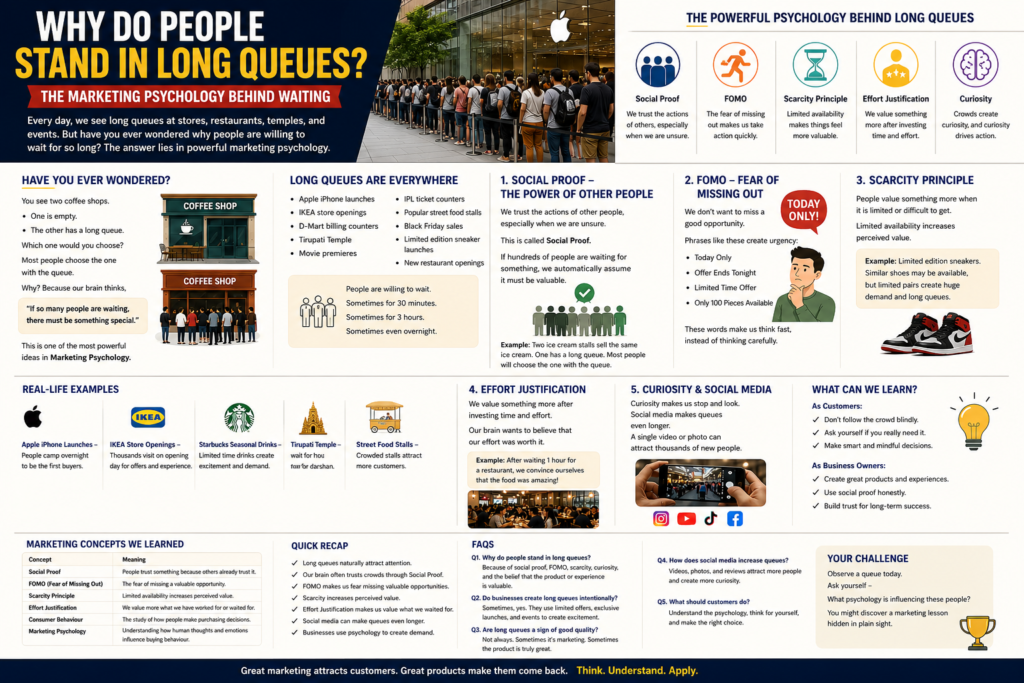
Have you ever walked past two coffee shops located right next to each other?
One café is almost empty. The other has a long queue stretching outside the entrance.
Without reading the menu, checking online reviews, or asking anyone for recommendations, which café would you choose?
For most of us, the answer is surprisingly predictable.
We instinctively walk towards the café with the longer queue.
But why?
How can a line of strangers influence our decision before we’ve even tasted the coffee?
The answer lies in Marketing Psychology—the fascinating study of how human thoughts, emotions, and social influences shape our buying decisions.
Every day, we make hundreds of choices about what to buy, where to eat, which movie to watch, or even which mobile phone to purchase.
While we like to believe these decisions are completely rational, the truth is that many are quietly influenced by the behaviour of people around us.
A long queue is more than just a group of people waiting.
It sends a powerful message.
“If so many people are willing to wait, this place must be worth it.”
That single thought influences millions of purchasing decisions every day.
Sometimes people don’t choose a product because it’s objectively the best.
They choose it because other people have already chosen it.
Table of Contents
- Why Do We Join Long Queues?
- The Psychology Behind Why We Follow Crowds
- Fear of Missing Out (FOMO) and the Scarcity Principle
- Why Long Queues Influence Our Decisions
- How Businesses Use Queue Psychology to Attract Customers
- Marketing Lessons We Can Learn from Long Queues
- Frequently Asked Questions (FAQs)
- Final Thoughts
Why Do We Join Long Queues?
Imagine we’re spending a weekend at a busy shopping mall.
As we walk through the food court, we notice two coffee shops located side by side.
The first café has plenty of empty seats.
Customers can walk in, order immediately, and enjoy their coffee without waiting.
The second café is completely different.
A long queue stretches outside the entrance.
People are patiently waiting for their turn.
Some are checking their phones.
Others are chatting with friends.
Despite the wait, more people continue joining the line.
Without knowing anything about either café, which one would you choose?
Most of us would naturally be drawn toward the crowded café.
Not because we’ve compared the menu.
Not because someone recommended it.
And certainly not because we’ve already tasted the coffee.
Instead, our brain quietly reaches a simple conclusion.
“If so many people are willing to wait, there must be something special about this place.”
That simple assumption is one of the most powerful psychological shortcuts our brain uses every day.
It helps us make decisions quickly without carefully analysing every available option.
Although this shortcut often saves us time, it also explains why crowds have such a strong influence on our choices.
And coffee shops are just the beginning.
Long Queues Are Everywhere
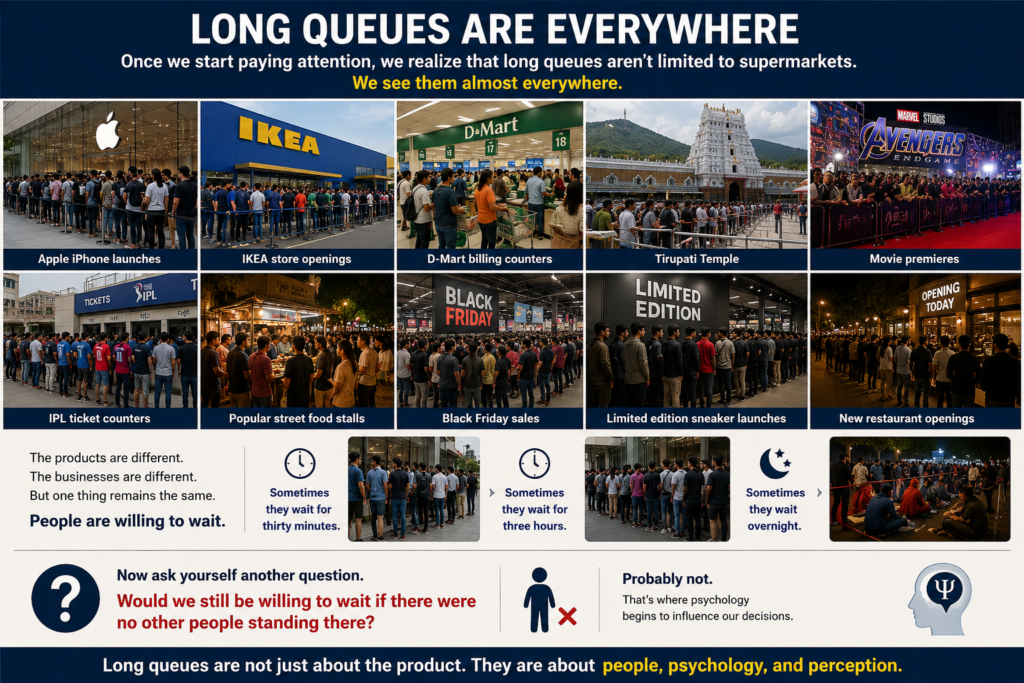
Once we begin paying attention, we realise that queues are part of our everyday lives.
We see them almost everywhere.
Outside Apple Stores during a new iPhone launch.
At IKEA store openings.
At D-Mart billing counters on weekends.
At Tirupati Temple during festival seasons.
Outside cinemas on the first day of a blockbuster movie.
At IPL ticket counters.
Near famous street food stalls.
During Black Friday sales.
Outside stores selling limited-edition sneakers.
And even outside newly opened restaurants.
Although these businesses belong to completely different industries, they all have one thing in common.
People are willing to wait.
Sometimes it’s only fifteen minutes.
Sometimes it’s an hour.
And sometimes people wait overnight.
Now ask yourself another question.
If those same stores were completely empty, would they feel equally attractive?
For many of us, the answer is probably no.
The crowd itself changes how we perceive the business.
A long queue makes us curious.
It suggests popularity.
It signals trust.
And without realising it, it increases the perceived value of the product or experience.
That’s why understanding long queues isn’t just about understanding customer behaviour.
It’s about understanding human psychology.
The Psychology Behind Why We Follow Crowds
Have you ever travelled to a new city and searched for a place to have lunch?
Imagine finding two restaurants on the same street.
One restaurant is almost empty.
The other has a long queue of customers waiting outside.
Without knowing anything about either restaurant, which one would you choose?
For most people, the answer is simple.
The crowded one.
But have you ever stopped to think about why?
Nobody told you the food was better.
You didn’t compare the menus.
You didn’t check Google reviews.
Yet your brain quietly whispered,
“If so many people are choosing this restaurant, it must be good.”
This natural tendency to follow the crowd is one of the most powerful psychological principles in marketing.
Businesses have understood it for decades.
And marketers even have a name for it.
What Is Social Proof?
Social Proof is the tendency to copy the actions of other people, especially when we’re uncertain about what decision to make.
Instead of spending hours researching every option, our brain looks for clues from those around us.
If hundreds of people are buying a product, we assume it must be worth buying.
If thousands of customers leave positive reviews, we believe the business is trustworthy.
If a restaurant is always full, we naturally assume the food must be delicious.
Our brain uses other people’s decisions as a shortcut for making our own.
Most of the time, this shortcut helps us make quicker decisions.
However, businesses also understand how influential this behaviour can be.
That’s why Social Proof has become one of the most widely used marketing strategies in the world.
A Simple Ice Cream Stall Experiment
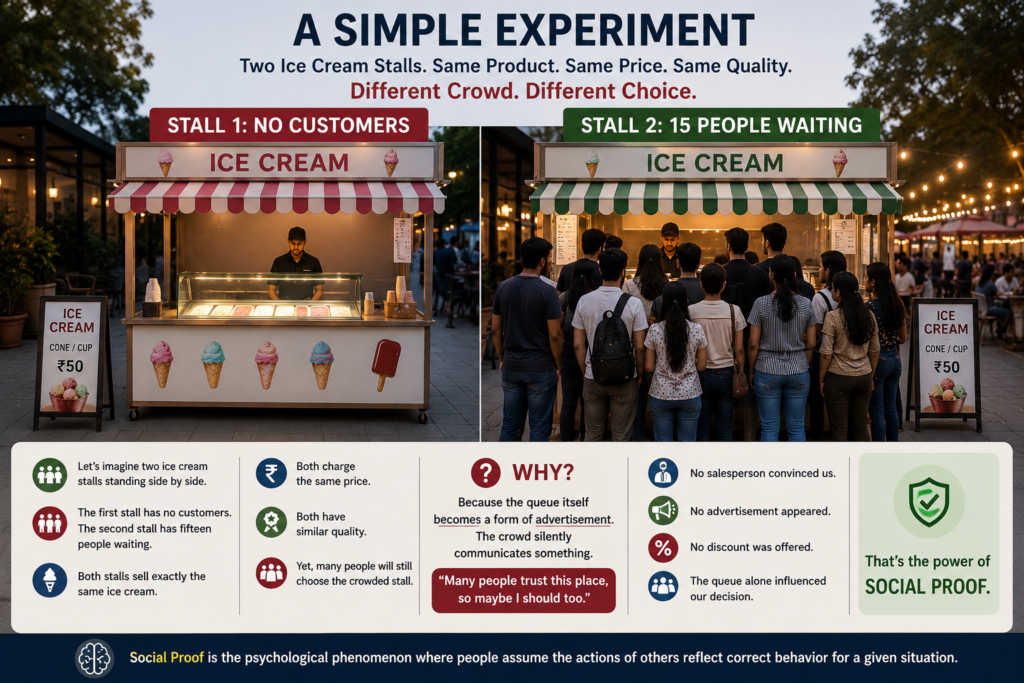
Let’s imagine two ice cream stalls standing side by side.
Both sell exactly the same flavours.
Both charge the same price.
Both offer the same quality.
The only difference is this:
One stall has no customers.
The other has fifteen people waiting in line.
Which stall do you think most people will choose?
For many of us, the answer is obvious.
We’ll naturally walk toward the crowded stall.
Why?
Because the queue itself becomes a powerful advertisement.
Without saying a single word, it sends a message.
“Many people trust this place. Maybe I should too.”
Notice something interesting.
No salesperson convinced us.
There were no flashy advertisements.
No discounts.
No special offers.
The crowd alone influenced our decision.
That’s the incredible power of Social Proof.
Why Brands Love Long Queues
Most customers think a queue is simply a sign that a business is busy.
Businesses see it very differently.
For them, every person standing in line becomes a walking advertisement.
Imagine walking past a newly opened restaurant.
A long queue stretches outside.
Immediately, questions begin appearing in your mind.
Why is everyone waiting?
Is the food really that good?
What are people ordering?
Should I try it too?
Without spending a single rupee on advertising, the restaurant has successfully captured your attention.
The queue creates curiosity.
Curiosity attracts more people.
More people create an even longer queue.
Soon, the crowd begins attracting even bigger crowds.
This is exactly why marketers often say,
“People attract people.”
Real-Life Example: Apple’s iPhone Launches
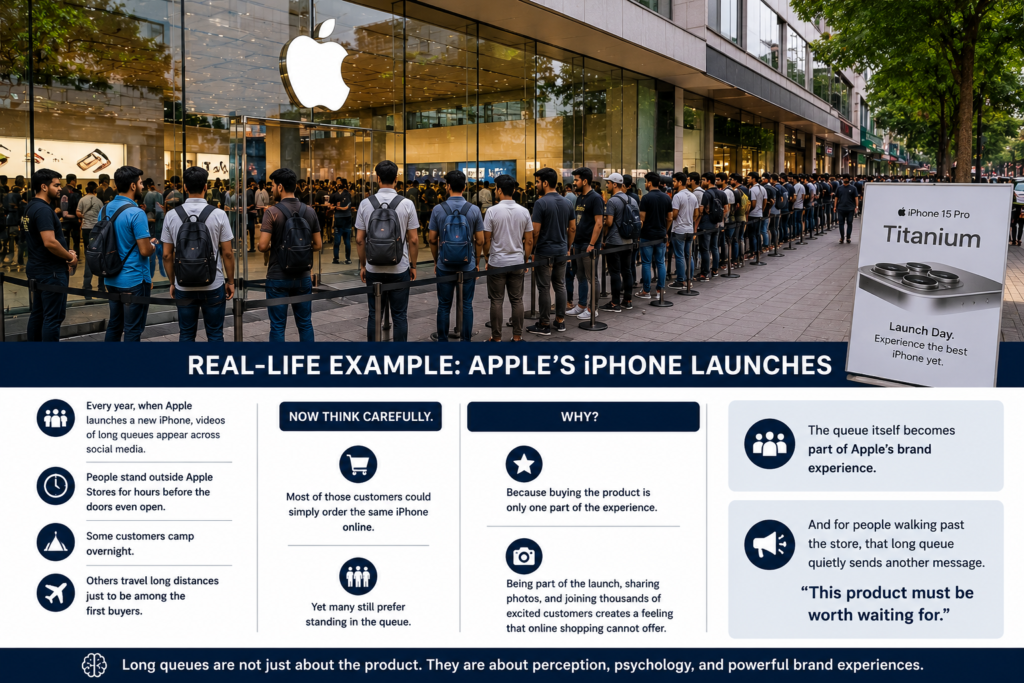
Every year, whenever Apple launches a new iPhone, something fascinating happens.
Long before the stores open, customers begin lining up outside Apple Stores.
Some arrive early in the morning.
Others camp overnight.
Many travel long distances just to be among the first buyers.
But here’s an interesting question.
Why do they wait?
After all, they could simply order the same iPhone online from the comfort of their homes.
The answer goes beyond buying a phone.
For many customers, standing in the queue becomes part of the experience.
They’re not just purchasing a product.
They’re participating in an event.
They take photos.
Record videos.
Share their excitement on social media.
Celebrate being among the first owners.
Meanwhile, everyone walking past the Apple Store notices the long queue.
Without reading a single advertisement, they receive a powerful message.
“This product must be worth waiting for.”
That’s the beauty of Social Proof.
The customers themselves become the marketing campaign.
Fear of Missing Out (FOMO) and the Scarcity Principle
Social Proof explains why we follow the crowd.
But it isn’t the only reason people willingly stand in long queues.
Another powerful psychological force quietly influences our decisions every day.
It’s called Fear of Missing Out, or simply FOMO.
Imagine walking through a shopping mall.
A clothing store has a huge crowd gathered outside.
A bright banner reads:
“Today Only – Flat 70% OFF.”
You had no intention of shopping.
You don’t even need new clothes.
Yet suddenly, you find yourself slowing down.
Your curiosity increases.
Your brain starts asking,
“What if I miss a great deal?”
That single question is enough to change your behaviour.
Welcome to the psychology of FOMO.
What Is Fear of Missing Out (FOMO)?
Fear of Missing Out is the feeling that other people might be enjoying an opportunity that we’re about to lose.
Interestingly, we don’t always buy because we need something.
Sometimes, we buy because we don’t want to regret missing the opportunity.
That’s why marketing phrases like these immediately capture our attention:
- Today Only
- Limited Time Offer
- Offer Ends Tonight
- Exclusive Launch
- Members Only
- Only 100 Pieces Available
These messages don’t just provide information.
They create urgency.
Instead of thinking carefully, our brain begins thinking quickly.
And that’s exactly what marketers want.
Why Limited-Time Offers Create Long Queues
Have you ever noticed people waiting outside stores before they even open?
This happens during events such as:
- Black Friday Sales
- Big Billion Days
- Grand Opening Offers
- Festival Discounts
- Limited Edition Product Launches
Now imagine two announcements.
Announcement One
“This discount is available throughout the year.”
Announcement Two
“Offer Ends Today at 9 PM.”
Which one makes you feel more excited?
Almost everyone chooses the second.
Why?
Because deadlines create urgency.
When time feels limited, opportunities suddenly become more valuable.
Psychologists call this the Scarcity Principle.
What Is the Scarcity Principle?
The Scarcity Principle explains that people tend to value something more when they believe it’s limited or difficult to obtain.
The product itself hasn’t changed.
Only its availability has changed.
Yet our brain immediately responds.
“If it’s becoming scarce, I should get it before it’s gone.”
This is why businesses often combine scarcity with FOMO.
Together, they create a powerful motivation to act quickly.
Real-Life Example: Limited Edition Sneakers
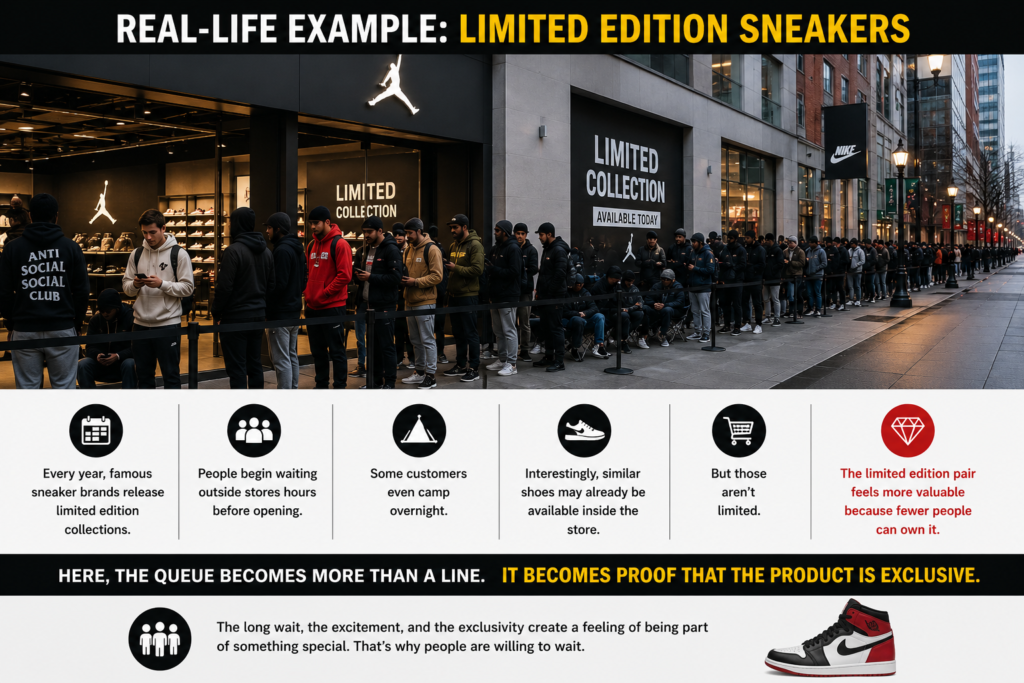
Every year, leading sneaker brands release limited-edition collections.
Customers begin waiting outside stores hours before opening.
Some even camp overnight.
What’s interesting is that similar shoes are already available inside the store.
But those shoes aren’t exclusive.
The limited-edition pair feels more valuable simply because fewer people can own it.
The queue itself becomes proof of exclusivity.
The longer the queue, the more desirable the product appears.
Sometimes, people don’t just buy the shoes.
They buy the feeling of owning something rare.
That’s the power of scarcity.
Real-Life Example: IKEA Store Openings
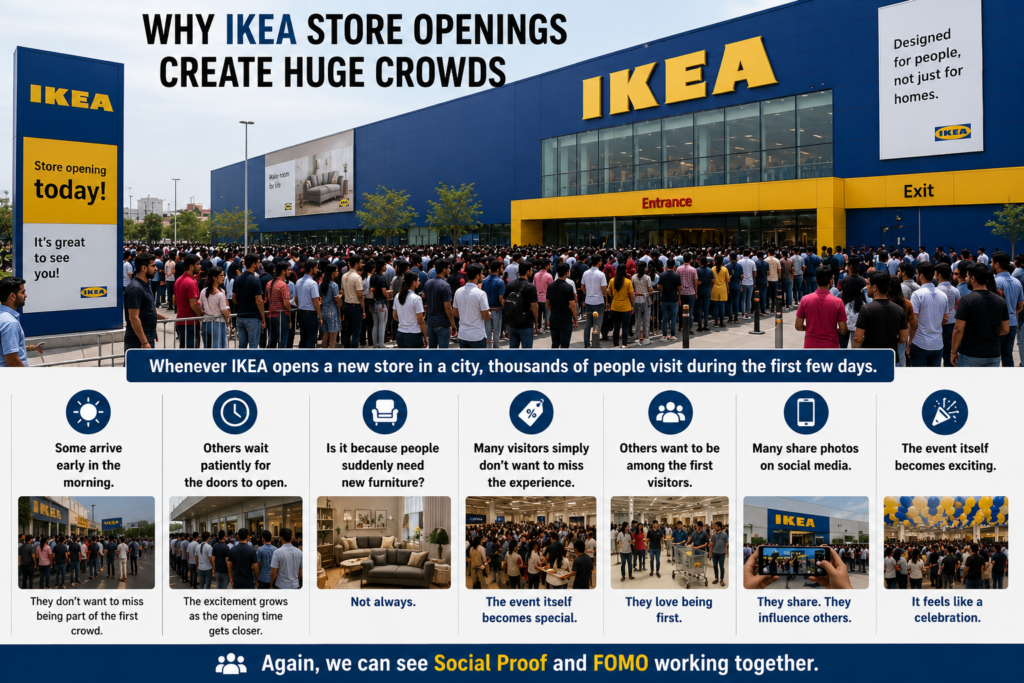
Whenever IKEA opens a new store in a city, something remarkable happens.
Thousands of people begin arriving long before the doors open.
Some reach the store early in the morning.
Others patiently wait in line for hours.
At first glance, it may seem as though everyone urgently needs new furniture.
But that’s rarely the real reason.
Many visitors simply don’t want to miss the experience.
Some are attracted by exclusive opening-day offers.
Others want to be among the first customers to explore the new store.
Many take photos and share their experience on social media.
The event itself becomes exciting.
In this situation, Social Proof and Fear of Missing Out (FOMO) work together.
The growing crowd creates curiosity, while the limited-time experience creates urgency.
Together, they transform an ordinary store opening into a memorable event.
Starbucks and the Power of Seasonal Products
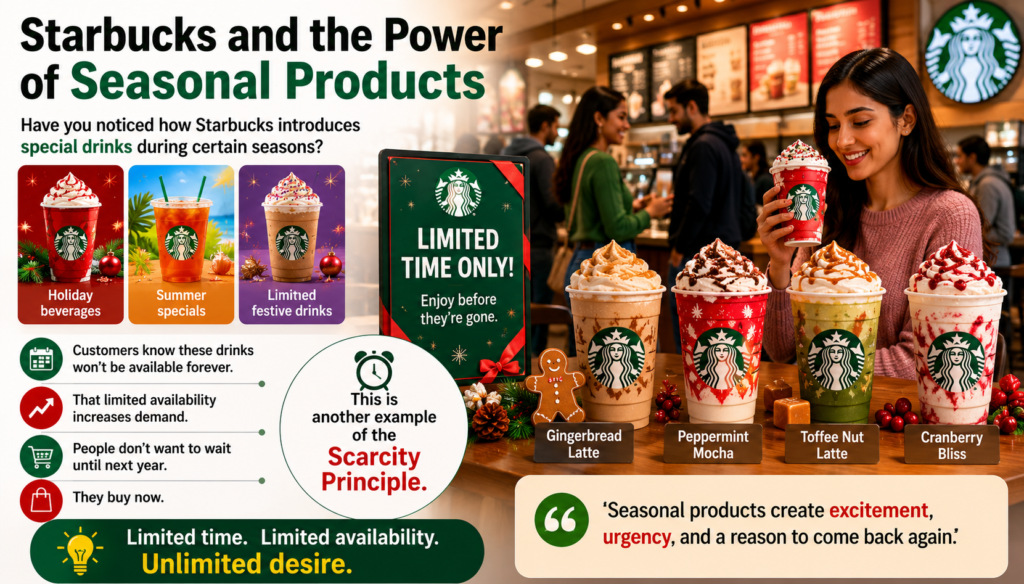
Have you ever noticed that Starbucks introduces special drinks during particular times of the year?
Holiday beverages.
Summer specials.
Festive favourites.
These drinks aren’t available throughout the year.
Customers know they’ll disappear after the season ends.
That limited availability makes them feel more valuable.
Many people buy them immediately—not because they’re thirsty, but because they don’t want to wait until next year.
Once again, we see the Scarcity Principle in action.
The product hasn’t become better simply because it’s seasonal.
Its limited availability changes how people perceive its value.
This simple strategy helps Starbucks create excitement every year without changing its core products.
Why Long Queues Influence Our Decisions
By now, we’ve discovered that Social Proof, FOMO, and Scarcity all encourage people to join long queues.
But there’s another fascinating question.
Why do we trust a crowd more than a business advertisement?
Imagine seeing a large billboard that proudly says,
“Our restaurant serves the best food in the city.”
Now imagine walking past that same restaurant and seeing fifty people patiently waiting outside.
Which feels more convincing?
For most of us, the answer is obvious.
The crowd.
Why?
Because advertisements are created by businesses.
Crowds are created by customers.
And human beings naturally trust the actions of other people more than promotional messages.
That’s why customer reviews, testimonials, ratings, and user-generated content have become some of the most powerful marketing tools in the world.
People trust people.
The Queue Creates Curiosity
Think about your own experience.
Have you ever slowed down while walking past a crowded food stall?
Perhaps you looked at the menu.
Maybe you searched for online reviews.
Or perhaps you simply joined the queue.
Something about the crowd captured your attention.
The business didn’t stop you.
Nobody invited you inside.
The queue did all the work.
That’s because curiosity is one of the strongest human emotions.
Whenever we notice a large group of people gathered in one place, our brain immediately begins asking questions.
What’s happening?
Why is everyone waiting?
Am I missing something?
Those questions naturally pull us closer.
That’s why marketers often say,
“Curiosity is the first step toward customer engagement.”
Why Does Waiting Make Something Feel More Valuable?
Now let’s explore another fascinating psychological principle.
Imagine two restaurants.
In the first restaurant, you walk in, immediately find a table, and your meal arrives within five minutes.
Everything is quick and convenient.
Now imagine visiting another restaurant.
You wait outside for forty-five minutes.
After finally getting a table, you wait another twenty minutes before your food arrives.
Here’s the surprising question.
Which experience are you more likely to remember?
Interestingly, many people remember the second experience more positively.
Not necessarily because the food tasted better.
But because they invested more time and effort to enjoy it.
Psychologists call this Effort Justification.
What Is Effort Justification?
Effort Justification is the tendency to value something more after investing significant time, effort, or energy to obtain it.
Our brain dislikes believing that we’ve wasted our effort.
So after waiting in a long queue, we naturally convince ourselves that the experience was worth it.
This happens automatically.
Without even realising it, our perception changes.
The waiting itself increases the value we assign to the experience.
This explains why some restaurants, attractions, and events become even more memorable simply because people had to wait for them.
Real-Life Example: Waiting for Famous Street Food
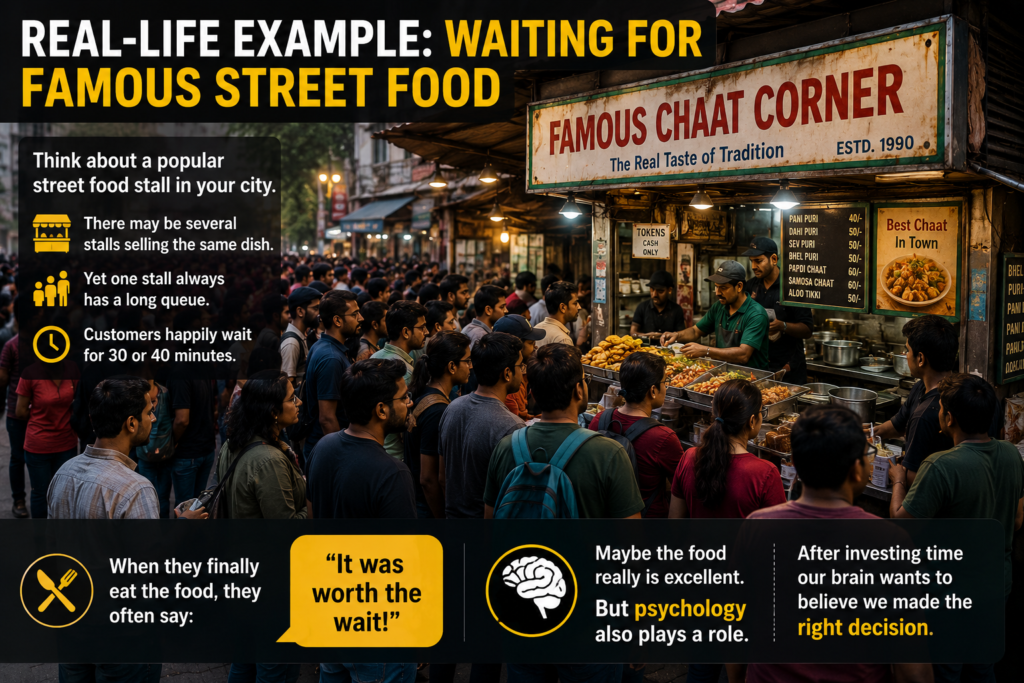
Almost every city has at least one famous street food stall that always has a long queue.
Interestingly, several nearby stalls may sell exactly the same dish.
Yet one stall consistently attracts larger crowds.
Customers happily wait thirty or even forty minutes.
When they finally receive their food, many proudly say,
“It was worth the wait.”
Perhaps the food really is exceptional.
But psychology also plays an important role.
After investing valuable time, our brain wants to believe we made the right decision.
The longer we wait, the stronger that feeling often becomes.
This is Effort Justification in everyday life.
Why Do Theme Parks Have Long Queues?
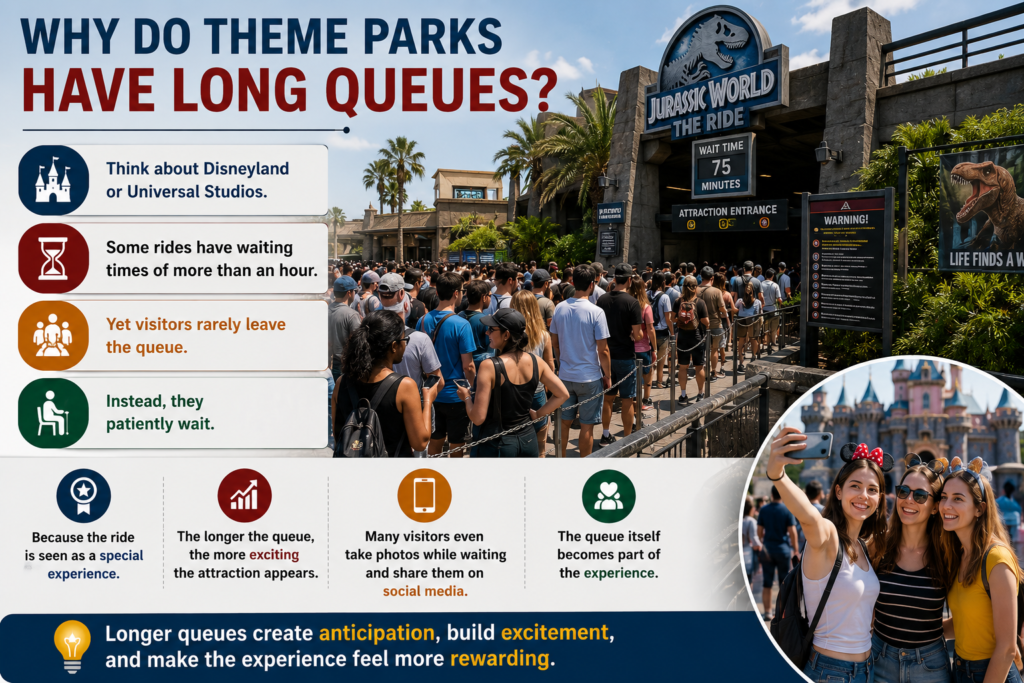
Think about famous theme parks such as Disneyland or Universal Studios.
Some attractions have waiting times of more than an hour.
Yet very few visitors leave the queue.
Instead, they patiently continue waiting.
Why?
Because the attraction feels special.
The longer the queue becomes, the more exciting the ride appears.
Visitors often take photographs while waiting.
They post updates on social media.
They talk about the experience with friends.
The queue itself becomes part of the adventure.
In other words, people aren’t simply waiting for a ride.
They’re becoming part of an experience that they’ll remember long after the day is over.
This perfectly demonstrates how Social Proof, anticipation, and Effort Justification work together to increase the perceived value of an experience.
How Businesses Use Queue Psychology to Attract Customers
The psychology behind long queues isn’t limited to physical stores anymore.
Today, social media has made queues even more powerful.
Years ago, only people walking past a shop could see a long line of customers.
Today, a single Instagram Reel, YouTube Short, or TikTok video can show that same queue to millions of people within hours.
Imagine watching a short video with the caption:
“People have been waiting here for three hours just to try this burger!”
Even if you’ve never heard of that restaurant before, your curiosity immediately increases.
You begin wondering:
What’s so special about this place?
Is it really worth waiting for?
Should I visit too?
Without spending money on traditional advertising, that business has successfully captured your attention.
The queue becomes the advertisement.
Why We Feel Curious When We See a Crowd
Curiosity is one of the strongest emotions that influence human behaviour.
Whenever we notice a large group of people gathered in one place, our brain automatically asks questions.
- What’s happening here?
- Why are so many people waiting?
- Am I missing something?
- Should I find out?
Notice something interesting.
The business didn’t ask you to stop.
The crowd did.
That’s why marketers love creating experiences that naturally attract attention.
Because curiosity brings people closer.
And once people become curious, they’re far more likely to become customers.
Do Businesses Intentionally Create Long Queues?
This is one of the most common questions people ask.
The answer is…
Sometimes, yes.
Successful businesses understand that visible demand increases perceived value.
That’s why many brands use strategies such as:
- Limited product launches.
- Exclusive opening-day events.
- Early access for selected customers.
- Releasing products in small quantities.
- Timed promotions and special offers.
The objective isn’t simply to make customers wait.
The goal is to create excitement, exclusivity, and conversation.
However, successful businesses also understand an important balance.
If customers wait too long without receiving value, excitement quickly turns into frustration.
That’s why great brands don’t create queues for the sake of creating queues.
They create experiences worth waiting for.
Do Long Queues Always Mean Quality?
Not necessarily.
A long queue often signals popularity.
But popularity doesn’t always guarantee quality.
Sometimes the product genuinely is exceptional.
Sometimes excellent marketing creates high demand.
And sometimes it’s a combination of both.
As customers, we should enjoy discovering popular places.
But we should also make our own decisions rather than assuming the crowd is always right.
Understanding psychology helps us make smarter choices instead of simply following everyone else.
Marketing Lessons We Can Learn from Long Queues
By now, it’s clear that long queues are about much more than waiting.
They reveal how people think, feel, and make decisions.
Whether you’re a customer, entrepreneur, marketer, or business owner, there are valuable lessons hidden inside every queue.
People Trust People More Than Advertisements
Imagine seeing a billboard claiming,
“We’re the best restaurant in town.”
Now imagine seeing fifty customers happily waiting outside that same restaurant.
Which one would you believe?
For most people, the crowd is far more convincing.
That’s because real people create trust.
Advertisements create awareness.
Trust leads to action.
This is why businesses encourage:
- Customer reviews.
- Testimonials.
- Ratings.
- User-generated content.
- Customer photos and videos.
People influence people.
Curiosity Is One of the Strongest Marketing Tools
Curiosity captures attention before logic has a chance to respond.
Whenever people notice something unusual, they naturally want to investigate.
A crowded restaurant.
A long queue.
A sold-out product.
An exclusive event.
Each one quietly asks the same question.
“What am I missing?”
Businesses that successfully create curiosity often attract attention without spending large amounts on advertising.
Scarcity Increases Perceived Value
People naturally value opportunities that appear limited.
Whether it’s:
- Limited-edition sneakers.
- Holiday drinks at Starbucks.
- Black Friday sales.
- Opening-day offers.
Scarcity makes products feel more valuable.
Not because the product changed.
But because the opportunity feels temporary.
Great Experiences Become Great Marketing
The most successful businesses don’t rely only on advertising.
Instead, they create experiences that customers naturally want to share.
Think about Apple launches.
Popular street food stalls.
Theme parks.
New restaurant openings.
People don’t just buy the product.
They talk about the experience.
Word-of-mouth remains one of the most powerful forms of marketing ever created.
Psychology Influences Everyday Decisions
Many of our daily decisions happen automatically.
Understanding concepts such as:
- Social Proof
- Fear of Missing Out (FOMO)
- Scarcity
- Effort Justification
helps us recognise why we make certain choices.
Once you understand these principles, you’ll begin noticing them everywhere—from supermarkets and restaurants to online shopping and social media.
What Can We Learn as Customers?
The next time you notice a long queue, pause before joining it.
Ask yourself:
- Am I buying because I genuinely want this product?
- Or because everyone else is buying it?
- Would I still make the same decision if there were no queue?
These simple questions help us become more mindful consumers.
What Can We Learn as Business Owners?
If you’re an entrepreneur, marketer, or small business owner, this psychology offers valuable lessons.
Focus on creating products that genuinely solve problems.
Deliver experiences people enjoy sharing.
Encourage honest customer reviews.
Use Social Proof ethically.
Create excitement without misleading customers.
Remember this:
Great marketing attracts customers.
Great products keep them coming back.
Frequently Asked Questions (FAQs)
Why do people stand in long queues?
People often join long queues because they believe the product or experience is valuable. Psychological principles such as Social Proof, Fear of Missing Out (FOMO), Scarcity, and Curiosity strongly influence these decisions.
What is Social Proof in marketing?
Social Proof is the tendency to trust a product, service, or business because many other people have already chosen it. We often use other people’s actions as a shortcut for making our own decisions.
Do businesses intentionally create long queues?
Sometimes.
Businesses may use limited launches, exclusive events, or early-access offers to increase excitement and demand. However, successful businesses focus on delivering value rather than making customers wait unnecessarily.
Why do long queues make products seem more valuable?
Long queues signal popularity and increase curiosity. People often assume that if others are willing to wait, the product or experience must be worth it.
Can social media make queues even longer?
Yes.
Videos, customer posts, influencer content, and viral trends can expose a queue to millions of people, creating even greater curiosity and attracting more visitors.
Final Thoughts
The next time you walk past a crowded restaurant, a busy shopping mall, or a newly opened store with a long queue outside, take a moment to observe what’s really happening.
You’re not simply looking at people waiting.
You’re witnessing psychology in action.
Every queue tells a story.
It creates curiosity.
Builds trust.
Signals popularity.
Increases perceived value.
And sometimes encourages complete strangers to join without knowing anything about the product.
That’s the remarkable power of Marketing Psychology.
Whether you’re a customer trying to make better purchasing decisions or a business owner looking to build stronger customer relationships, understanding these psychological principles gives you a valuable advantage.
Because the most effective marketing doesn’t always rely on expensive advertisements.
Sometimes, it begins with something as simple as a line of people waiting patiently outside a store.
The next time you find yourself joining a queue, ask yourself one simple question:
“Am I waiting because the product is truly exceptional—or because the crowd convinced me that it must be?”
The answer might surprise you.
“People don’t always join long queues because a product is the best. Sometimes they join because seeing others wait convinces them it’s worth waiting for.”
We’d Love to Hear From You
Have you ever waited in a long queue for a restaurant, product launch, movie, temple, or special event?
What made you wait?
Was it the quality of the product…
The excitement of the experience…
Or simply the fact that everyone else was waiting?
Share your thoughts and experiences in the comments below.
Your story might help someone else understand the fascinating psychology behind everyday decisions.