Have you ever bought a product simply because a website displayed “Only 2 Hours Left!” or “Offer Ends Tonight!”?
Perhaps you weren’t even planning to make a purchase.
You were just browsing.
But suddenly, the countdown timer made the decision feel urgent.
Instead of thinking,
“I’ll think about it later,”
you found yourself clicking “Buy Now.”
If this has happened to you, you’re not alone.
Every day, millions of people make purchasing decisions because of limited-time offers.
Whether it’s an online shopping sale, a restaurant discount, a travel booking, or a streaming subscription, businesses use these promotions to encourage customers to act quickly.
But have you ever wondered why these offers are so effective?
The answer lies in Consumer Psychology.
Businesses understand that people don’t always make buying decisions based purely on logic.
Our emotions, fears, and perceptions often play a much bigger role.
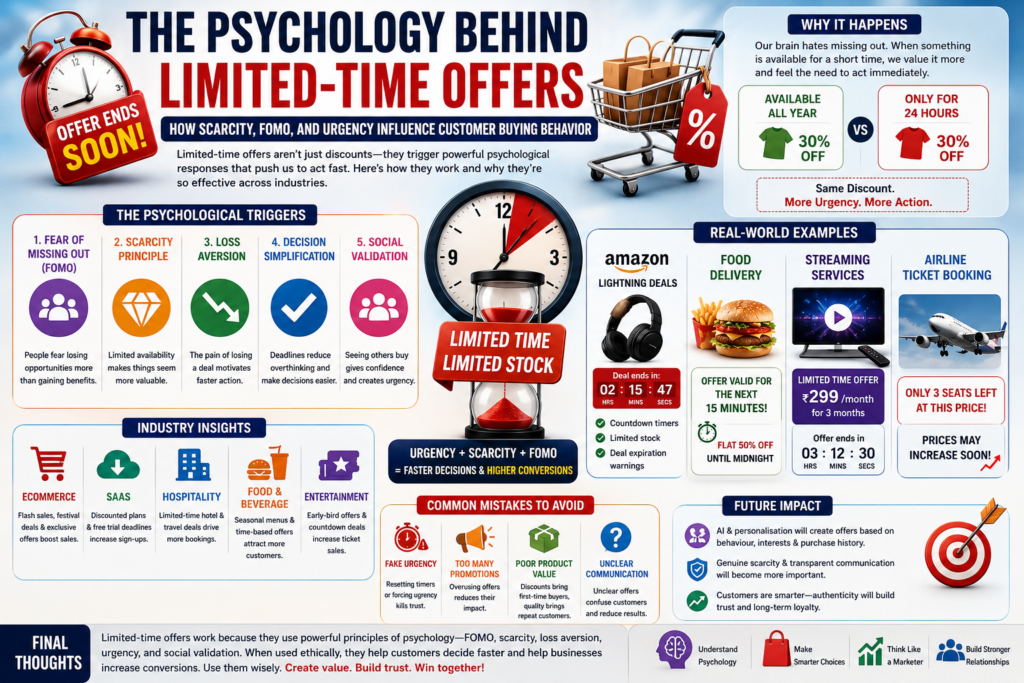
That’s why marketers use psychological principles such as Scarcity, Fear of Missing Out (FOMO), Loss Aversion, and Urgency to influence customer buying behavior.
A simple countdown timer or a message saying “Only 3 Items Left” can completely change how we perceive a product.
It doesn’t change the product itself.
It changes how we feel about missing the opportunity.
Table of Contents
- Introduction: Why Limited-Time Offers Are So Effective
- The Psychology Behind Limited-Time Offers
- Real-World Examples of Limited-Time Offers
- How Different Industries Use Limited-Time Offers
- Common Mistakes Businesses Make with Limited-Time Offers
- The Future of Limited-Time Offers
- What Can We Learn from Limited-Time Offers?
- Frequently Asked Questions (FAQs)
Introduction: Why Limited-Time Offers Are So Effective
Imagine you’re shopping online for a pair of running shoes.
After comparing several brands, you decide to think about it and come back later.
Just as you’re about to leave the website, a message appears on your screen.
“30% OFF – Offer Ends in 2 Hours!”
Suddenly, your thinking changes.
A few moments ago, buying the shoes didn’t feel urgent.
Now, it feels like you might lose a valuable opportunity.
Instead of asking,
“Do I really need these shoes?”
your brain begins asking,
“What if I miss this discount?”
Nothing about the product has changed.
The price hasn’t become lower than it was a few seconds ago.
The only difference is the deadline.
Yet that small change often influences our decision.
Now imagine another situation.
Two clothing stores are offering exactly the same discount.
Store A
Offers 30% off throughout the year.
Store B
Offers 30% off for the next 24 hours only.
Although both stores provide the same savings, most people feel more excited about Store B.
Why?
Because the second offer creates a sense of urgency.
Our brain naturally places a higher value on opportunities that appear temporary.
Instead of thinking,
“I can always buy it later,”
we begin thinking,
“I should act before it’s too late.”
This shift in thinking is exactly what businesses hope to create.
It’s one of the most effective marketing strategies because it encourages customers to make decisions faster.
But urgency alone isn’t the reason these promotions work so well.
Behind every successful limited-time offer are powerful psychological principles that have been studied for decades.
Understanding these principles helps us see why countdown timers, flash sales, and limited-period discounts influence millions of purchasing decisions every day.
The Psychology Behind Limited-Time Offers
By now, we’ve seen how a simple deadline can change the way we think about buying a product.
But why does this happen?
After all, the product hasn’t changed.
The price may not have changed either.
Only the time available to make the purchase has changed.
Yet somehow, the offer suddenly feels more valuable.
The answer lies in Consumer Psychology.
Businesses understand that purchasing decisions are often driven by emotions rather than logic.
Instead of carefully analysing every option, our brains rely on psychological shortcuts that help us make quick decisions.
Limited-time offers take advantage of several of these psychological principles.
Let’s explore the most important ones.
Fear of Missing Out (FOMO)
One of the strongest reasons limited-time offers work is Fear of Missing Out, commonly known as FOMO.
FOMO is the feeling that we might lose an opportunity if we don’t act immediately.
Imagine you’re browsing an online store and see this message:
“Offer Ends Tonight!”
Suddenly, your attention shifts.
Instead of thinking about whether you need the product, your brain starts thinking about what you might lose if you don’t buy it.
This emotional shift encourages faster decision-making.
Interestingly, many purchases influenced by FOMO aren’t based on necessity.
They’re based on the fear of future regret.
People often buy because they don’t want to say,
“I should have bought it when it was on sale.”
That fear of regret is one of the most powerful motivators in marketing.
Why FOMO Works
Human beings naturally dislike missing opportunities.
Whether it’s a discount, an exclusive event, or a limited-edition product, our brains place greater value on things that appear temporary.
This is why messages such as:
- Offer Ends Today
- Limited-Time Only
- Flash Sale
- Only a Few Hours Left
immediately capture our attention.
These phrases don’t change the product.
They change our perception of the opportunity.
The shorter the deadline, the greater the urgency often feels.
As a result, customers spend less time delaying their decision and are more likely to complete the purchase.
The Scarcity Principle
Another powerful psychological concept behind limited-time offers is the Scarcity Principle.
The Scarcity Principle states that people assign greater value to things that are rare, limited, or difficult to obtain.
Psychologist Robert Cialdini, one of the world’s leading experts on influence and persuasion, identified scarcity as one of the key principles that shape human decision-making.
Think about these two situations.
Situation One
A product is available all year.
Situation Two
The same product is available for the next 24 hours only.
Which one feels more valuable?
For most people, it’s the second option.
The product hasn’t changed.
Only its availability has.
Yet our brain immediately perceives it as more desirable.
Scarcity creates importance.
And importance encourages action.
How Scarcity Influences Customer Buying Behavior
Scarcity changes the way customers evaluate opportunities.
When people believe a product may no longer be available later, they naturally become more motivated to buy it now.
This explains why businesses frequently display messages like:
- Only 5 Items Left
- Limited Stock Available
- Exclusive Edition
- Available While Supplies Last
These messages don’t simply provide information.
They create urgency.
Customers begin focusing on what they might lose rather than what they might gain.
That emotional response often speeds up purchasing decisions.
Loss Aversion
Closely connected to scarcity is another fascinating principle called Loss Aversion.
Behavioral economists discovered that people experience the pain of losing something more intensely than the pleasure of gaining something of equal value.
In simple terms, losing ₹1,000 usually feels worse than finding ₹1,000 feels good.
Businesses use this insight in their marketing.
When customers see a message like:
“You’ll lose this discount if you don’t purchase today.”
their attention immediately shifts toward avoiding that loss.
Rather than thinking about saving money, they think about losing the opportunity to save money.
This subtle difference has a surprisingly strong influence on buying decisions.
Real-World Examples of Loss Aversion
You encounter Loss Aversion more often than you may realise.
For example:
- Flash sale discounts that expire at midnight.
- Limited coupon codes sent by email.
- Membership benefits that expire after a free trial.
- Seasonal discounts available for only a few days.
In each case, businesses encourage customers to act by highlighting what could be lost if no action is taken.
It’s not always the discount itself that motivates people.
Often, it’s the fear of missing the discount.
Decision Simplification
Have you ever delayed buying something because there were simply too many options?
This happens more often than we realise.
When customers face too many choices, they often postpone making a decision altogether.
Psychologists refer to this as Decision Fatigue.
Limited-time offers help reduce this problem.
Instead of spending days comparing every available option, customers have a clear deadline.
That deadline encourages them to make a decision.
Whether they buy or not, the choice feels simpler because the available time is limited.
This is why many businesses use limited-time promotions to improve conversion rates.
A deadline reduces hesitation.
And less hesitation often leads to more completed purchases.
Why Simpler Decisions Increase Sales
The easier a decision feels, the more likely customers are to take action.
Businesses understand that reducing complexity improves the overall buying experience.
A clear offer.
A clear deadline.
A clear discount.
Together, these elements make the decision feel straightforward.
Rather than overwhelming customers with endless choices, limited-time offers encourage them to focus on one opportunity at a time.
This simplicity often results in higher sales and better customer engagement.
Social Validation
Imagine visiting an online shopping website during a flash sale.
You notice a message saying:
“2,500 people purchased this item today.”
Immediately, your confidence in the product increases.
Why?
Because people naturally look to others when making decisions.
If many customers are buying something, we assume it must be valuable.
This psychological principle is known as Social Validation or Social Proof.
It reduces uncertainty and builds trust.
Instead of wondering whether the product is worth buying, customers feel reassured by seeing that many others have already chosen it.
The Role of Social Proof
Social Proof works especially well when combined with urgency.
Imagine seeing these messages together:
- Only 4 Items Left
- Offer Ends in 2 Hours
- Over 1,000 Customers Purchased Today
Each message reinforces the others.
Scarcity creates urgency.
FOMO creates emotional pressure.
Social Proof creates confidence.
Together, these psychological principles make limited-time offers incredibly persuasive.
And that’s why businesses across industries continue using them to influence customer buying behavior.
Real-World Examples of Limited-Time Offers
Limited-time offers aren’t just marketing theories discussed in business books.
They’re used every day by some of the world’s most successful companies to encourage faster purchasing decisions.
From online shopping platforms and food delivery apps to airlines and streaming services, businesses across industries rely on urgency, scarcity, and FOMO to influence customer behavior.
Let’s explore some real-world examples.
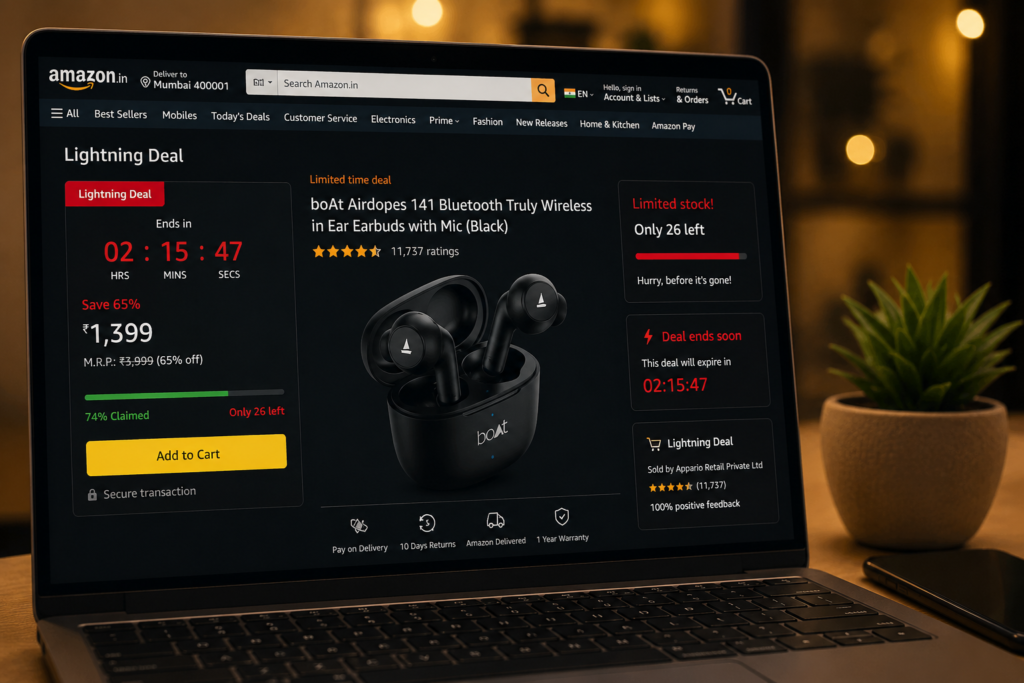
Amazon Lightning Deals
If you’ve ever shopped on Amazon, you’ve probably come across Lightning Deals.
These offers are available for only a short period and usually include:
- Countdown timers
- Limited stock notifications
- Deal expiration warnings
- Progress bars showing how many items have already been claimed
Imagine you’re browsing for wireless headphones.
You notice a message saying:
“Lightning Deal – Ends in 1 Hour 45 Minutes.”
Just below it, another message reads:
“Only 12% of stock remaining.”
Even if you weren’t planning to buy immediately, the combination of a countdown timer and limited stock makes the deal feel more valuable.
You begin thinking,
“If I wait, I might lose this discount.”
Amazon isn’t simply selling a product.
It’s creating urgency.
And that urgency often encourages customers to complete their purchase sooner rather than later.
Food Delivery Discounts
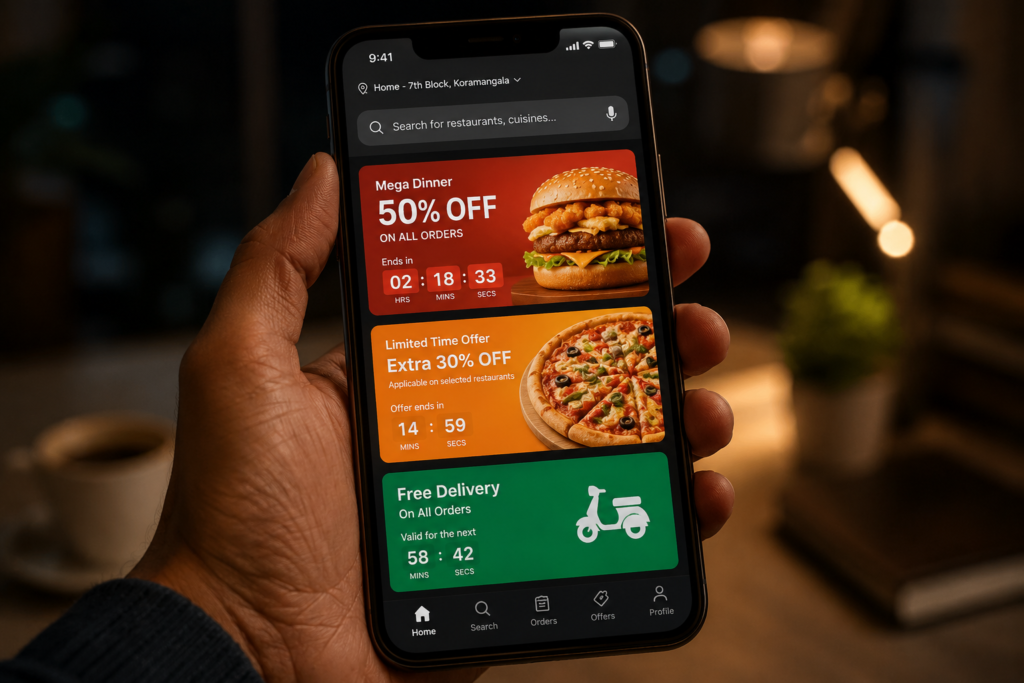
Food delivery platforms such as Swiggy, Zomato, and Uber Eats regularly use limited-time promotions to increase orders.
You may have seen notifications like:
- Flat 50% OFF until Midnight
- Offer Valid for the Next 15 Minutes
- Free Delivery for the Next Hour
These offers encourage customers to order immediately rather than postponing their meal.
Interestingly, many people weren’t originally planning to order food.
The deadline itself creates the motivation.
Instead of cooking at home or waiting until later, customers think,
“I should order now before the offer expires.”
That’s the power of urgency marketing.
Streaming Service Promotions
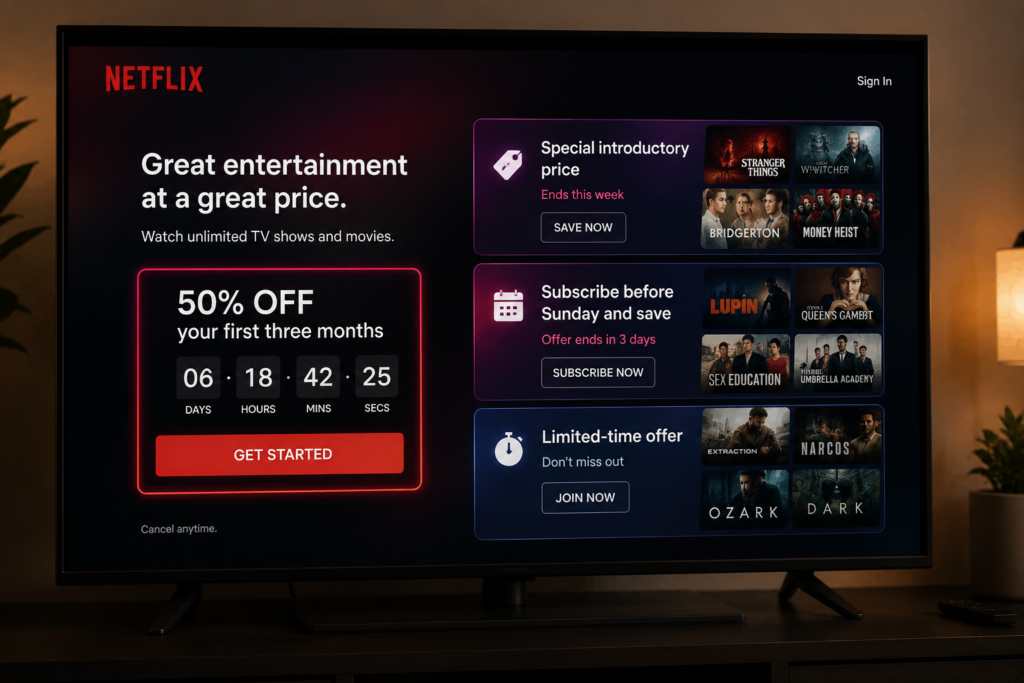
Streaming platforms also use limited-time offers to attract new subscribers.
For example, a platform may advertise:
- 50% OFF Your First Three Months
- Special Introductory Price – Ends This Week
- Subscribe Before Sunday and Save
These offers reduce hesitation for new customers.
Instead of delaying the decision, many people subscribe because they don’t want to miss the discounted pricing.
Once they become subscribers, many continue their membership even after the promotional period ends.
This strategy helps streaming companies acquire new customers while creating a sense of immediate value.
Airline Ticket Bookings
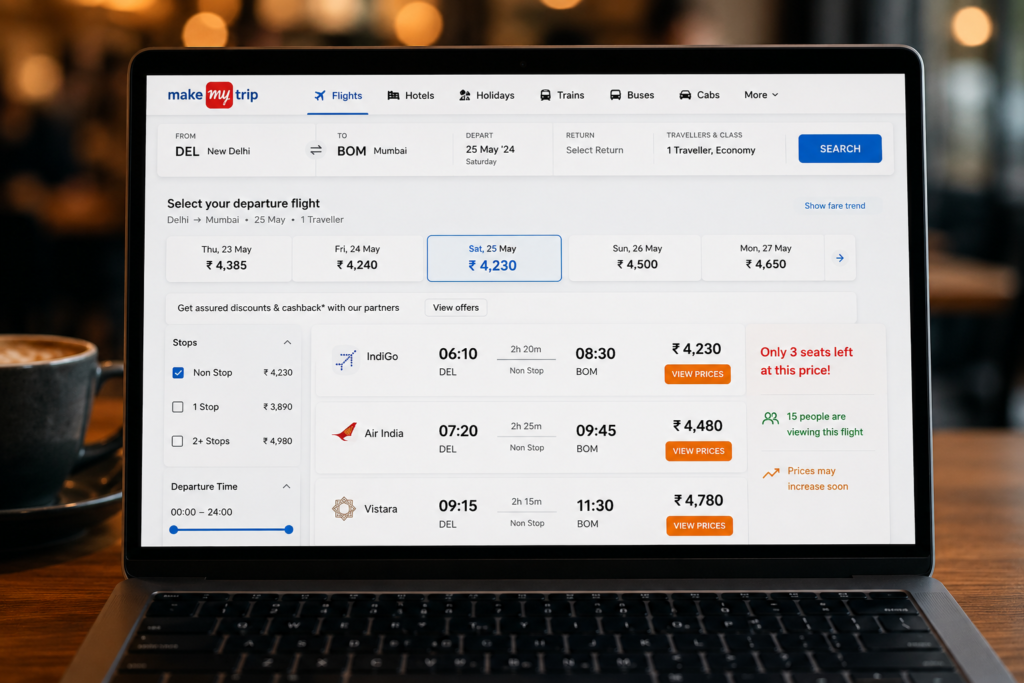
Airline websites are among the best examples of urgency marketing.
While booking a flight, you might see messages such as:
- Only 3 Seats Left at This Price
- 15 People Are Viewing This Flight
- Prices May Increase Soon
These notifications create urgency by suggesting that delaying the purchase could result in paying more later.
Even if ticket prices haven’t changed yet, customers often complete their booking immediately to avoid the possibility of losing the current fare.
This is a perfect example of Scarcity, Loss Aversion, and FOMO working together.
How Different Industries Use Limited-Time Offers
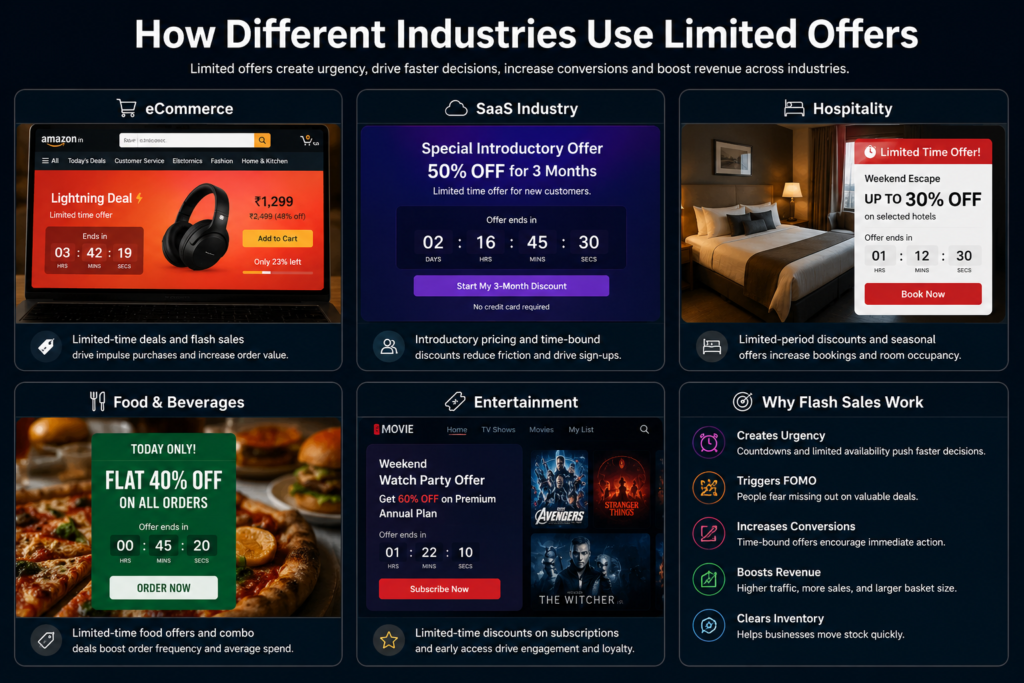
Limited-time offers are effective because they appeal to fundamental aspects of human psychology.
That’s why they’re used across almost every industry.
Although the products and services may differ, the psychological principles remain the same.
Let’s see how different industries apply these strategies.
eCommerce Industry
Online retailers rely heavily on urgency marketing.
Some of the most common examples include:
- Flash Sales
- Festival Discounts
- Members-Only Deals
- Limited-Time Coupon Codes
- Countdown Timers
These promotions encourage customers to make quicker purchasing decisions instead of delaying their shopping.
Many eCommerce businesses also combine urgency with personalized recommendations, making offers feel even more relevant.
Why Flash Sales Work
Flash sales are successful because they combine several psychological triggers at the same time.
Customers experience:
- Urgency because the offer expires soon.
- Scarcity because stock appears limited.
- Social Proof because thousands of people are shopping during the sale.
- Loss Aversion because missing the discount feels like losing money.
Instead of asking,
“Should I buy this?”
customers begin asking,
“Can I afford to miss this opportunity?”
That subtle shift in thinking explains why flash sales consistently generate high conversion rates.
SaaS Industry
Software companies also use limited-time offers to encourage sign-ups.
Common examples include:
- Annual subscription discounts
- Free trial deadlines
- Limited-period feature upgrades
- Early adopter pricing
These promotions encourage users to subscribe before the offer expires.
Once customers start using the software, many continue their subscriptions because they’ve already experienced the product’s value.
Hospitality Industry
Hotels and travel companies frequently use urgency marketing during holiday seasons and peak travel periods.
Booking websites often display messages like:
- Only 2 Rooms Left
- Booked 15 Times Today
- Last Chance to Get This Price
These messages encourage travelers to complete their reservations quickly rather than continuing to compare options.
The fear of losing a good deal often motivates immediate action.
Food & Beverage Industry
Restaurants and cafés regularly introduce:
- Seasonal menus
- Weekend-only specials
- Festival offers
- Buy One Get One promotions
- Limited-period combo meals
These promotions encourage repeat visits while creating excitement around new menu items.
Customers often visit sooner because they know the offer won’t last forever.
Entertainment Industry
Entertainment businesses also rely heavily on limited-time offers.
Examples include:
- Early bird concert tickets
- Advance movie booking discounts
- Limited-time streaming bundles
- Festival passes
- Special event pricing
These offers encourage customers to secure their tickets before prices increase or availability becomes limited.
The combination of urgency and exclusivity makes the experience feel more valuable.
One Common Strategy Across Every Industry
Whether you’re shopping on Amazon, booking a hotel, ordering dinner, subscribing to software, or purchasing concert tickets, the strategy remains remarkably consistent.
Businesses create urgency.
Scarcity increases perceived value.
FOMO encourages faster decisions.
Social Proof builds trust.
Together, these psychological principles influence millions of purchasing decisions every single day.
Common Mistakes Businesses Make with Limited-Time Offers
Limited-time offers can be one of the most effective marketing strategies when used responsibly.
However, many businesses misunderstand the purpose of urgency marketing.
Instead of building trust, they focus only on increasing short-term sales.
As a result, customers become skeptical, promotions lose their effectiveness, and the brand’s credibility suffers.
Let’s look at some of the most common mistakes businesses make.
Fake Urgency
Have you ever visited a website where a countdown timer reaches zero, only to refresh the page and see it restart from the beginning?
Many businesses use fake urgency to pressure customers into making quick purchases.
At first, this tactic may seem effective.
But customers quickly recognize when urgency isn’t genuine.
Once they realize the offer isn’t actually limited, they begin questioning the brand’s honesty.
Trust is difficult to earn but very easy to lose.
That’s why businesses should use urgency only when the deadline is real.
Why Fake Urgency Hurts Brands
Customers today are more informed than ever before.
They compare prices.
Read reviews.
Track product history.
And recognize common marketing tactics.
If they discover that a “limited-time offer” has been running for weeks, they’ll start doubting future promotions.
A single misleading campaign can damage customer trust far more than it increases short-term sales.
Successful businesses understand that credibility is one of their most valuable assets.
Too Many Promotions
Imagine visiting an online store where every product is labeled:
- Limited-Time Offer
- Ends Tonight
- Last Chance
- Flash Sale
- Exclusive Deal
At first, these messages may seem exciting.
But after seeing them repeatedly, customers stop paying attention.
Urgency loses its impact when it becomes the norm.
If every offer is presented as urgent, eventually none of them feel urgent.
The most successful brands use limited-time offers selectively, making each promotion feel genuinely special.
Poor Product Value
No marketing strategy can compensate for a poor product.
A countdown timer may encourage someone to make their first purchase.
But only a quality product or service will encourage them to return.
Imagine buying a product simply because it was on sale.
If the product fails to meet your expectations, you’ll probably never buy it again, regardless of future discounts.
This is why successful businesses focus on delivering genuine value before creating urgency.
Marketing attracts customers.
Quality keeps them.
Unclear Communication
A limited-time offer should never confuse customers.
Instead, it should answer three simple questions immediately:
- What is the offer?
- When does it expire?
- How much will the customer save?
If customers struggle to understand the promotion, many will abandon the purchase altogether.
Clear communication builds confidence.
Confusing communication creates hesitation.
The Future of Limited-Time Offers
Consumer behavior continues to evolve.
As technology advances, limited-time offers are becoming more personalized, intelligent, and customer-focused.
Rather than showing the same promotion to every visitor, businesses are beginning to tailor offers to individual preferences.
Artificial Intelligence and Personalization
Artificial Intelligence (AI) is transforming the way businesses create marketing campaigns.
Instead of displaying identical offers to every customer, AI can analyze data such as:
- Browsing behavior
- Purchase history
- Customer interests
- Shopping patterns
- Preferred product categories
Based on this information, businesses can create promotions that feel more relevant to each individual.
For example, two customers visiting the same website may see completely different offers based on their previous interactions.
This makes promotions more useful for customers while improving conversion rates for businesses.
Personalized Offers
Imagine visiting your favorite online store.
Instead of seeing a generic discount, you receive an offer based on products you’ve recently viewed.
Perhaps you’ve been researching running shoes.
The website might display:
“15% OFF on Running Shoes — Valid Until Tonight.”
For another customer interested in laptops, the website may show a completely different promotion.
Personalized marketing creates a better customer experience because the offer matches the customer’s interests instead of interrupting them with irrelevant promotions.
Authenticity Will Matter More Than Ever
As consumers become more familiar with marketing psychology, they are also becoming better at recognizing fake urgency.
This means future marketing won’t simply be about creating excitement.
It will be about creating genuine value.
Businesses that communicate honestly, use real scarcity, and respect their customers’ trust will continue to build stronger relationships.
The future belongs to brands that balance effective marketing with transparency and authenticity.
What Can We Learn from Limited-Time Offers?
At first glance, this article may seem to be about discounts and promotional campaigns.
But the lesson is much bigger than that.
Limited-time offers teach us how emotions, urgency, and perception influence the decisions we make every day.
Whether you’re shopping online, booking a flight, choosing a subscription, or running a business, understanding these psychological principles helps you make smarter decisions.
Make Decisions Based on Value, Not Pressure
One of the biggest lessons from this article is to avoid making decisions simply because a countdown timer is running.
Before making a purchase, ask yourself:
- Would I still buy this if there were no deadline?
- Does this product solve a real problem for me?
- Am I buying because of the product or because I’m afraid of missing the offer?
These simple questions can help you avoid impulse purchases and make more thoughtful financial decisions.
Understand That Opportunities Will Always Come Again
Many people feel disappointed after missing a sale.
But in reality, businesses regularly introduce new promotions throughout the year.
Missing one discount doesn’t mean you’ve missed your only chance.
Sometimes, choosing not to buy is the smarter decision.
Learning to resist unnecessary urgency can save money and reduce buyer’s remorse.
Apply These Principles Ethically in Business
If you’re a business owner, marketer, or entrepreneur, this psychology offers an equally important lesson.
Limited-time offers should create excitement—not pressure.
Instead of relying on fake countdown timers or misleading scarcity, focus on:
- Honest communication
- Genuine value
- Real deadlines
- High-quality products
- Long-term customer relationships
Customers may buy because of urgency, but they stay because they trust your brand.
Ethical marketing creates loyal customers, while manipulative marketing often creates one-time buyers.
The Biggest Lesson
The Psychology Behind Limited-Time Offers isn’t really about discounts.
It’s about understanding how people make decisions.
The same psychological principles appear in many areas of everyday life:
- Airline ticket bookings
- Hotel reservations
- Event registrations
- Online shopping
- Restaurant promotions
- Streaming subscriptions
Once you understand how urgency, scarcity, FOMO, and social proof influence behavior, you’ll begin making decisions more consciously instead of reacting emotionally.
Whether you’re a consumer trying to make better choices or a business owner trying to serve customers more effectively, understanding psychology gives you a lasting advantage.
“Great marketing creates urgency. Great decision-making comes from understanding why we feel that urgency in the first place.”
Frequently Asked Questions (FAQs)
Why do limited-time offers work so well?
Limited-time offers work because they trigger powerful psychological principles such as Fear of Missing Out (FOMO), Scarcity, Loss Aversion, and Social Proof. These emotions encourage customers to make purchasing decisions more quickly.
What is FOMO in marketing?
FOMO, or Fear of Missing Out, is the feeling that delaying a decision may cause you to lose a valuable opportunity. Marketers use this principle to create urgency and encourage faster purchases.
What is the Scarcity Principle?
The Scarcity Principle states that people place greater value on products or opportunities that are limited or difficult to obtain. When availability is restricted, customers often perceive the product as more desirable.
Do limited-time offers always increase sales?
Limited-time offers can improve sales when used honestly and strategically. However, they work best when combined with quality products, clear communication, and genuine customer value.
Are countdown timers an example of marketing psychology?
Yes. Countdown timers create a sense of urgency by reminding customers that an offer will soon expire. They are one of the most widely used tools in urgency-based marketing.
Final Thoughts
The next time you see a message saying “Offer Ends Tonight”, “Only 3 Items Left”, or “Flash Sale Ending Soon”, remember that you’re not just seeing a promotion.
You’re witnessing marketing psychology in action.
These messages are carefully designed to influence how people think, evaluate opportunities, and make decisions.
Understanding these psychological principles doesn’t mean you’ll stop responding to limited-time offers.
Instead, it helps you recognize when your emotions are influencing your choices.
For businesses, the lesson is equally valuable.
The most successful brands don’t create urgency to manipulate customers.
They use it to highlight genuine opportunities, build trust, and encourage timely action.
Because in the end, the best marketing isn’t about making people buy quickly.
It’s about helping people make confident decisions.
And when urgency is combined with honesty, transparency, and real value, everyone benefits.
We’d Love to Hear From You
Have you ever purchased something simply because a countdown timer was running or an offer was about to expire?
Did you later feel it was a smart decision—or an impulse purchase?
Share your experience in the comments below.
Your story might help others recognize how marketing psychology influences the decisions we make every day.