Growth Loops vs Growth Funnels is one of the most important concepts every marketer, startup founder, and business owner should understand today.
What if I told you that one customer could bring you 10 more customers without spending another rupee on advertising?
Sounds impossible?
Yet companies like Dropbox, Airbnb, Uber, Canva, Slack, Notion, and ChatGPT have achieved exactly that.
Traditional marketing tells us to pour more money into ads, attract visitors, convert them into customers, and repeat the cycle. Every month, businesses spend thousands or even millions just to keep the funnel alive.
But the fastest-growing companies think differently.
Instead of asking,
“How do we get more customers?”
they ask,
“How can every customer help us acquire the next customer?”
That single shift in thinking is the difference between a Growth Funnel and a Growth Loop.
If you’ve ever wondered why startups with smaller budgets sometimes outperform billion-dollar companies.
Table of Contents
- Chapter 1: What Is a Growth Funnel?
- Chapter 2: Why Funnels Worked for So Many Years
- Chapter 3: What Is a Growth Loop?
- Chapter 4: Growth Funnel vs Growth Loop: The Fundamental Difference
- Chapter 5: Growth Loops vs Growth Funnels: What's the Difference?
- Chapter 5. 1: Why Are Companies Shifting from Growth Funnels to Growth Loops?
- Chapter 6: How AI Is Making Growth Loops Even More Powerful
Chapter 1: What Is a Growth Funnel?

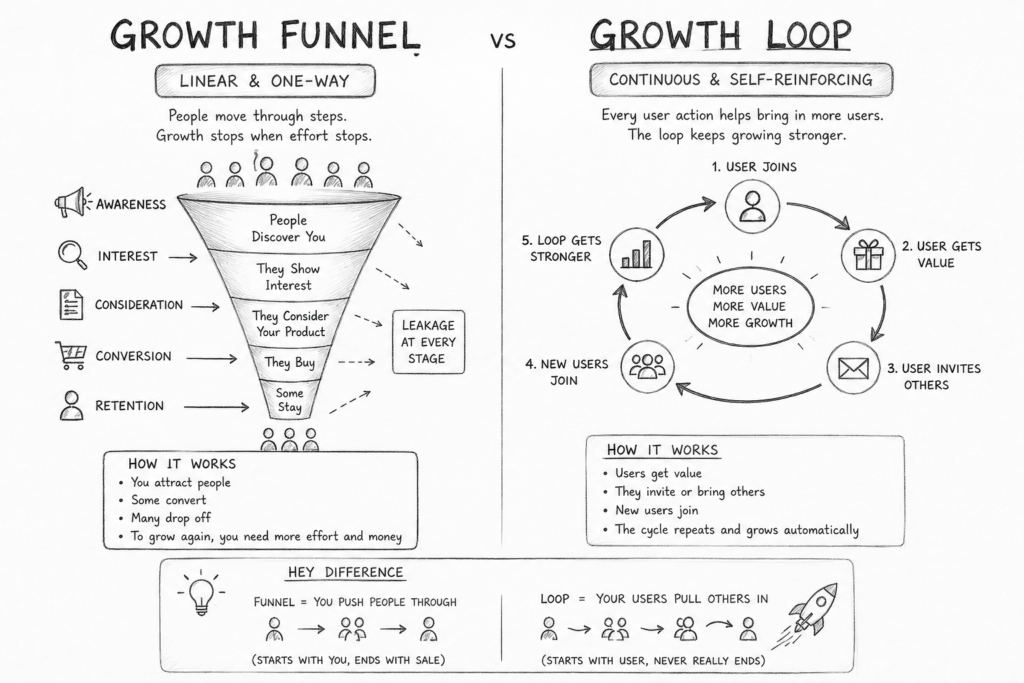
”A Growth Funnel is a one-way path where businesses attract people, convert some into customers, and repeat the process to grow”.
Simple example:
A clothing brand runs Instagram ads.
Ad → Website Visit → Product Page → Purchase
Once the sale is complete, the funnel ends. To get more customers, the company must run more ads.
For decades, businesses relied on a Growth Funnel to acquire customers.
A growth funnel is a linear marketing model where customers move through a fixed sequence of stages before making a purchase.
Linear Marketing Model
A linear marketing model moves customers through a fixed, one-way journey from awareness to purchase, where growth depends on continuously attracting new customers.
A typical funnel looks like this:
Awareness → Interest → Consideration → Purchase → Retention
Imagine pouring water into a funnel.
Lots of people enter at the top.
Only a few reach the bottom.
That is exactly how traditional marketing works.
For example:
A company runs Facebook Ads.
↓
10,000 people visit the website.
↓
2,000 sign up.
↓
300 purchase.
↓
The campaign ends.
To get another 300 customers, the company must spend on ads again.
The funnel stops once the campaign ends.
That is why funnels are often called linear growth systems.
Linear Growth System
A linear growth system requires constant marketing and advertising efforts because each new customer must be acquired separately.
Chapter 2: Why Funnels Worked for So Many Years

Growth funnels were extremely effective because businesses mainly relied on:
- Newspaper advertisements
- Television commercials
- Radio advertising
- Billboards
- Cold calling
- Email campaigns
The goal was simple.
Bring as many people into the funnel as possible and convert a percentage into customers.
Companies focused heavily on metrics such as:
- Website Traffic
- Click-Through Rate (CTR)
- Conversion Rate
- Cost Per Acquisition (CPA)
- Return on Ad Spend (ROAS)
These metrics are still important today.
However, there is one major problem.
The Biggest Problem with Growth Funnels
A funnel leaks.
Every stage loses customers.
Imagine attracting 100,000 visitors.
Perhaps:
- 10,000 sign up.
- 2,000 start a free trial.
- 500 purchase.
- 150 become repeat customers.
The rest disappear forever.
The company now has only one option.
Spend more money.
More ads.
More campaigns.
More promotions.
The cycle never ends.
This means growth depends heavily on continuous marketing investment.
As customer acquisition costs increase every year, this model becomes expensive and difficult to scale.
Example: An Online Clothing Store
Imagine an online fashion brand.
It spends ₹1 lakh on Instagram advertisements.
The campaign attracts:
- 40,000 visitors
- 3,000 product views
- 600 purchases
Great!
But what happens next month?
The company must spend another ₹1 lakh.
Without advertising, growth slows down.
The funnel doesn’t continue growing by itself.
Chapter 3: What Is a Growth Loop?

''A Growth Loop is a cycle where every happy customer helps bring in the next customer, creating continuous growth without relying only on advertising''.
“How do we get more visitors?”
the company asks,
“How can today’s customer naturally bring tomorrow’s customer?”
That is a Growth Loop.
A Growth Loop is a self-reinforcing growth system where every customer action creates opportunities to attract, engage, or retain additional customers.
Unlike funnels, loops don’t end after a purchase.
Every completed action feeds the beginning of the next cycle.
Instead of looking like this:
Ads → Customer → Sale → End
It becomes:
Customer → Value → Sharing → New Customers → More Value → More Sharing
The cycle keeps repeating.
This is why Growth Loops are considered compounding growth systems.
Chapter 4: Growth Funnel vs Growth Loop: The Fundamental Difference
The easiest way to understand the difference is with a simple analogy.
Imagine you have a bucket of water.
A Growth Funnel is like pouring water into a bucket with holes.
You must constantly add more water because some leaks out.
If you stop pouring, the bucket eventually becomes empty.
A Growth Loop is like planting a tree.
The tree grows.
It produces seeds.
Those seeds grow into more trees.
Each new tree produces even more seeds.
Over time, growth compounds naturally.
That’s exactly what companies like Dropbox, Canva, LinkedIn, Airbnb, Slack, and ChatGPT have built.
Instead of relying entirely on paid acquisition, they created products that encourage users to invite others, share content, collaborate, or generate value that attracts even more users.
The result is a growth engine that becomes stronger with every satisfied customer.
Why Modern Startups Prefer Growth Loops
Today’s startups face challenges that businesses didn’t have twenty years ago.
Advertising costs continue to rise.
Competition increases every day.
Customers have endless choices.
Winning attention has become harder than ever.
Because of this, modern companies are shifting away from traditional funnels and investing in Growth Loops.
Growth Loops create momentum.
Every happy customer contributes to future growth.
Every shared document, referral, invitation, review, or piece of content becomes free marketing.
Instead of buying every customer, companies build systems where customers help attract the next generation of users.
That is why some of the world’s fastest-growing companies spend less on advertising than many of their competitors while continuing to grow rapidly.
Chapter 5: Growth Loops vs Growth Funnels: What’s the Difference?
At first glance, Growth Funnels and Growth Loops may seem like they serve the same purpose. After all, both help businesses acquire customers and grow revenue.
However, their approach to growth is fundamentally different.
A Growth Funnel focuses on moving customers through a series of one-time stages until they make a purchase.
A Growth Loop focuses on creating a continuous cycle where every customer action contributes to acquiring, engaging, or retaining future customers.
Think of it this way.
A funnel ends.
A loop continues.
The goal of a funnel is to convert customers.
The goal of a loop is to create customers who generate more customers.
Growth Loops vs Growth Funnels Comparison
| Growth Funnel | Growth Loop |
|---|---|
| Linear growth model | Continuous growth model |
| Ends after conversion | Continues after conversion |
| Relies heavily on paid marketing | Relies on customer value and sharing |
| Every new customer usually requires additional marketing spend | Existing customers help acquire new customers |
| Growth slows when advertising stops | Growth can continue even with less advertising |
| Focuses on acquisition | Focuses on acquisition, retention, referrals, and engagement |
| One-way customer journey | Self-reinforcing customer cycle |
| Common in traditional businesses | Common in modern digital businesses and startups |
Chapter 5. 1: Why Are Companies Shifting from Growth Funnels to Growth Loops?
Marketing has become more competitive than ever.
Customers are exposed to thousands of advertisements every day.
Advertising costs on platforms like Google, Meta, and LinkedIn continue to rise.
As a result, acquiring every new customer through paid campaigns is becoming increasingly expensive.
This is why companies are asking a different question.
Instead of asking,
“How do we acquire more customers?”
they ask,
“How can every customer help us acquire the next customer?”
That simple change creates sustainable growth.
Real-World Growth Loop Examples
Let’s understand this using companies we interact with every day.
Dropbox‘s Referral Growth Loop

Dropbox didn’t become popular by spending billions on advertising.
Instead, it rewarded users with extra cloud storage whenever they invited friends.
The loop looked like this:
Customer signs up
↓
Invites a friend
↓
Friend signs up
↓
Both receive free storage
↓
Friend invites more people
↓
The cycle repeats.
Each new user became part of Dropbox’s marketing strategy.
Instead of buying every customer, Dropbox encouraged customers to bring the next customer.
Why It Worked
People genuinely wanted more storage.
Dropbox rewarded behavior that naturally attracted more users.
The product marketed itself.
Airbnb‘s Marketplace Growth Loop
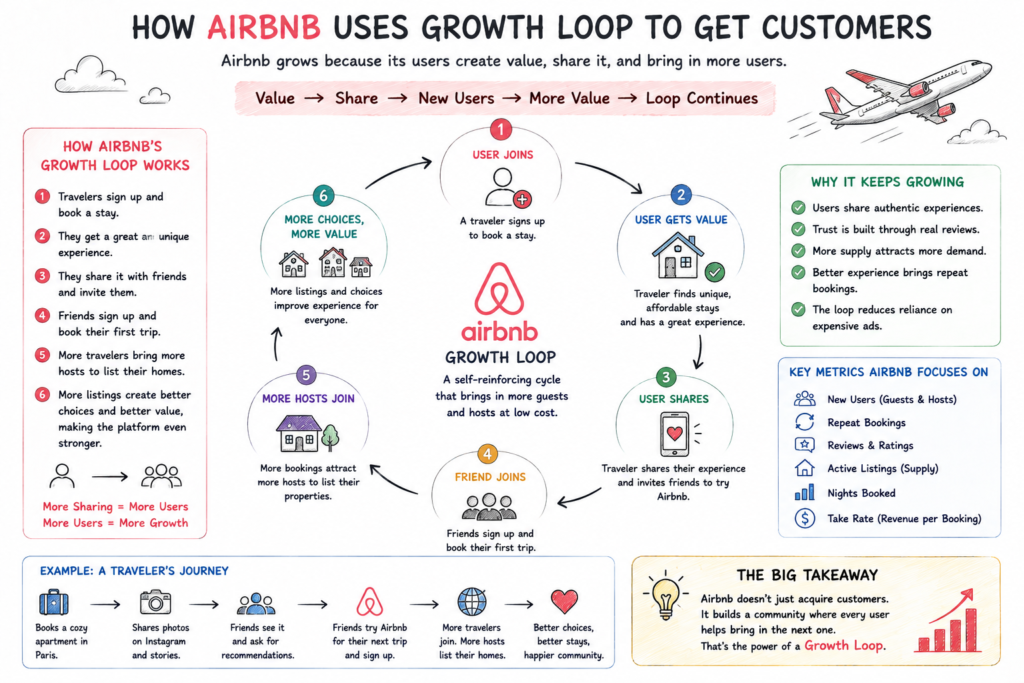
Airbnb depends on two groups.
- Hosts
- Travelers
Here’s how the loop works.
More hosts list properties.
↓
Travelers discover more options.
↓
More bookings happen.
↓
Hosts earn income.
↓
More people become hosts.
↓
Travelers find even more properties.
The loop keeps strengthening itself.
More supply attracts more demand.
More demand attracts more supply.
Why It Worked
Every satisfied host made Airbnb more attractive to travelers.
Every traveler made Airbnb more valuable for future hosts.
Uber‘s Supply and Demand Loop

Uber doesn’t simply connect passengers with drivers.
It creates a marketplace.
More drivers join Uber.
↓
Waiting times decrease.
↓
Customers enjoy faster pickups.
↓
More people book rides.
↓
Drivers earn more money.
↓
More drivers join.
The cycle repeats.
Why It Worked
Better service attracted more customers.
More customers increased driver earnings.
Higher earnings attracted even more drivers.
Canva‘s Sharing Growth Loop

Canva’s growth comes from something incredibly simple.
Sharing designs.
A user creates a presentation.
↓
Shares it with teammates.
↓
Teammates open Canva.
↓
Some create their own designs.
↓
They invite more teammates.
↓
More teams begin using Canva.
Without realizing it, users become marketers for Canva.
Why It Worked
The product naturally encouraged collaboration.
Every shared design introduced Canva to new potential users.
LinkedIn‘s Network Growth Loop

LinkedIn becomes more valuable every time someone joins.
A new professional creates a profile.
↓
Connects with colleagues.
↓
Colleagues receive invitations.
↓
They create profiles.
↓
The professional network grows.
↓
LinkedIn becomes even more useful.
Unlike a funnel, every new member increases the platform’s value for everyone else.
Why It Worked
People join because their colleagues are already there.
The larger the network becomes, the more valuable it is.
Why Growth Loops Create Compounding Growth
Compounding Growth:
Compounding growth means each new customer helps generate more customers, so growth builds on itself instead of starting from zero every time.
The biggest advantage of Growth Loops is that they compound over time.
Imagine two startups.
Startup A spends ₹5 lakh every month on advertisements.
Every month:
- 1,000 customers join.
If advertising stops,
Growth stops.
Now imagine Startup B.
It acquires 1,000 customers.
Those customers invite another 500.
Those 500 invite another 250.
Those customers continue inviting others.
Even if Startup B reduces advertising, the product continues generating new users.
This is called compounding growth.
Growth builds upon previous growth instead of starting from zero every month.
Chapter 6: How AI Is Making Growth Loops Even More Powerful
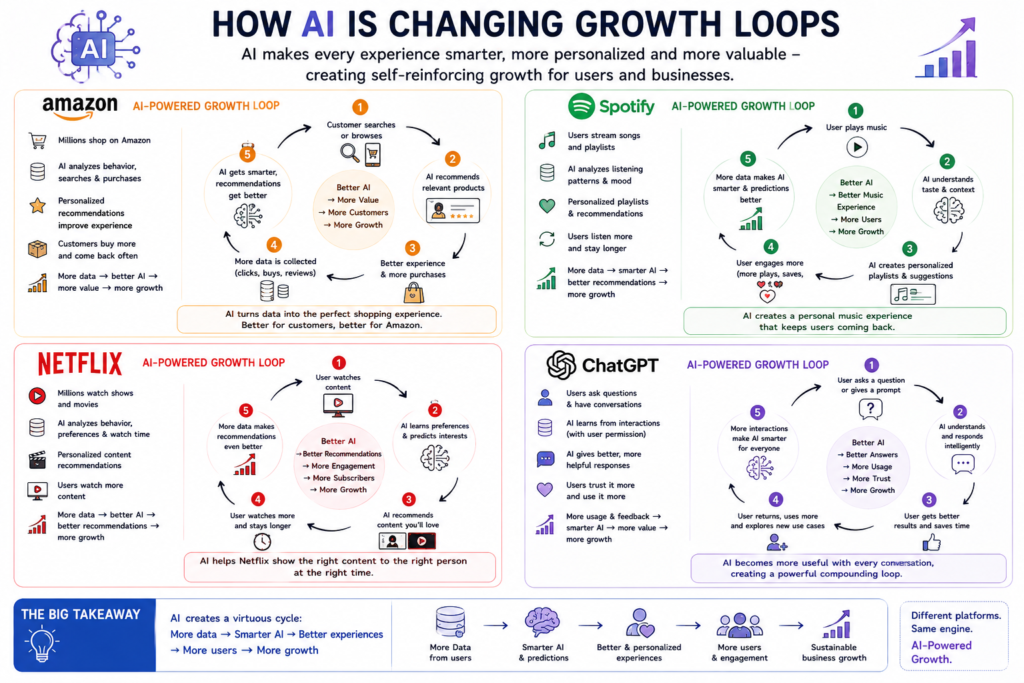
Artificial Intelligence is changing how Growth Loops work.
Earlier, companies relied on customers to manually share products.
Today, AI predicts customer behavior and strengthens the loop automatically.
For example:
Amazon
AI recommends products based on browsing history.
Better recommendations increase purchases.
Satisfied customers return more often.
More purchases improve AI recommendations.
The loop keeps improving.
Spotify
AI creates personalized playlists.
Users spend more time listening.
Higher engagement teaches AI about user preferences.
AI recommends even better music.
Listening increases further.
Netflix
AI recommends movies based on viewing history.
Better recommendations increase watch time.
Higher watch time generates more viewing data.
The algorithm becomes even smarter.
ChatGPT
Every interaction helps improve how users apply AI in their work.
As more professionals share successful use cases, more people adopt AI tools, creating a broader ecosystem of learning and adoption.
The combination of Growth Loops + Artificial Intelligence allows companies to deliver faster, more personalized experiences while encouraging users to return, engage, and recommend products to others.
Common Mistakes Businesses Make When Building Growth Loops
While Growth Loops can create sustainable growth, many businesses fail because they misunderstand how loops actually work.
Here are the most common mistakes.
1. Focusing Only on Customer Acquisition
Many businesses invest all their time and budget in attracting new customers but ignore retention.
Without satisfied customers, there is no one to recommend your product or bring in new users.
A Growth Loop starts with creating value, not just acquiring users.
2. Building a Product That Isn’t Worth Sharing
People recommend products that solve real problems.
If your product doesn’t provide enough value, no referral program can fix it.
The product must be useful before it becomes shareable.
3. Ignoring Customer Experience
A poor customer experience breaks the loop.
Slow websites, confusing interfaces, poor customer support, or delayed deliveries reduce customer satisfaction.
Happy customers create Growth Loops.
Unhappy customers stop them.
4. Depending Only on Paid Advertising
Advertising is useful, but it shouldn’t be your only growth strategy.
The most successful businesses combine paid acquisition with referrals, word of mouth, content marketing, communities, and product-led growth.
5. Measuring the Wrong Metrics
Many businesses only track:
- Website traffic
- Clicks
- Impressions
Growth Loop companies also measure:
- Customer Retention
- Referral Rate
- Repeat Purchases
- Customer Lifetime Value (CLV)
- Net Promoter Score (NPS)
These metrics indicate whether the loop is becoming stronger over time.
Should Your Business Choose Growth Funnels or Growth Loops?
The answer depends on your business model.
Choose a Growth Funnel if:
- You’re launching a new business.
- You need immediate sales.
- Your business depends on paid advertising.
- You sell high-value products with longer buying cycles.
Examples:
- Real estate
- Insurance
- Luxury automobiles
- B2B consulting
Choose a Growth Loop if:
- You have a digital product.
- Customer referrals matter.
- Users can invite or collaborate with others.
- You want long-term, sustainable growth.
Examples:
- SaaS companies
- Mobile apps
- Online marketplaces
- Subscription businesses
- Social media platforms
The Best Strategy
The smartest companies don’t choose one over the other.
They use both.
Funnels help acquire the first customer.
Growth Loops help that customer bring the next one.
Think of it like this:
Growth Funnel = Customer Acquisition
Growth Loop = Sustainable Growth
Key Takeaways
If you remember only five things from this article, let them be these:
- A Growth Funnel is a one-way process that ends after a customer makes a purchase.
- A Growth Loop is a continuous cycle where customer actions create future growth.
- Growth Funnels depend heavily on continuous advertising and marketing spend.
- Growth Loops reduce customer acquisition costs by encouraging referrals, sharing, collaboration, and repeat engagement.
- Companies like Dropbox, Airbnb, Uber, Canva, LinkedIn, and Slack have grown by designing products that naturally create Growth Loops.
Frequently Asked Questions (FAQ)
What is the difference between a Growth Funnel and a Growth Loop?
A Growth Funnel is a linear process that guides customers from awareness to purchase. A Growth Loop is a continuous system where existing customers help attract, engage, or retain future customers.
Why are Growth Loops becoming popular?
Growth Loops create sustainable and compounding growth. Instead of relying only on advertising, they encourage customers to generate additional customers through referrals, collaboration, and product sharing.
Can a business use both Growth Funnels and Growth Loops?
Yes. Most successful companies use Growth Funnels to acquire initial customers and Growth Loops to keep growth going over time.
Which companies use Growth Loops?
Many successful businesses use Growth Loops, including:
- Dropbox
- Airbnb
- Uber
- Canva
- Slack
- Spotify
- Amazon
- ChatGPT
How does AI improve Growth Loops?
AI helps businesses personalize recommendations, predict customer behavior, automate engagement, and improve customer experiences. These improvements encourage users to return more often and share products with others, making Growth Loops stronger.
Conclusion
The future of business growth is no longer about spending more on advertising. It’s about building products and experiences that encourage customers to create value for other customers.
Traditional Growth Funnels still play an important role, especially for acquiring new users. However, relying only on funnels can become expensive as advertising costs continue to rise.
Growth Loops offer a different approach. They transform satisfied customers into advocates, collaborators, and promoters who help drive continuous, self-sustaining growth.
As Artificial Intelligence becomes more integrated into products and services, Growth Loops will become even smarter. AI can personalize experiences, predict customer needs, automate engagement, and strengthen every stage of the loop.
Businesses that combine Growth Funnels for acquisition with Growth Loops for retention and expansion will be better positioned to build sustainable growth in the years ahead.
The biggest lesson is simple:
Funnels help you acquire customers. Growth Loops help your customers acquire more customers.
That’s the mindset behind many of today’s fastest-growing companies.