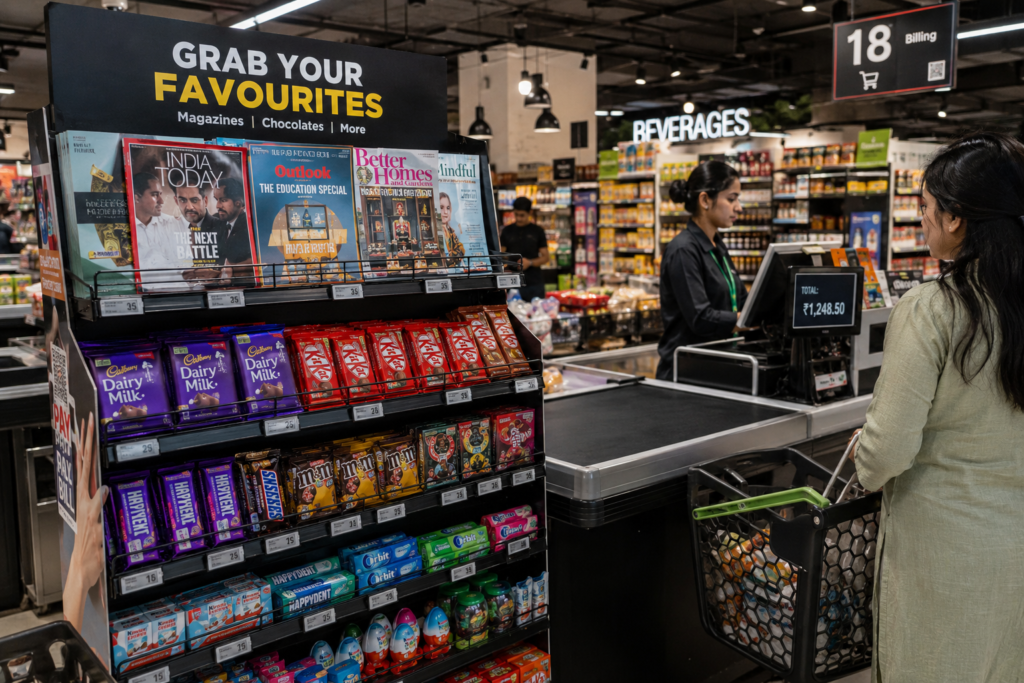
Have We Ever Really Looked at the Checkout Counter?
Think about the last time we visited a supermarket.
Maybe it was D-Mart.
Maybe Reliance Smart.
Maybe Star Bazaar.
Or perhaps a small grocery store near our home.
We walked around the store, picked up the products we needed, and finally reached the billing counter.
While waiting for our turn, we probably noticed something like this.
- Chocolates
- Candies
- Chewing gum
- Magazines
- Batteries
- Bottled water
- Small toys
Now here’s an interesting question.
Why are these products always placed near the checkout counter?
Is it because there wasn’t enough space elsewhere?
Or is there a hidden reason behind it?
The answer might surprise us.
These products are not placed there by accident.
They are placed there after years of studying how people shop.
Let’s understand why.
Table of Contents
- The Checkout Counter Is the Most Valuable Place in a Supermarket
- Why Don’t We See Rice or Cooking Oil There?
- Have We Ever Bought Something That Wasn’t on Our Shopping List?
- Why Waiting in Line Changes Our Decisions
- Why Chocolates? Why Not Biscuits?
- Why Are Magazines Still There?
- The Secret Behind Eye-Level Placement
- Did You Know?
- What Can We Learn as Business Owners?
The Checkout Counter Is the Most Valuable Place in a Supermarket
Imagine we own a supermarket.
Every day, 1,000 people visit the store.
Some customers buy vegetables.
Some only buy snacks.
Some skip entire sections.
But every customer who makes a purchase has one thing in common.
They all stop at the checkout counter.
No matter what they buy, everyone has to stand there.
That makes the checkout counter the only place in the store that every paying customer will definitely visit.
For retailers, this space is extremely valuable.
It’s the last chance to show customers one more product before they leave.
That’s why the checkout counter isn’t designed randomly.
Every shelf, every product, and every display is planned carefully.
Why Don’t We See Rice or Cooking Oil There?
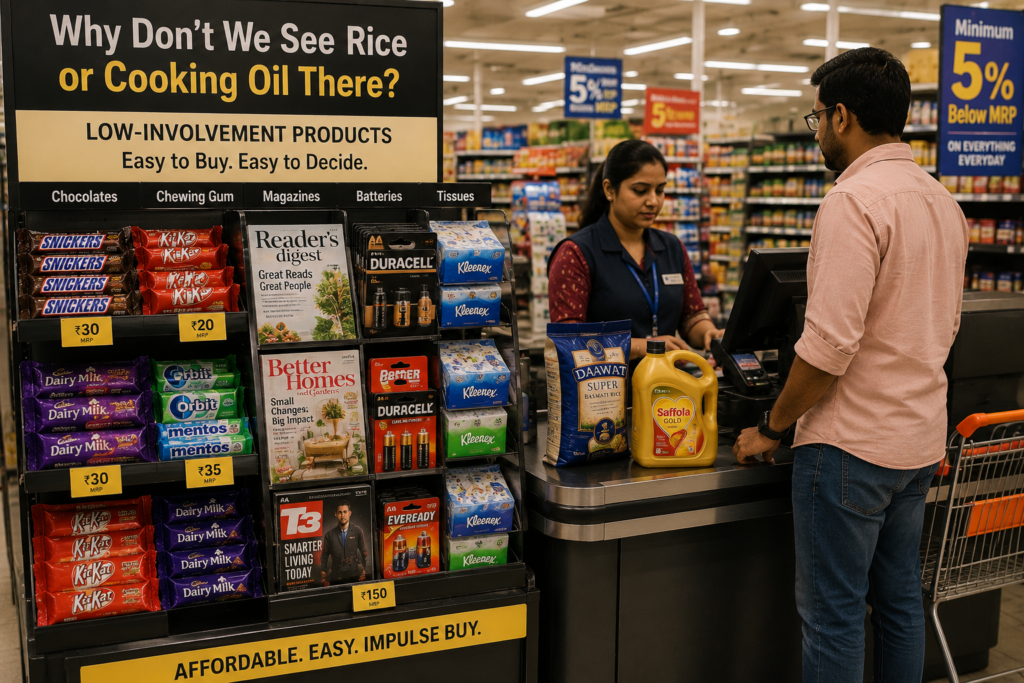
Now let’s think about another question.
If the checkout counter is so valuable, why don’t supermarkets place rice bags or cooking oil near the cashier?
Why chocolates?
Why chewing gum?
Why magazines?
Let’s compare two situations.
Situation 1
We see a chocolate costing ₹30.
Buying it feels easy.
We don’t need to compare brands.
We don’t need to ask anyone.
We simply pick it up.
Situation 2
Now imagine seeing a refrigerator costing ₹35,000.
Would we buy it while waiting in the queue?
Of course not.
Buying expensive products takes time.
Buying small products takes only a few seconds.
That’s exactly why checkout counters are filled with affordable items.
Marketing professionals call these low-involvement products.
That sounds like a difficult term, but the meaning is very simple.
A low-involvement product is something we can buy without spending much time thinking.
For example:
- A chocolate
- A bottle of water
- Chewing gum
- Batteries
- Tissues
These products don’t require research.
They don’t need planning.
They’re quick decisions.
And that’s exactly what retailers want at the checkout counter.
Have We Ever Bought Something That Wasn’t on Our Shopping List?
Let’s be honest.
Most of us have.
We entered the store planning to buy groceries.
But while waiting to pay, we noticed our favourite chocolate.
Or a bottle of cold water.
Or a packet of chewing gum.
We picked it up without much thought.
This behaviour has a name.
Marketing experts call it Impulse Buying.
Don’t let the term scare you.
It’s actually very simple.
Impulse Buying means buying something that we didn’t plan to buy before entering the store.
The decision happens in just a few seconds.
Sometimes we don’t even realise it.
Think about the last time this happened to you.
Can you remember what you bought?
If yes, you’ve experienced Impulse Buying yourself.
Why Waiting in Line Changes Our Decisions
Here’s something fascinating.
The checkout counter doesn’t just display products.
It also uses waiting time.
While we’re shopping, our brain is busy.
We’re comparing prices.
Choosing brands.
Checking our shopping list.
But once we reach the billing counter, everything slows down.
Now we’re simply waiting.
And while waiting, our eyes naturally start looking around.
That’s exactly what retailers expect.
They know that a waiting customer becomes an observing customer.
So instead of leaving the space empty, they fill it with products that are easy to notice and easy to buy.
In other words, the checkout counter quietly turns waiting time into shopping time.
Real-Life Example
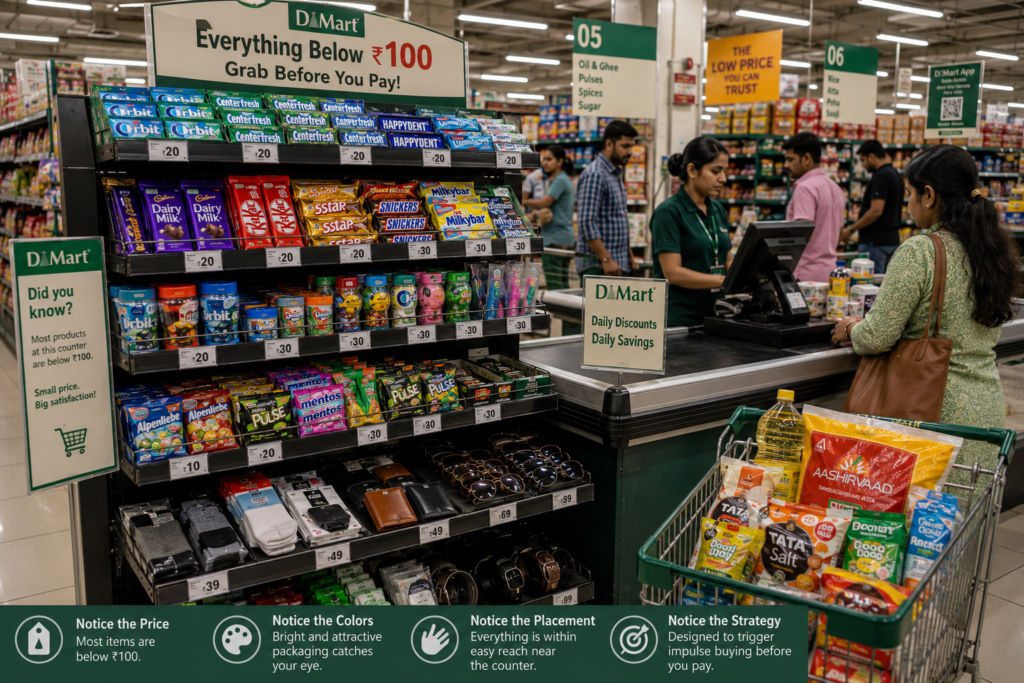
The next time we visit D-Mart or Reliance Smart, let’s do a small experiment.
Before paying, spend just 30 seconds looking around the checkout counter.
Notice how many products cost less than ₹100.
Notice how colourful the packaging is.
Notice how easy they are to pick up.
You’ll quickly realise that every product has been placed there for a reason.
Nothing is random.
Why Chocolates? Why Not Biscuits?
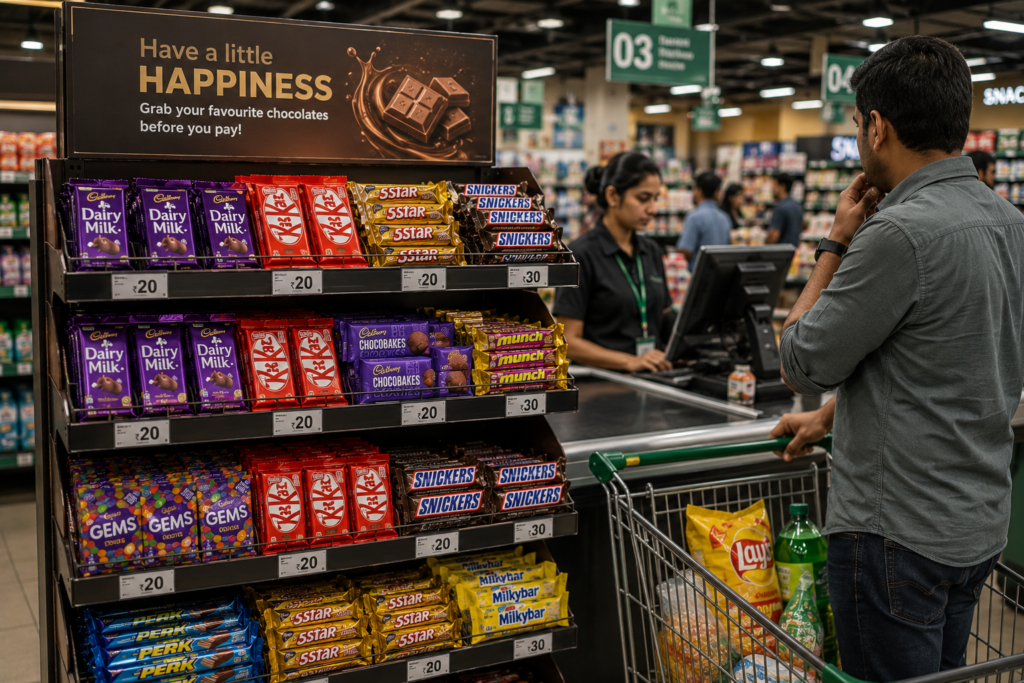
At first glance, chocolates and biscuits seem similar.
Both are snacks.
Both are affordable.
Both are popular.
So why do supermarkets almost always keep chocolates near the checkout counter?
The answer is surprisingly simple.
Chocolates create faster decisions.
A chocolate is usually treated as a small reward.
After spending 30 to 60 minutes walking through a supermarket, many people feel they’ve completed a task.
Without even realizing it, our brain looks for a small reward.
A ₹20 or ₹30 chocolate feels like the perfect choice.
It’s affordable.
It’s familiar.
And it doesn’t require much thinking.
This is one reason chocolates perform better than many other products at the checkout counter.
Small Prices Feel Like Small Decisions
Let’s compare two products.
- Chocolate: ₹30
- Rice Bag: ₹1,200
Even if we need both, which one feels easier to buy without planning?
The chocolate.
Not because we need it more.
Because the risk feels much smaller.
Our brain quietly says,
“It’s only ₹30.”
Retailers understand this very well.
Instead of asking customers to make another big decision, they present products that feel almost effortless to buy.
This is why most checkout products cost less than ₹100.
One customer buying one chocolate doesn’t seem important.
But imagine 400 customers buying one chocolate every day.
Small purchases become big business.
Why Are Magazines Still There?
This surprises many people.
Almost everyone carries a smartphone today.
We read articles online.
Watch videos on YouTube.
Scroll Instagram.
So why are printed magazines still kept near the checkout counter?
The answer isn’t just about selling magazines.
It’s about attracting attention.
Imagine waiting in line.
Your eyes naturally move around.
A magazine with a bright cover and a bold headline catches your attention.
Even if you don’t buy it, you’ve already looked in that direction.
And beside the magazine…
There’s chewing gum.
There’s chocolate.
There’s bottled water.
The magazine works like a visual magnet.
It attracts attention not only to itself but also to the products placed around it.
In marketing, everything begins with one simple step.
If people don’t notice a product, they can’t buy it.
The Secret Behind Eye-Level Placement
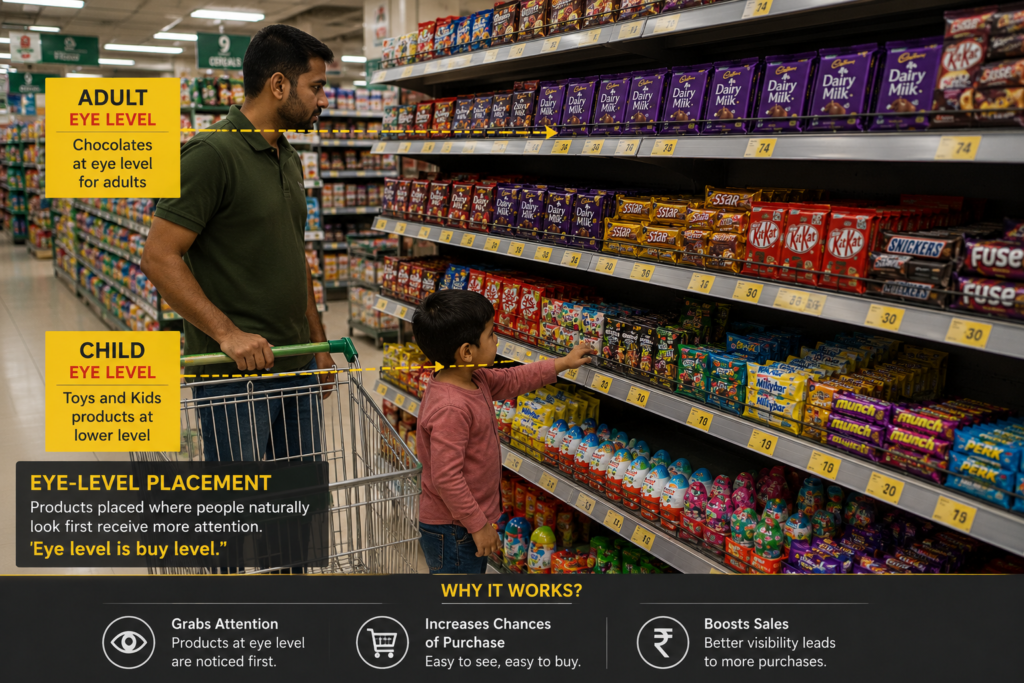
The next time we visit a supermarket, let’s pay attention to where products are placed.
Many chocolates are displayed around an adult’s eye level.
Small toys are often placed lower.
Why?
Because retailers know that adults and children look at different heights.
This strategy is called Eye-Level Placement.
The idea is simple.
Products placed where people naturally look first receive more attention.
In retail, there’s a famous saying:
“Eye level is buy level.”
The easier a product is to see, the easier it becomes to sell.
That’s why supermarkets spend so much time deciding exactly where each product should be displayed.
Children Influence More Purchases Than We Think
Have we ever noticed a child asking for a chocolate while waiting at the billing counter?
It happens almost every day.
This isn’t because children planned to buy chocolate before entering the store.
It’s because the product suddenly became visible.
Bright colours.
Interesting shapes.
Favourite cartoon characters.
All of these are designed to attract a child’s attention.
Once the child asks,
“Can we buy this?”
Many parents agree because the price is relatively low.
For the parent, it’s a small purchase.
For the retailer, it becomes another successful sale.
This doesn’t mean supermarkets are targeting children alone.
They’re designing an experience for the entire family.
Bright Colours Catch Our Eyes First
Take a closer look at checkout products.
Most of them use bright packaging.
Red.
Yellow.
Purple.
Orange.
These colours are easier to notice than plain colours.
Marketing experts often refer to this as Color Psychology.
Different colours create different feelings.
For example:
- Red often attracts attention and creates excitement.
- Yellow is bright and easy to notice.
- Green is commonly associated with freshness.
- Blue often represents trust and reliability.
This doesn’t mean colour alone makes us buy something.
But it increases the chance that we’ll notice the product first.
And before any purchase happens…
Attention comes first.
Checkout Counters Are Carefully Designed
Many people believe products are placed wherever there’s empty space.
In reality, checkout counters are one of the most carefully planned areas in a supermarket.
Retailers study questions like:
- Which products sell best together?
- Which products customers buy without planning?
- Which packaging attracts attention?
- Which shelf height receives the most visibility?
The answers to these questions help decide what appears beside the cashier.
That’s why checkout counters in different supermarkets often look surprisingly similar.
Whether we visit D-Mart, Reliance Smart, Star Bazaar, or another large supermarket, we’ll usually find the same types of products.
That’s because human behaviour doesn’t change much.
Retailers simply adapt their stores to match it.
Did You Know?
Some brands pay supermarkets to display their products near the checkout counter.
This practice is known as Slotting Fees.
Instead of waiting for customers to discover their products somewhere else in the store, brands pay for premium shelf space because they know that visibility often leads to higher sales.
To retailers, the checkout counter isn’t just a place to collect payments.
It’s valuable advertising space.
We’ve now uncovered why chocolates, magazines, toys, and chewing gum dominate checkout counters.
But something even more interesting has happened over the last decade.
The checkout counter has moved from supermarkets to our smartphones.
The Checkout Counter Has Gone Digital
Think about the last time we ordered something online.
Maybe it was from Amazon.
Or Flipkart.
Or Blinkit.
Just before making the payment, we often see messages like these:
- Frequently Bought Together
- Customers Also Bought
- Add this item for just ₹49
- You’re ₹120 away from FREE delivery
These messages may seem normal.
But they follow the same marketing strategy used by supermarkets.
The only difference is this.
Instead of placing chocolates beside a billing counter, online shopping apps place product suggestions beside the Pay Now button.
The location has changed.
The psychology hasn’t.
Why Does Amazon Suggest a Mouse When We Buy a Laptop?
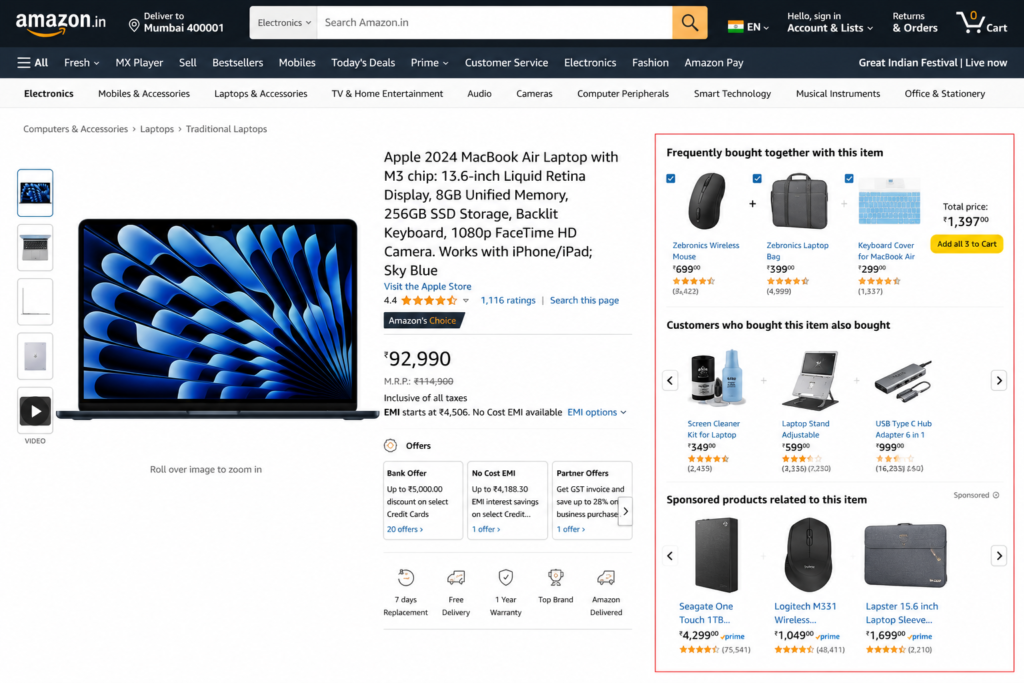
Let’s imagine we’re buying a laptop.
Before placing the order, Amazon recommends:
- A wireless mouse
- A laptop bag
- A keyboard cover
- A screen cleaning kit
Did we visit Amazon to buy these products?
Probably not.
But they suddenly seem useful.
This marketing technique is called Cross-Selling.
Cross-Selling simply means recommending products that go well with the item we’re already buying.
We see this everywhere.
Buying a smartphone?
The store suggests a phone case.
Buying toothpaste?
The website recommends a toothbrush.
Ordering a pizza?
The restaurant asks if we’d like garlic bread or a cold drink.
These suggestions don’t feel like advertisements.
They feel helpful.
That’s why Cross-Selling works so well.
“Customers Also Bought This”
Here’s another feature we’ve all seen.
Customers who bought this product also bought…
At first, it looks like a simple recommendation.
But there’s interesting psychology behind it.
When we see that thousands of people bought the same product, our confidence increases.
We think,
“If so many people bought it, it must be a good choice.”
Marketing experts call this Social Proof.
Social Proof means people often trust a decision more when they see others making the same decision.
That’s why restaurants display customer reviews.
Hotels highlight ratings.
Apps show download numbers.
And e-commerce websites showcase best-selling products.
People naturally learn from other people.
Why Do We Spend More for Free Delivery?
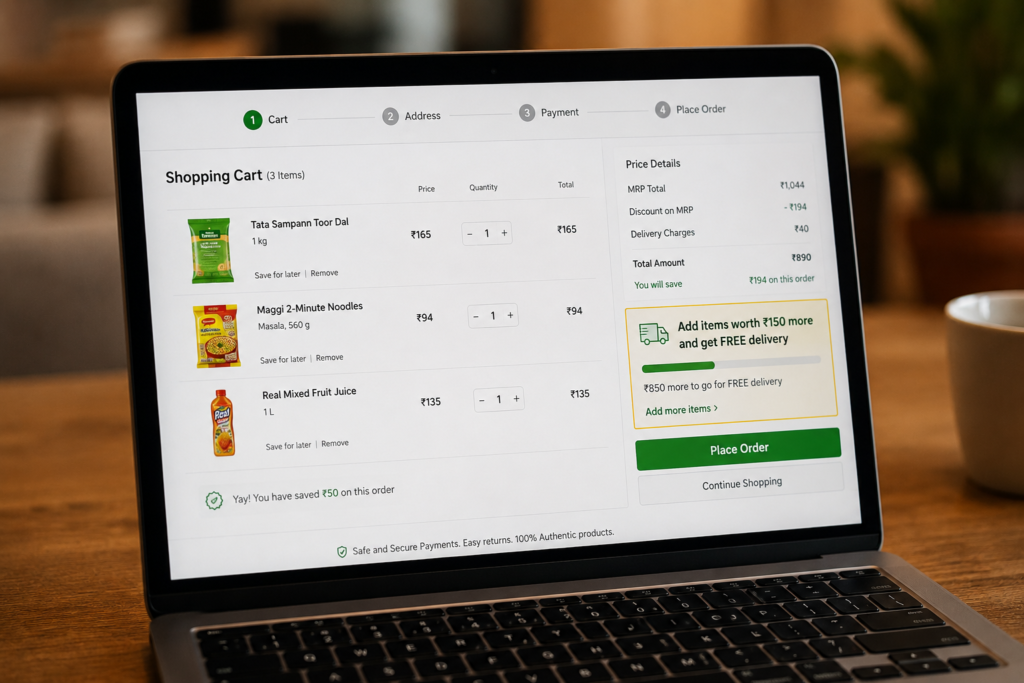
Imagine our shopping cart total is ₹850.
Then we see this message.
Add products worth ₹150 more and get FREE delivery.
Suddenly, we start searching for another item.
A packet of biscuits.
A bottle of juice.
A chocolate.
Our bill increases to ₹1,000.
We feel happy because we “saved” the delivery charge.
But if we think carefully, we actually spent more than we planned.
This happens because our brain dislikes losing something.
Psychologists call this Loss Aversion.
Loss Aversion simply means we often try harder to avoid a loss than to gain something of equal value.
The idea of losing free delivery feels bigger than spending a little more.
Why Do Restaurants Ask, “Would You Like Fries with That?”
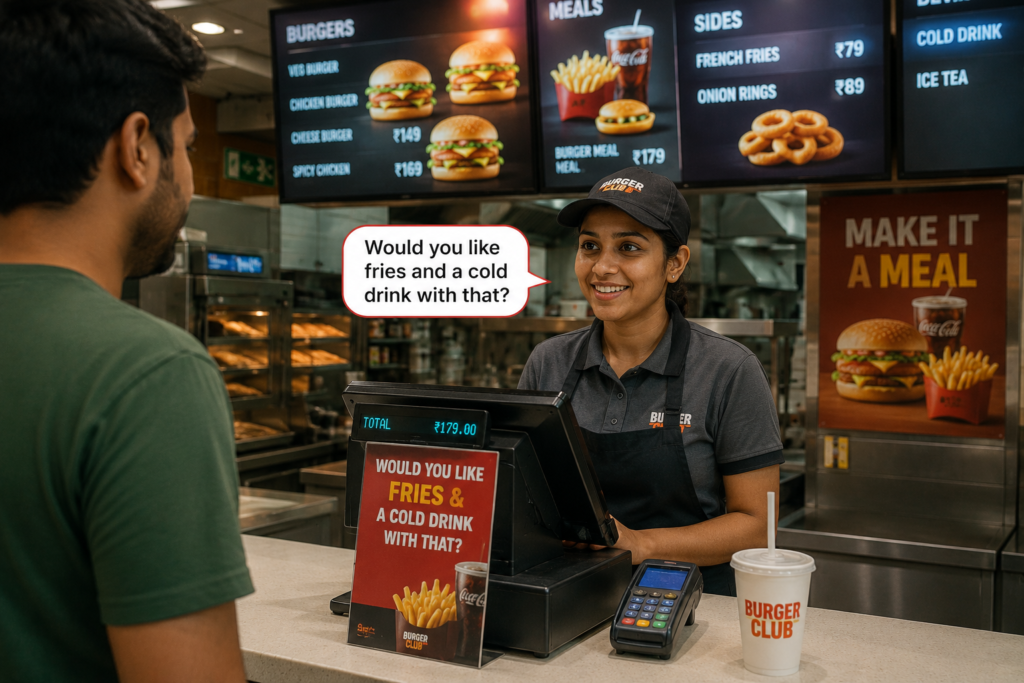
Let’s move away from supermarkets for a moment.
Think about the last time we ordered a burger.
Very often, the cashier asks,
“Would you like fries and a cold drink with that?”
This isn’t a random question.
It’s another example of Cross-Selling.
The restaurant knows we’ve already decided to buy food.
Adding one more item feels much easier than making the first buying decision.
Coffee shops do the same.
Order a coffee, and they recommend a muffin.
Pizza outlets recommend garlic bread.
Movie theatres suggest popcorn with soft drinks.
Different businesses.
Same marketing principle.
What About Pharmacies?
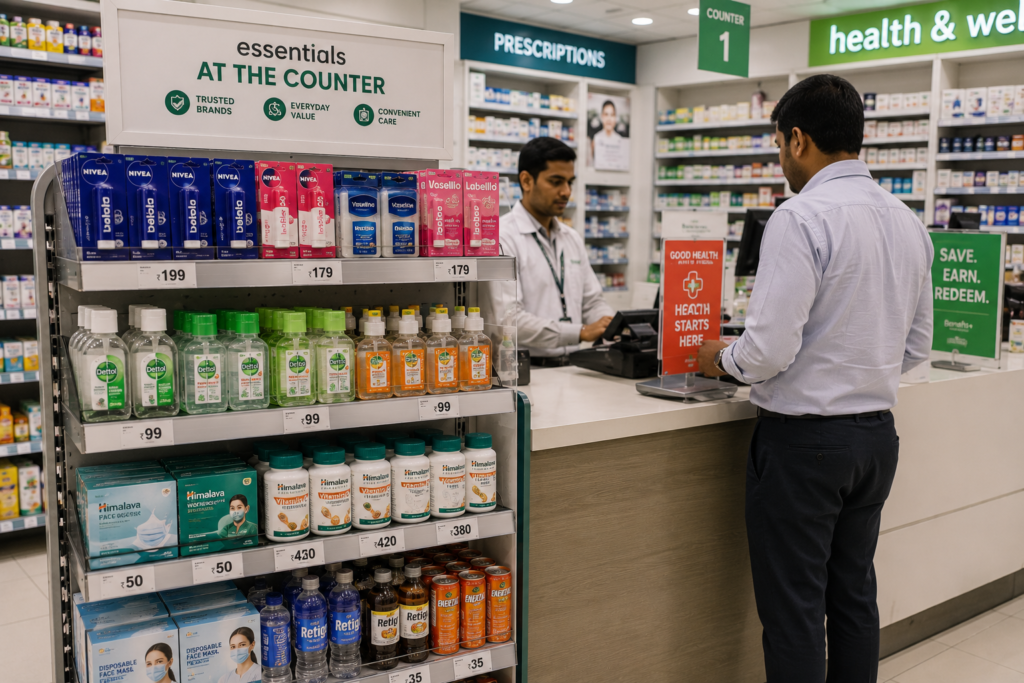
Even pharmacies use similar strategies.
Near the billing counter, we often see:
- Lip balm
- Hand sanitizer
- Vitamin tablets
- Face masks
- Energy drinks
These are products many people buy without much planning.
Again, they’re affordable.
Easy to understand.
Easy to pick up.
Easy to buy.
The same psychology works across different industries.
Marketing Is Often Invisible
When most people hear the word marketing, they think about television advertisements, social media campaigns, or billboards.
But marketing is much more than advertising.
Sometimes, marketing is simply deciding:
- Where should this product be placed?
- Which products should be displayed together?
- Which colour will attract more attention?
- What should the customer see while waiting?
These small decisions may seem unimportant.
But together, they can influence millions of buying decisions every day.
That’s why companies invest so much time in understanding customer behaviour.
What Can We Learn From This?
If we look closely, it’s actually about how people make decisions.
Retailers understand that customers don’t always buy because they need something immediately.
Sometimes they buy because the product is:
- Easy to notice
- Easy to reach
- Easy to afford
That’s why product placement is such an important part of marketing.
This Isn’t Just About Supermarkets
Once we understand this strategy, we begin noticing it everywhere.
At an Airport
Have you noticed that chocolates, headphones, neck pillows, and travel books are often placed near the boarding gates or payment counters?
People are waiting.
While waiting, they look around.
Some of those products end up in their shopping bags.
At a Coffee Shop
Order a cappuccino at Starbucks or Café Coffee Day.
Before your coffee arrives, you’ll probably notice cookies, brownies, muffins, or sandwiches displayed near the counter.
Many customers buy them without planning.
Not because they were hungry five minutes ago.
But because the products were visible at the right moment.
At a Clothing Store
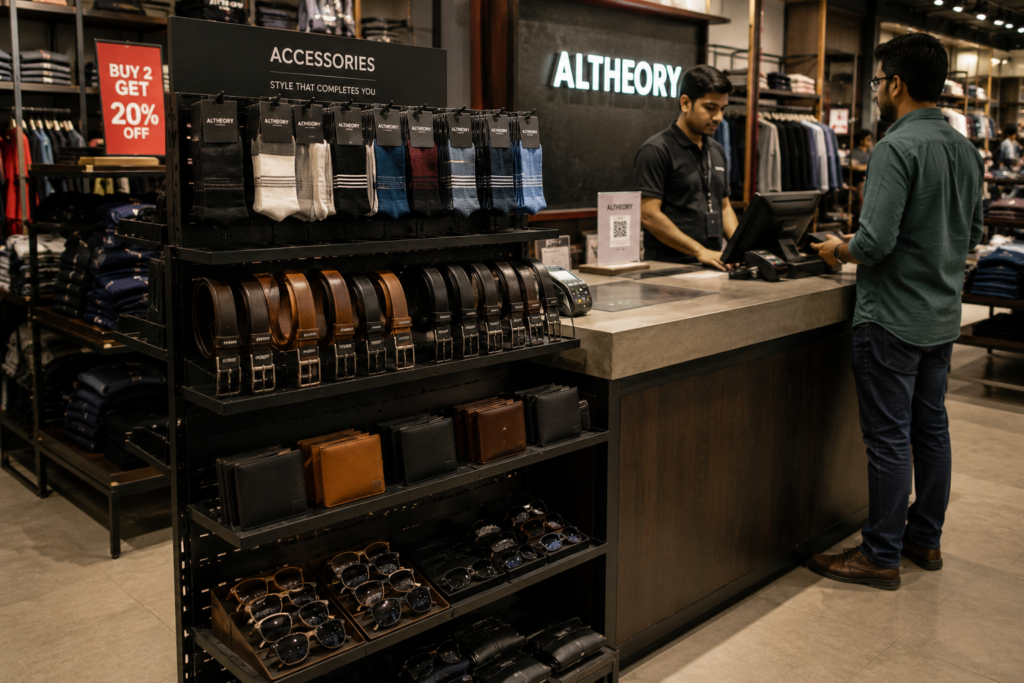
Visit a clothing store and look near the billing counter.
You’ll often find:
- Socks
- Belts
- Wallets
- Sunglasses
These are affordable products that customers can easily add to their purchase.
Again, it’s the same marketing principle.
Does This Mean Businesses Are Manipulating Us?
Not necessarily.
There’s an important difference between helping customers and misleading customers.
Imagine buying a new smartphone.
The store suggests a screen protector.
That recommendation can actually be useful.
Or imagine buying groceries and remembering at the last moment that you need batteries.
Finding them near the checkout counter saves time.
Good marketing isn’t about forcing people to buy.
It’s about making products easy to discover when they are genuinely useful.
The final decision still belongs to us.
What Can We Learn as Customers?
The next time we stand in a checkout queue, let’s pause for a moment.
Instead of immediately picking up a chocolate or a bottle of water, ask ourselves:
“Did I plan to buy this before entering the store?”
If the answer is no, that’s completely fine.
It simply means we’ve noticed how our environment can influence our decisions.
Being aware doesn’t mean we stop buying.
It means we start making more conscious choices.
What Can We Learn as Business Owners?
This article isn’t only useful for shoppers.
It’s equally valuable for entrepreneurs, shop owners, marketers, and anyone selling a product.
Here are a few lessons.
Make Important Products Easy to Notice
Customers can’t buy what they don’t see.
Whether it’s a supermarket shelf or a website homepage, visibility matters.
Keep Related Products Together
If customers buy one product, think about what they might need next.
A bakery can place butter beside bread.
A mobile shop can display phone covers next to smartphones.
An online store can recommend accessories before checkout.
Helping customers find related products improves their experience.
Make Decisions Easy
Customers already make dozens of decisions while shopping.
If a product is affordable, useful, and easy to understand, they’re more likely to add it to their purchase.
Sometimes, reducing effort is more powerful than increasing persuasion.
Next Time We Visit a Supermarket…
Let’s become a marketing observer.
Spend one minute looking around the checkout counter.
Notice:
- Which products are placed closest to the cashier?
- Which products cost less than ₹100?
- Which products are at eye level?
- Which products are placed where children can easily see them?
- Did anything tempt us to buy it?
Once we start observing these details, we’ll realise that marketing isn’t hidden.
It’s happening all around us.
We simply never noticed it before.
Frequently Asked Questions (FAQs)
Why are chocolates and candies placed near checkout counters?
Because they’re affordable, familiar, and easy to buy without much thinking. Their placement encourages Impulse Buying, which increases overall sales.
Why are magazines still kept near billing counters?
Magazines attract attention with colourful covers and interesting headlines. Even when customers don’t buy them, they help draw attention to nearby products.
Why do supermarkets place toys near the cashier?
Small toys are often placed where children can easily notice them. This increases the chances of parents making a small, unplanned purchase.
What is Impulse Buying?
Impulse Buying means purchasing something that wasn’t on our shopping list. It usually happens because a product catches our attention at the right moment.
Do online shopping apps use the same strategy?
Yes.
Instead of physical shelves, apps use product recommendations, combo offers, and free-delivery messages to encourage additional purchases before checkout.
Before You Leave…
We’d Love to Hear From You
Have you ever noticed chocolates, chewing gum, magazines, or small toys near a checkout counter?
Which supermarket did you notice it in?
Did you ever buy something that wasn’t on your shopping list?
Share your experience in the comments below.
Your observation might help someone else notice something they had overlooked for years.
Fear of Missing Out (FOMO): The Feeling That Pushes Us to Join the Queue
Imagine you’re walking through a shopping mall.
You notice a clothing store with a huge crowd outside.
A large banner reads:
“Today Only! Flat 70% OFF.”
Suddenly, your curiosity increases.
You weren’t planning to shop.
Yet you find yourself walking toward the entrance.
Why?
Because your brain starts asking a question.
“What if I miss a great deal?”
This feeling is called FOMO (Fear of Missing Out).
What Is FOMO?
Fear of Missing Out (FOMO) is the feeling that other people might be getting something valuable while we are being left behind.
It doesn’t always mean we need the product.
Sometimes, we simply don’t want to miss an opportunity.
This is why words like these grab our attention:
- Limited Time Offer
- Today Only
- Offer Ends Tonight
- Exclusive Launch
- Members Only
- Only 100 Pieces Available
These phrases create urgency.
Instead of thinking carefully, our brain starts thinking quickly.
And that’s exactly what many marketers want.
Why Limited-Time Offers Create Long Queues
Have you ever seen people standing outside a store before it even opens?
This often happens during:
- Black Friday Sales
- Big Billion Days
- Grand Opening Events
- Festival Discounts
- Limited Edition Product Launches
Now imagine two situations.
Situation 1
A store announces:
“This discount is available throughout the year.”
Situation 2
The same store announces:
“Offer Ends Today at 9 PM.”
Which offer creates more excitement?
Almost everyone chooses the second one.
Why?
Because deadlines create urgency.
When time feels limited, the opportunity appears more valuable.
This marketing strategy is called the Scarcity Principle.
What Is the Scarcity Principle?
Scarcity Principle means people value something more when they believe it is limited or difficult to get.
The product may not have changed.
Only its availability has changed.
That’s enough to influence our decisions.
Our brain quietly says:
“If it’s becoming scarce, I should get it before it’s gone.”
This is why marketers often combine scarcity with FOMO.
Together, they become extremely powerful.
Real-Life Example: Limited Edition Sneakers
Every year, famous sneaker brands release limited edition collections.
People begin waiting outside stores hours before opening.
Some customers even camp overnight.
Interestingly, similar shoes may already be available inside the store.
But those aren’t limited.
The limited edition pair feels more valuable because fewer people can own it.
Here, the queue becomes more than a line.
It becomes proof that the product is exclusive.
Why IKEA Store Openings Create Huge Crowds
Whenever IKEA opens a new store in a city, thousands of people visit during the first few days.
Some arrive early in the morning.
Others wait patiently for the doors to open.
Is it because people suddenly need new furniture?
Not always.
Many visitors simply don’t want to miss the experience.
Some are attracted by opening-day offers.
Others want to be among the first visitors.
Many share photos on social media.
The event itself becomes exciting.
Again, we can see Social Proof and FOMO working together.
Starbucks and the Power of Seasonal Products
Have you noticed how Starbucks introduces special drinks during certain seasons?
For example:
- Holiday beverages
- Summer specials
- Limited festive drinks
Customers know these drinks won’t be available forever.
That limited availability increases demand.
People don’t want to wait until next year.
They buy now.
This is another example of the Scarcity Principle.
Why Do We Trust Crowds More Than Advertisements?
Imagine seeing a billboard that says:
“Our restaurant serves the best food in the city.”
Now imagine walking past the same restaurant and seeing fifty people waiting outside.
Which one feels more convincing?
For most people, the crowd is more believable.
Why?
Because advertisements come from businesses.
Crowds come from customers.
Our brain naturally trusts the actions of other people.
This is why businesses love positive customer reviews, testimonials, and user-generated content.
Real people often influence us more than advertisements.
The Queue Creates Curiosity
Think about your own experience.
Have you ever slowed down while walking past a crowded food stall?
Maybe you looked at the menu.
Maybe you searched for reviews.
Maybe you even joined the queue.
The crowd achieved something remarkable.
It captured your attention without spending money on advertising.
That’s why marketers often say:
“People attract people.”
A busy business often becomes even busier because the crowd itself acts as marketing.
What We’ve Learned So Far
- FOMO makes us fear missing valuable opportunities.
- Scarcity increases perceived value.
- Limited-time offers encourage faster decisions.
- Long queues create curiosity.
- Crowds often feel more trustworthy than advertisements.
- Businesses combine Social Proof and Scarcity to increase demand.
But there’s another fascinating question.
Sometimes, people wait in a queue for hours.
After waiting that long, they often believe the product or experience was worth it.
Why does waiting actually increase the value we place on something?
The answer lies in another powerful psychological principle called Effort Justification.
We’ll explore that in Part 3.