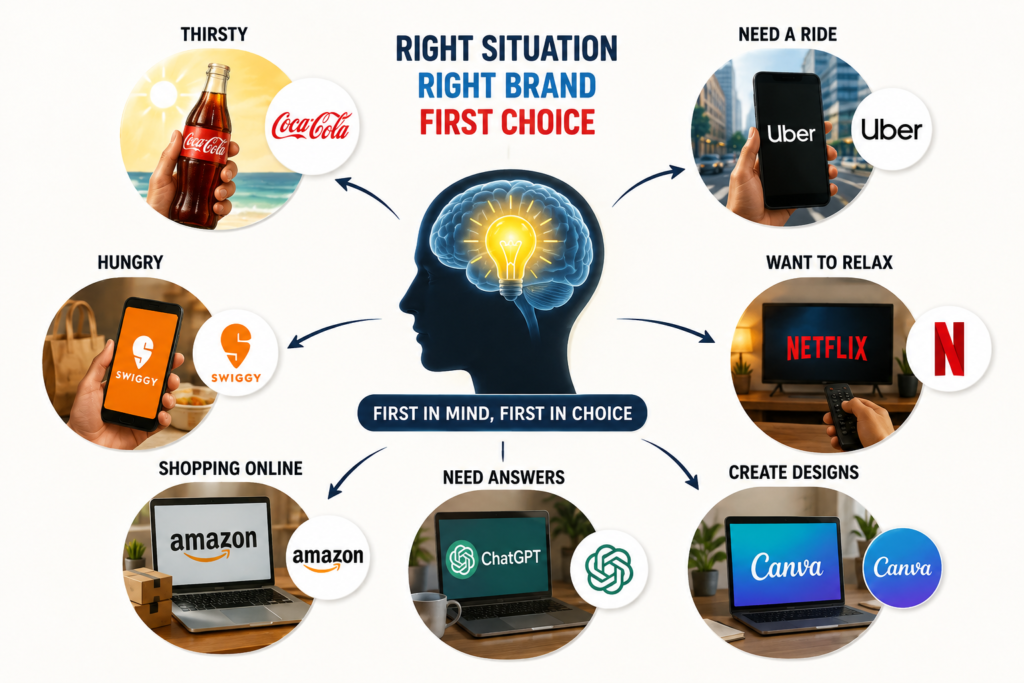
How Brands Become the First Choice in Different Buying Situations is one of the most fascinating concepts in modern marketing. Every day, customers make countless buying decisions, yet they rarely compare every available brand. Instead, they instinctively choose the one they remember first and trust the most. Whether it’s grabbing a Coca-Cola on a hot summer day, booking an Uber when running late, or opening Canva to design a presentation, these choices are rarely accidental. They are the result of years of strategic branding, customer experiences, and consistent marketing.
Imagine you’ve just landed at an airport after a long flight.
You’re thirsty.
Without comparing prices or reading labels, you walk straight to the refrigerator and grab a bottle of Coca-Cola.
Now imagine another situation.
It’s raining heavily, and you’re getting late for an important meeting.
You instinctively open Uber.
Or suppose it’s Friday night, you’re exhausted after work, and you want to relax.
Without much thought, you open Netflix.
Have you ever wondered why?
Did you spend five minutes comparing every ride-hailing app, every soft drink, or every streaming service before making your decision?
Probably not.
That’s because the world’s most successful brands don’t simply sell products.
They make sure they are the first brand that comes to your mind when a specific situation arises.
This is one of the biggest secrets behind companies like Apple, Amazon, Coca-Cola, Uber, Nike, Netflix, Spotify, and ChatGPT.
Chapter 1: What Does “First Choice Brand” Mean?
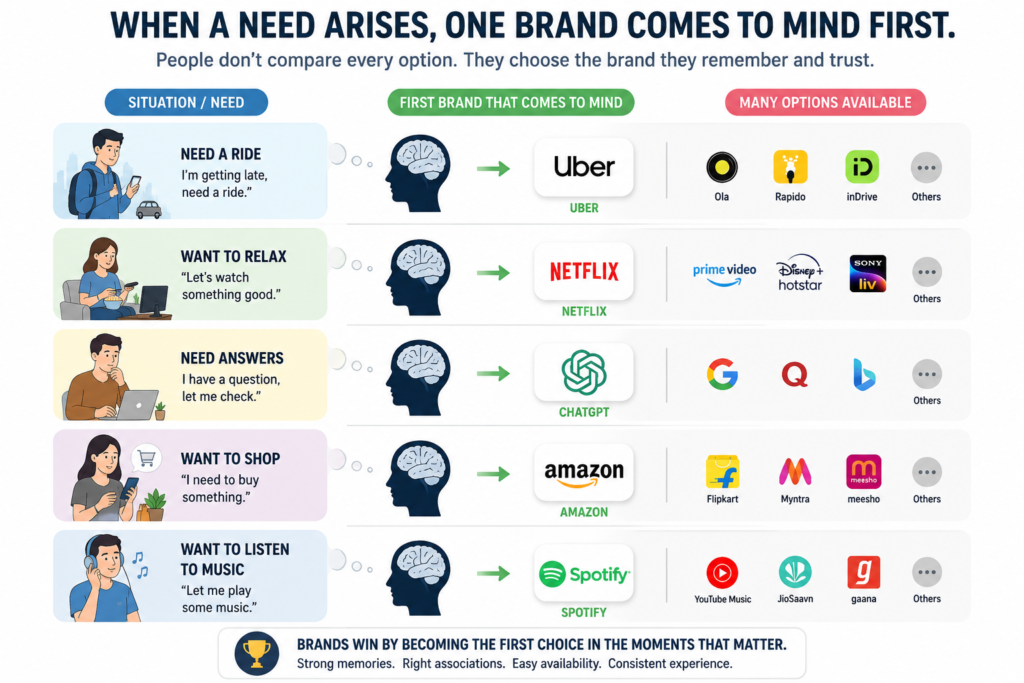
A first-choice brand is the brand customers think of automatically whenever they face a particular need or problem.
Customers don’t consciously decide to remember these brands.
Instead, years of marketing, consistent customer experiences, product quality, and repeated exposure make these brands easy to recall.
Think about these everyday situations.
| Situation | First Brand That Often Comes to Mind |
|---|---|
| Need a ride | Uber |
| Watch movies | Netflix |
| Buy online | Amazon |
| Search something | |
| Listen to music | Spotify |
| Edit photos | Canva |
| Instant messaging | |
| Sports shoes | Nike |
Notice something interesting?
None of these brands became successful overnight.
They became successful because they consistently connected themselves with specific buying situations.
Why Customers Don’t Evaluate Every Brand
One of the biggest myths in marketing is that customers carefully compare every available option before making a purchase.
In reality, very few people do that.
Our brains are designed to save energy.
Every day, we make thousands of decisions.
If we analyzed every purchase from scratch, we’d quickly become mentally exhausted.
Psychologists call this decision fatigue.
Instead of evaluating every option, our brains rely on shortcuts.
These shortcuts are known as mental associations.
For example:
“I’m hungry.”
↓
Swiggy
“I need groceries quickly.”
↓
Blinkit
“I have a question.”
↓
ChatGPT
“I need to attend an online meeting.”
↓
Zoom
Customers rarely compare ten different alternatives.
They usually choose the first trusted option that comes to mind.
That’s exactly why becoming the first recalled brand is so valuable.
The Science Behind Customer Memory
Customers don’t remember brands randomly.
Every brand competes for a small space inside a customer’s memory.
Whenever a buying situation occurs, the brain searches its memory for the easiest solution.
Think of your brain like Google Search.
When you type:
“Ride”
Google instantly suggests Uber.
When you think:
“Online shopping”
Your brain suggests Amazon.
When you’re bored,
Netflix appears.
The brand doesn’t necessarily win because it’s objectively the best.
It wins because it was easiest to remember.
Marketing experts call this Mental Availability.
Chapter 2: What Is Mental Availability?
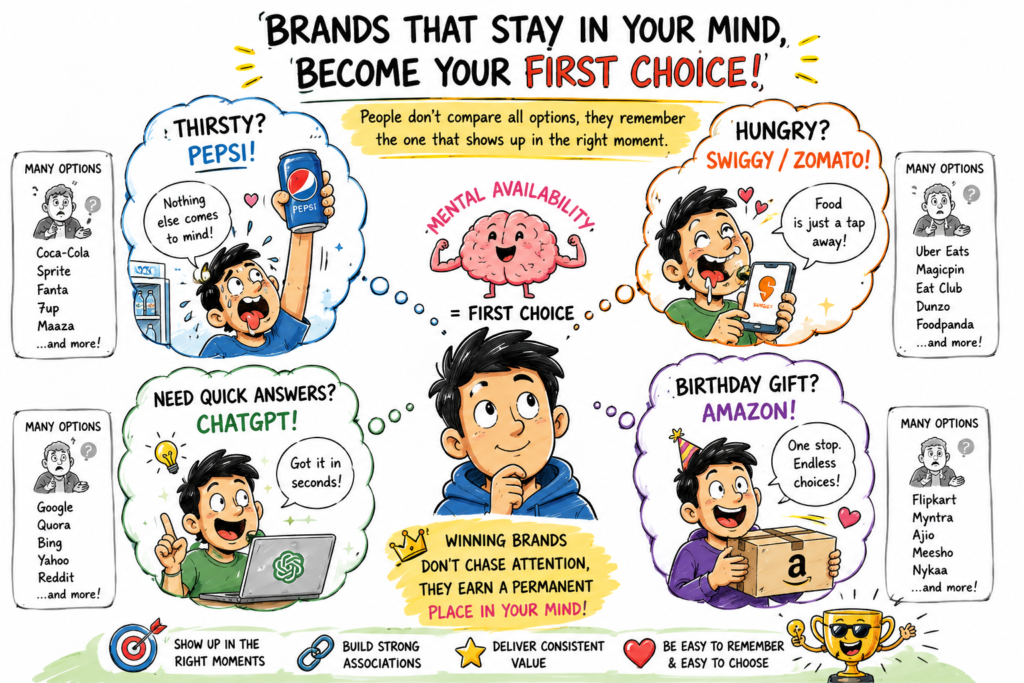
Mental Availability is the likelihood that a customer will think about your brand when they are ready to buy.
Simply put,
Mental Availability means being the first brand customers remember in a buying situation.
It has very little to do with advertising alone.
Instead, it is built through consistent exposure, memorable branding, customer experiences, emotional connections, and repeated usage.
Imagine you’re planning a family vacation.
You need accommodation.
Which brand appears first?
Many people immediately think of Airbnb.
Now imagine you’re preparing a presentation.
Canva probably appears before many other design tools.
These companies have successfully connected themselves to particular buying situations.
That connection is what marketers spend years trying to build.
Mental Availability in Everyday Life
Let’s look at a few examples.
Situation 1
You’re thirsty while shopping.
Most people think about Coca-Cola or Pepsi.
Not because they compared every beverage.
Because those brands are deeply stored in memory.
Situation 2
You’re hungry after work.
Many people immediately open Swiggy or Zomato.
They don’t search:
“Top 25 food delivery apps.”
The first familiar option usually wins.
Situation 3
You need quick answers.
Increasingly, many professionals open ChatGPT.
Why?
Because repeated positive experiences have strengthened their memory of the brand.
Situation 4
You want to buy a birthday gift.
Amazon becomes the default option for millions of shoppers.
Again, not because it’s the only marketplace.
Because it has become mentally available.
Chapter 3: Mental Availability vs Brand Awareness
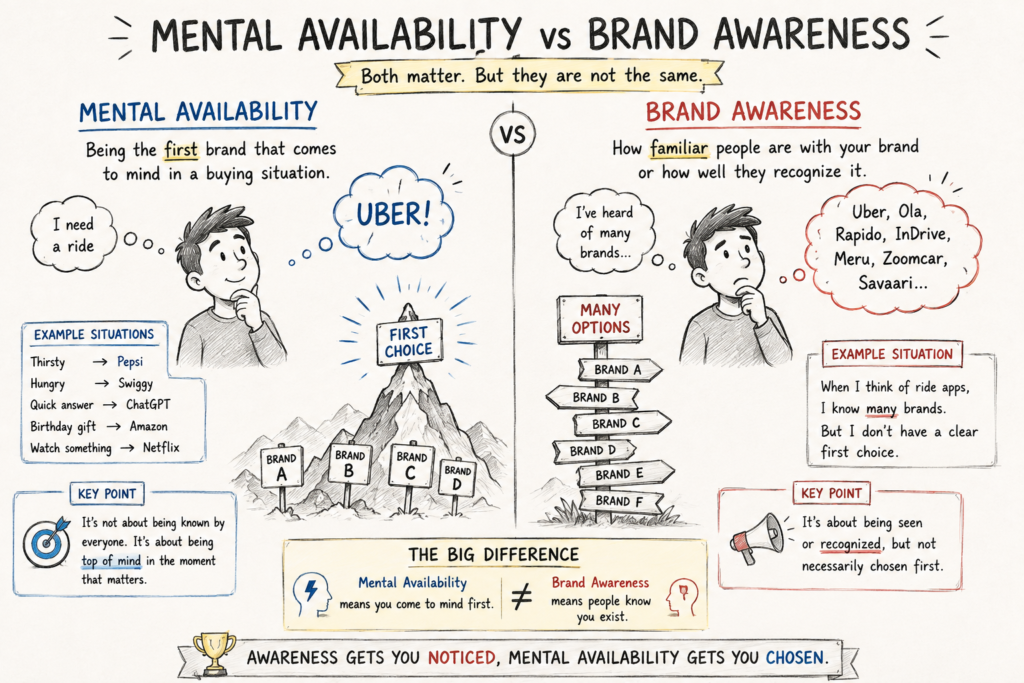
Many people confuse these two concepts.
They are related, but not identical.
Brand Awareness
Brand Awareness means how familiar people are with your brand or whether they recognize it.
People may know your brand exists, but they may not choose it first.
Simple Example:
You know brands like Puma, Reebok, Skechers, and Adidas exist. That’s Brand Awareness. But if you immediately think of Nike when buying running shoes, that’s Mental Availability.
In simple terms: Brand Awareness means people know your brand. Mental Availability means people choose your brand first.
Customers know your brand exists.
Example:
“I’ve heard about Canva.”
Mental Availability
Mental Availability means how quickly your brand comes to a customer's mind when they need a product or service.
Simple Example:
When you’re hungry and immediately think of Swiggy, or when you have a question and instantly open ChatGPT, that’s Mental Availability.
In simple terms: Mental Availability is being the first brand people remember when they need something.
Customers remember your brand exactly when they need it.
Example:
“I need to create a presentation.”
↓
“Let’s use Canva.”
That’s a huge difference.
Many brands have awareness.
Very few become the first choice.
Chapter 4: What Is Physical Availability?
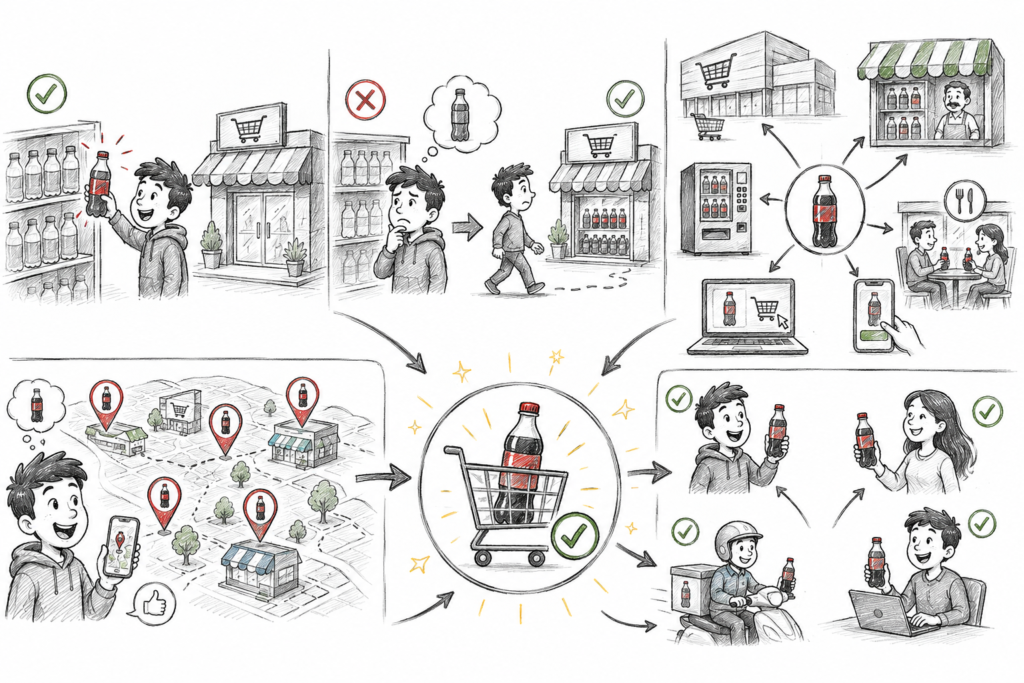
Even if customers remember your brand, they still need access to it.
This is called Physical Availability.
Definition
Physical Availability means making your product or service easy to find, buy, and use whenever customers need it.
Imagine Coca-Cola spending millions on advertising.
Customers walk into a store wanting Coke.
But the shelves are empty.
Instead, only Pepsi is available.
What happens?
Many customers simply buy Pepsi.
Because availability often beats preference.
This is why successful companies invest heavily in distribution.
Examples include:
- Amazon offers fast delivery across thousands of locations.
- Blinkit delivers groceries within minutes.
- McDonald’s has restaurants in convenient locations.
- Uber operates across hundreds of cities.
- Netflix is available on phones, TVs, tablets, and laptops.
Customers shouldn’t have to work hard to buy your product.
The easier you make it, the more sales you’ll generate.
Chapter 5: Category Entry Points (CEPs): The Hidden Trigger Behind Every Purchase
Imagine it’s 8:00 AM.
You’re rushing to work and stop at a café for coffee.
Now imagine it’s 9:30 PM.
You’ve finished dinner and suddenly crave something sweet.
Different moments.
Different needs.
Different buying decisions.
These moments are called Category Entry Points (CEPs).
What Are Category Entry Points?
A Category Entry Point is a situation, emotion, location, or occasion that triggers someone to think about buying a product or service.
In simple words,
Category Entry Points are the moments that make customers think, "I need this right now."
The more buying situations a brand owns, the more opportunities it has to become the customer’s first choice.
How Brands Become the First Choice in Different Buying Situations
Customers rarely compare dozens of brands.
Instead, they remember the brand that has built the strongest connection with a specific buying moment.
Let’s look at a few examples.
Coca-Cola
Buying Situation
“I’m thirsty on a hot summer day.”
↓
Coca-Cola
Coca-Cola doesn’t simply advertise a soft drink.
It connects its brand with celebrations, cricket matches, family gatherings, festivals, vacations, restaurants, and happy moments.
Over the years, these emotional associations make Coca-Cola one of the first beverages people think about whenever they’re thirsty.
IKEA
Buying Situation
“I’ve moved into a new home.”
↓
IKEA
Instead of selling furniture, IKEA positions itself as the solution for creating a comfortable and stylish home.
Customers associate IKEA with new beginnings, affordable design, and home improvement.
Nike
Buying Situation
“I want to start working out.”
↓
Nike
Nike doesn’t sell shoes.
It sells motivation, confidence, and achievement.
Its “Just Do It” message has become closely linked with fitness and personal growth.
Canva
Buying Situation
“I need to create a presentation or social media post.”
↓
Canva
Instead of learning complicated design software, millions of people immediately think of Canva because it makes designing simple and accessible.
Airbnb
Buying Situation
“I’m planning a vacation.”
↓
Airbnb
Airbnb is no longer just an accommodation platform.
It has become associated with unique travel experiences and local stays, making it one of the first brands travelers consider.
Chapter 6: Mental Availability + Physical Availability = Brand Growth
According to marketing scientist Byron Sharp, brands grow when they improve two things:
Mental Availability
Can customers remember your brand when they need it?
Physical Availability
Can customers easily buy your product or service?
Having only one isn’t enough.
If customers remember your brand but can’t find it, you lose the sale.
If your product is available everywhere but no one remembers it, you also lose the sale.
Successful brands invest in both memory and accessibility.
Real-World Examples
Coca-Cola
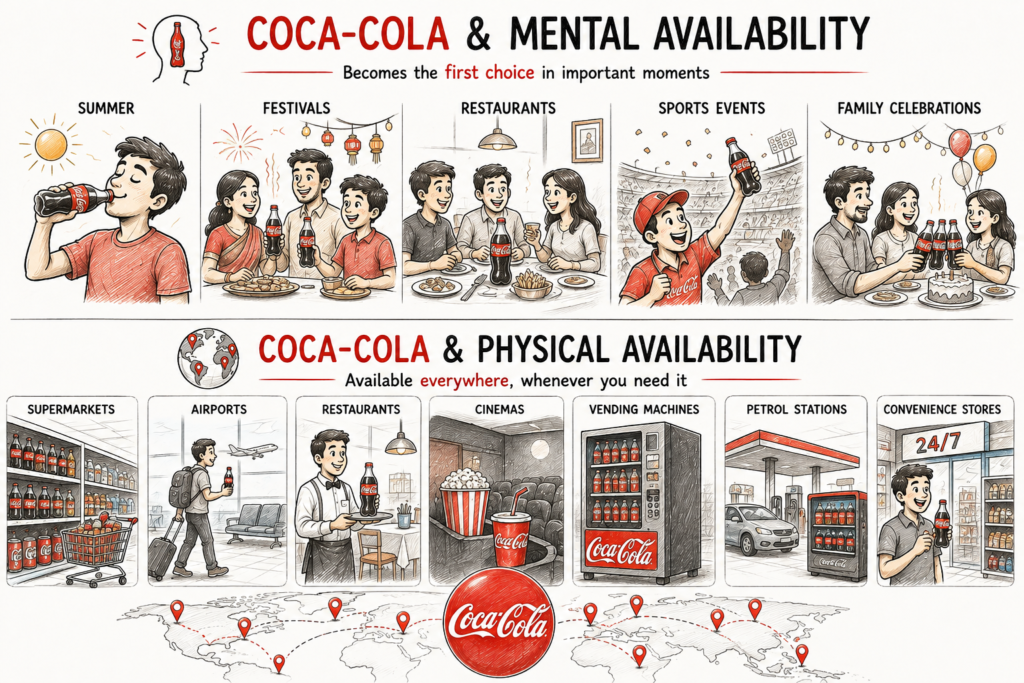
Mental Availability
Summer.
Festivals.
Restaurants.
Sports events.
Family celebrations.
Physical Availability
Available in supermarkets, airports, restaurants, cinemas, vending machines, petrol stations, and convenience stores worldwide.
IKEA
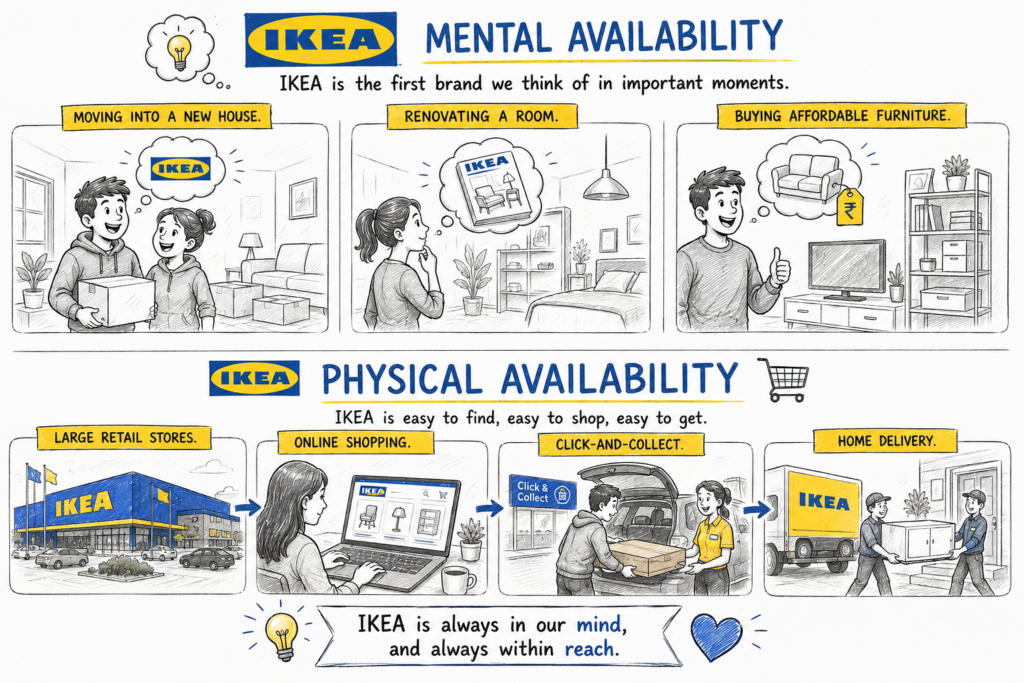
Mental Availability
Moving into a new house.
Renovating a room.
Buying affordable furniture.
Physical Availability
Large retail stores.
Online shopping.
Click-and-collect services.
Home delivery.
Canva
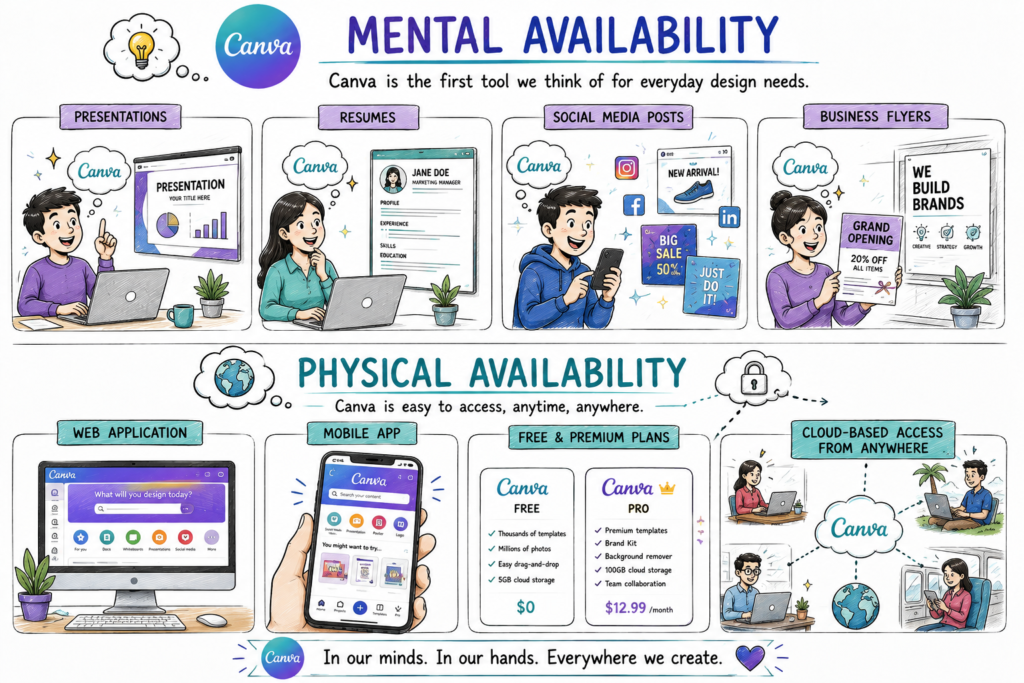
Mental Availability
Presentations.
Resumes.
Social media posts.
Business flyers.
Physical Availability
Web application.
Mobile app.
Free and premium plans.
Cloud-based access from anywhere.
How AI Is Reshaping Mental Availability
Traditionally, brands became memorable through television commercials, newspaper ads, billboards, and sponsorships.
Today, Artificial Intelligence is fundamentally changing how brands stay in customers’ minds.
Instead of broadcasting the same message to everyone, AI delivers highly personalized experiences based on individual preferences, behavior, and intent.
Every personalized interaction strengthens brand recall.
Rather than asking customers to remember a brand, AI gives them reasons to return repeatedly.
Coca-Cola: AI-Powered Personalization
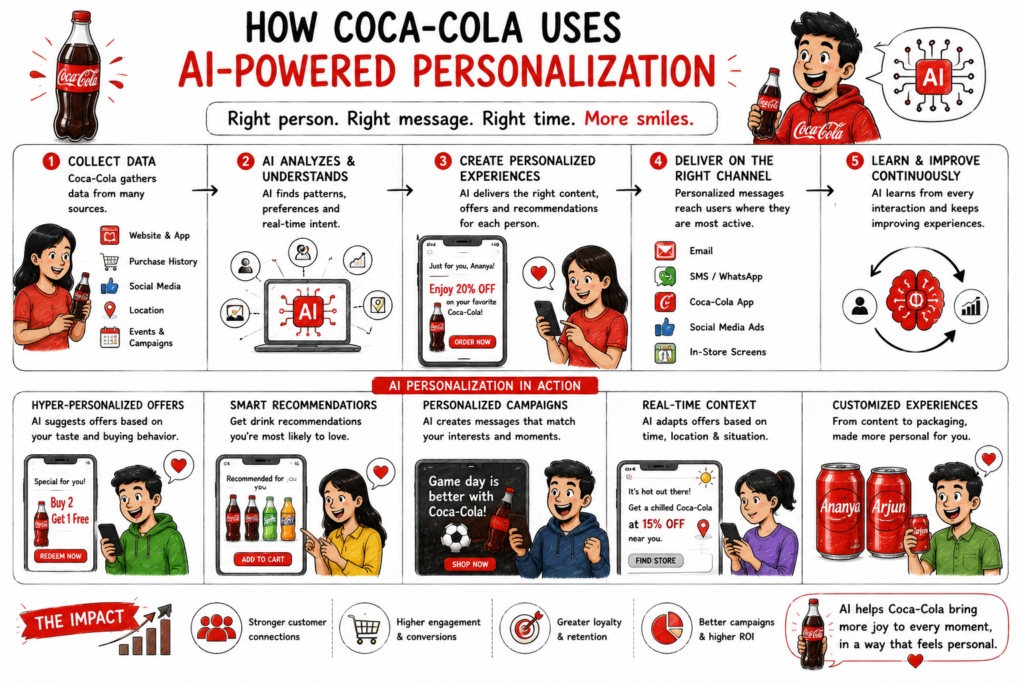
Coca-Cola has begun using AI to create personalized marketing campaigns, digital experiences, and customer engagement.
Instead of generic advertisements, AI helps the company understand consumer preferences and create more relevant content.
The result is stronger emotional connections and better brand recall.
Netflix: AI Knows What You Want to Watch
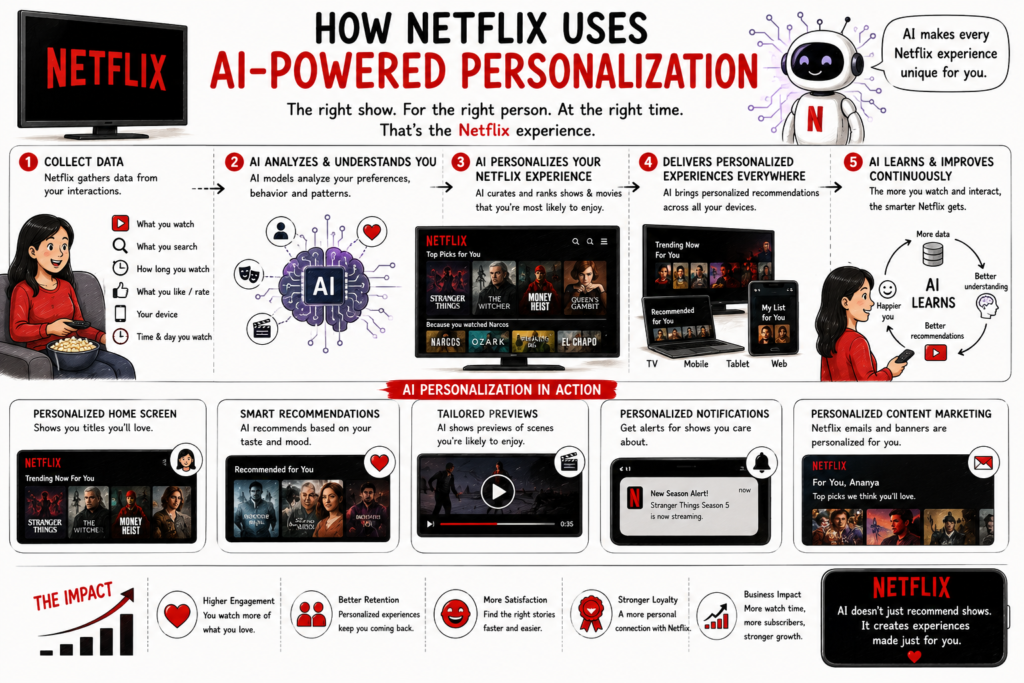
Netflix analyzes your viewing history, favorite genres, watch time, and preferences.
Instead of spending twenty minutes searching for something to watch, you immediately see content you’ll likely enjoy.
This reduces decision fatigue and increases customer satisfaction.
Over time, Netflix becomes the first entertainment platform that comes to mind.
Spotify: Personalized Music Every Day
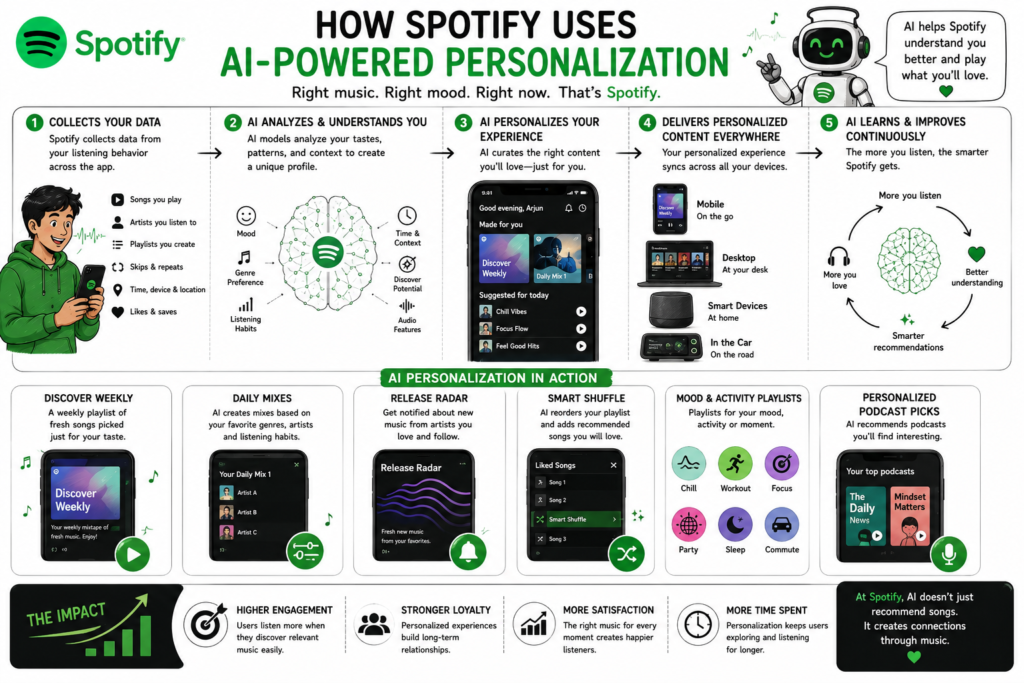
Spotify’s AI creates playlists such as Discover Weekly, Daily Mix, and Release Radar.
These recommendations improve every week.
The more customers enjoy these personalized playlists, the stronger their habit of opening Spotify first whenever they want music.
ChatGPT: Becoming the First Place People Ask Questions
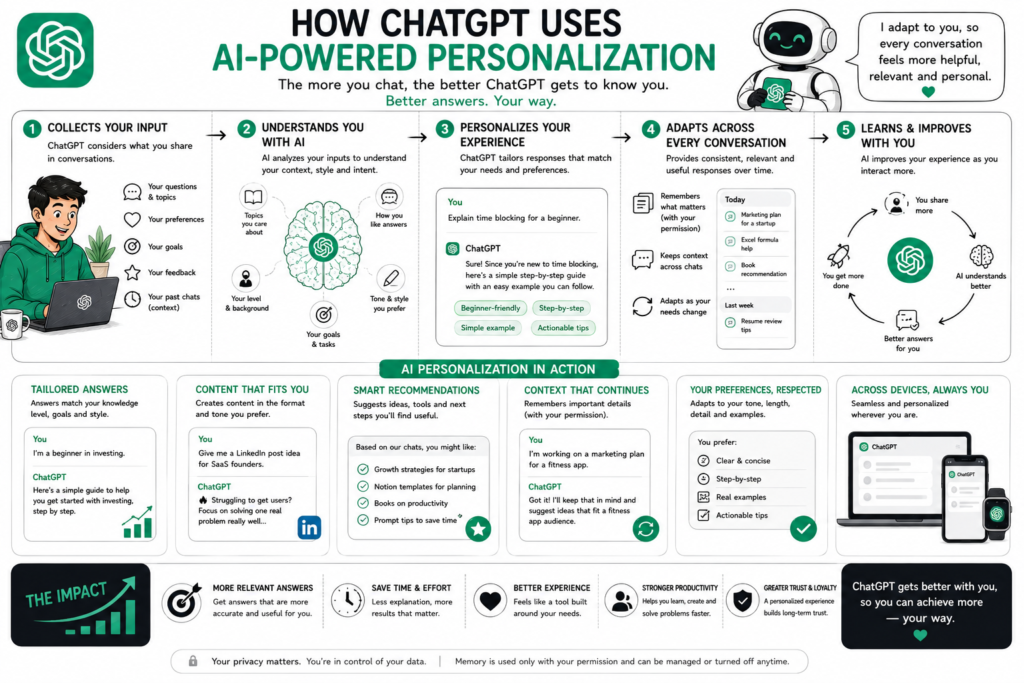
People once searched almost everything on traditional search engines.
Today, many professionals, students, marketers, and entrepreneurs often begin with ChatGPT.
Every useful response builds trust.
Every successful conversation reinforces the habit.
Over time, ChatGPT becomes the first place people think of for learning, brainstorming, writing, and solving problems.
Is AI Changing How Brands Become the First Choice?
Absolutely.
AI isn’t replacing branding.
It’s transforming how brands build relationships and stay memorable.
Instead of depending only on advertisements, brands now use AI to:
- Deliver personalized recommendations.
- Understand customer behavior.
- Predict customer needs.
- Improve customer service.
- Send relevant offers at the right time.
- Create tailored shopping experiences.
- Build stronger long-term relationships.
Customers now expect brands to understand them.
Businesses that use AI responsibly to create better experiences are more likely to become the customer’s first choice.
How AI Will Shape the Future of Branding
The future of branding will be less about broadcasting messages and more about creating meaningful experiences.
Brands that combine AI with strong branding principles will stand out because they can:
- Personalize every customer interaction.
- Reduce decision fatigue.
- Deliver relevant content instantly.
- Improve customer loyalty.
- Increase repeat purchases.
- Strengthen Mental Availability over time.
In the future, customers won’t just remember brands because of advertising.
They’ll remember brands because those brands consistently deliver value exactly when it’s needed.
Frequently Asked Questions (FAQs)
1. Why do customers choose one brand over another?
Customers often choose the brand they remember first and trust most. Familiarity, convenience, positive experiences, and availability usually influence buying decisions more than comparing every available option.
2. What is Mental Availability?
Mental Availability is the likelihood that customers think about your brand when they need a product or service. The easier your brand comes to mind, the higher the chance they’ll choose it.
3. What is Physical Availability?
Physical Availability means making your product or service easy to find, buy, and use across different channels, locations, and devices.
4. How does AI help brands become the first choice?
AI helps brands understand customer behavior, personalize recommendations, improve customer support, and deliver relevant experiences. These interactions strengthen customer trust and make the brand easier to remember.
5. Will AI replace traditional branding?
No. AI is a powerful tool, but it cannot replace trust, brand identity, consistency, or customer experience. Strong branding still depends on delivering value. AI simply helps brands do it more effectively.
6. Can small businesses use AI to build stronger brands?
Yes. Small businesses can use AI for personalized email marketing, customer support chatbots, content creation, product recommendations, and customer insights. Even simple AI tools can improve customer experiences and strengthen brand recall.
Conclusion
Becoming the first choice isn’t about having the biggest advertising budget or the lowest price.
It’s about being remembered at the right moment and being available when customers are ready to buy.
Brands like Coca-Cola, Nike, Canva, IKEA, and Airbnb have achieved this by consistently connecting themselves with specific buying situations. They don’t just promote products, they build lasting mental associations that influence everyday decisions.
Today, AI is accelerating this process. Instead of relying solely on mass advertising, businesses can now deliver personalized experiences that strengthen customer relationships and increase brand recall with every interaction.
The biggest lesson is simple:
Customers don’t always choose the best product. They choose the brand they remember first, trust most, and can access easily.
If you want your business to become the first choice, focus on building Mental Availability, improving Physical Availability, owning more Category Entry Points, and using AI to deliver personalized value at every customer touchpoint. These four principles will help your brand stay relevant today and thrive in the future.