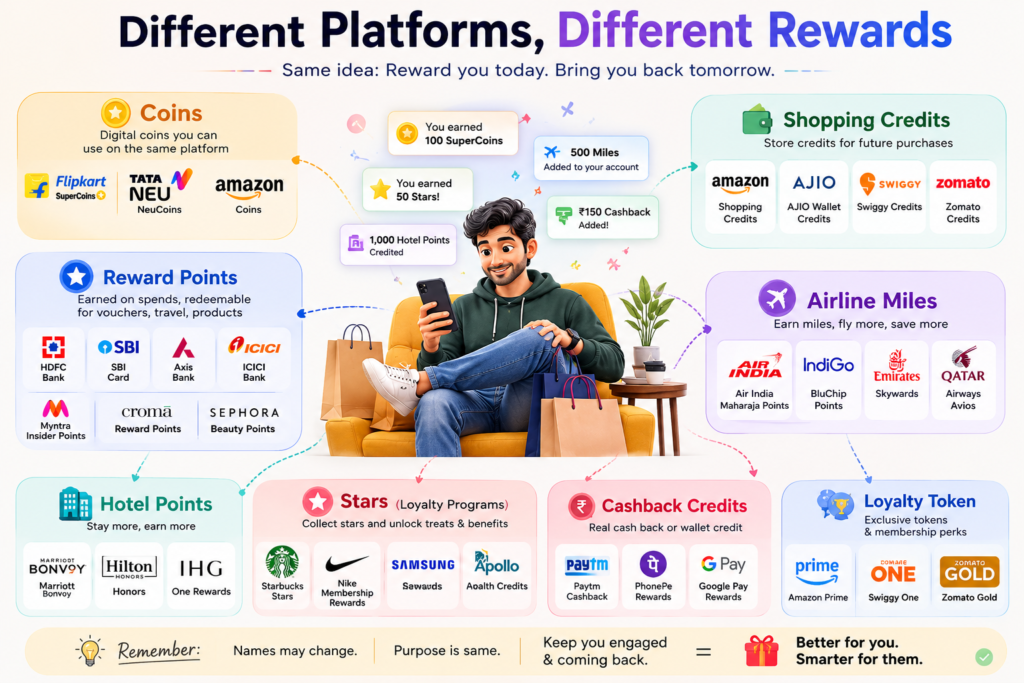
Shopping Rewards are everywhere.
Buy a smartphone on Flipkart.
You earn SuperCoins.
Book a flight.
You receive Airline Miles.
Purchase coffee from Starbucks.
You collect Stars.
Use your credit card.
You earn Reward Points.
Shop across Tata brands.
You receive NeuCoins.
Buy an app from Google Play.
You collect Play Points.
At first glance, all these rewards seem like generous gifts from companies.
After all, who doesn’t love getting something back after shopping?
But have you ever stopped and asked yourself one simple question?
If companies really want to reward customers, why don’t they simply give us cashback?
Why create coins?
Why invent points?
Why issue miles?
Why offer shopping credits?
Why not transfer money directly into our bank accounts?
The answer has very little to do with generosity.
Instead, it has everything to do with consumer psychology, customer loyalty, and long-term business strategy.
Modern companies aren’t just trying to reward today’s purchase.
They’re trying to influence tomorrow’s purchase.
That’s why almost every industry has created its own version of money.
Flipkart has SuperCoins.
Tata has NeuCoins.
Airlines offer Miles.
Hotels provide Reward Points.
Coffee chains reward customers with Stars.
Banks issue Credit Card Reward Points.
Technology companies offer Shopping Credits.
Although these rewards have different names, they all serve the same purpose.
They encourage customers to stay within the company’s ecosystem instead of switching to competitors.
The strategy is so effective that it has become one of the most powerful customer retention techniques in modern marketing.
“Companies reward today’s purchase. Encourage tomorrow’s purchase. That’s what makes Shopping Rewards one of the most successful customer loyalty strategies ever created.”
Shopping Rewards Are Everywhere
We might think Shopping Rewards are limited to e-commerce websites like Flipkart or Tata Neu.
In reality, almost every industry has created its own version of a loyalty currency. Whether we’re booking a flight, ordering coffee, buying electronics, shopping online, or using a credit card, companies reward us with coins, points, miles, stars, or shopping credits to encourage us to return.
Although these rewards have different names, they all serve the same purpose: building customer loyalty and increasing repeat purchases.
| Industry | Company | Reward Name | How Customers Use It |
|---|---|---|---|
| E-commerce | Flipkart | SuperCoins | Discounts, subscriptions, partner offers |
| Retail Ecosystem | Tata Neu | NeuCoins | Redeem across Tata brands (BigBasket, Croma, Westside, etc.) |
| E-commerce Fashion | Myntra | Insider Points | Exclusive rewards, early access, member benefits |
| Electronics | Samsung | Samsung Rewards | Discounts on Samsung products and services |
| Electronics | Croma | Croma Reward Points | Discounts on future purchases |
| Retail | Reliance Digital (RelianceOne) | RelianceOne Points | Redeem across participating Reliance brands |
| Coffee Chain | Starbucks | Stars | Free drinks, food, and rewards |
| Food Delivery | Swiggy | Swiggy One Benefits (membership perks, promotional credits) | Free delivery, discounts, exclusive offers |
| Food Delivery | Zomato | Zomato Gold Benefits (membership perks) | Free delivery, dining offers, discounts |
| Beauty | Sephora | Beauty Insider Points | Beauty products and exclusive rewards |
| Sportswear | Nike | Nike Membership Rewards | Exclusive products, early access, member experiences |
| Hotels | Marriott | Marriott Bonvoy Points | Hotel stays, room upgrades, travel experiences |
| Hotels | Hilton | Hilton Honors Points | Free nights and travel benefits |
| Hotels | IHG | IHG One Rewards Points | Hotel stays and upgrades |
| Airlines | Air India | Maharaja Points | Flights, upgrades, partner rewards |
| Airlines | IndiGo | BluChip Points | Flight bookings and travel benefits |
| Airlines | Emirates | Skywards Miles | Flights, upgrades, shopping |
| Airlines | Singapore Airlines | KrisFlyer Miles | Flights and partner rewards |
| Airlines | Qatar Airways | Avios | Flights and upgrades |
| Credit Cards | HDFC Bank | Reward Points | Vouchers, shopping, travel, cashback options |
| Credit Cards | SBI Card | Reward Points | Shopping, vouchers, travel |
| Credit Cards | Axis Bank | EDGE Rewards | Shopping, travel, gift vouchers |
| Credit Cards | ICICI Bank | Reward Points | Shopping and travel redemption |
| Mobile Apps | Google Play | Google Play Points | Apps, games, in-app purchases |
| Gaming | Xbox | Microsoft Rewards Points | Gift cards, subscriptions, Xbox rewards |
| Gaming | PlayStation | PlayStation Stars Points | Digital collectibles and wallet funds |
| Pharmacy | Apollo | Health Credits / Reward Points | Discounts on medicines and healthcare services |
Chapter 1: What Are Shopping Rewards?
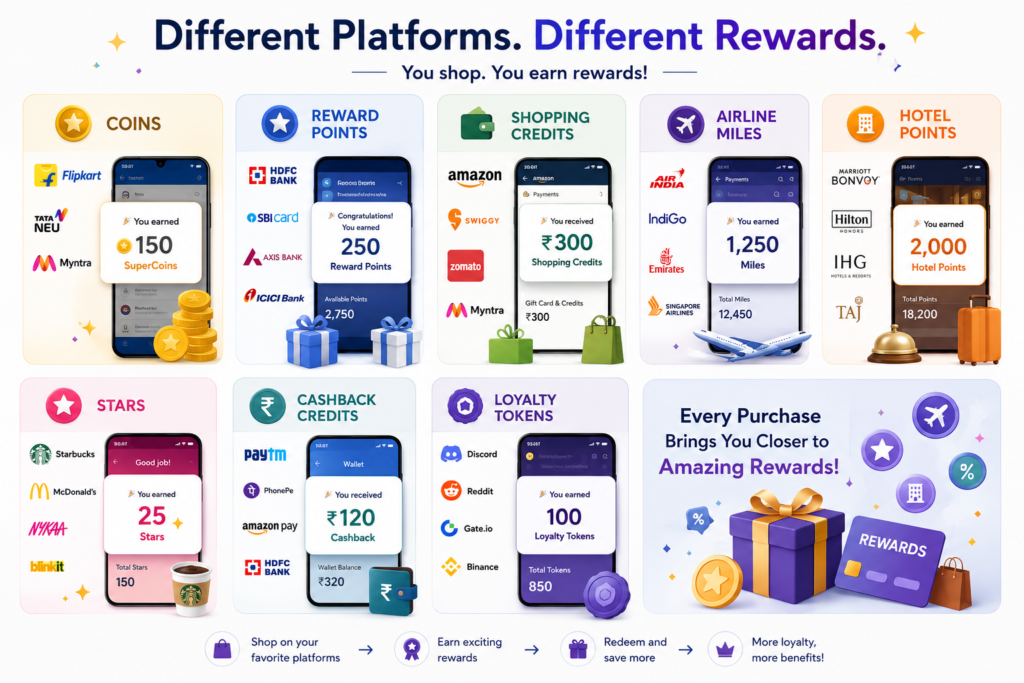
Shopping Rewards are loyalty incentives that companies give customers after they complete specific actions, such as making a purchase, booking a service, using a credit card, or engaging with a brand.
Unlike cashback, which returns real money, Shopping Rewards usually stay within the company’s own ecosystem.
These rewards may appear in different forms, including:
- Coins
- Reward Points
- Shopping Credits
- Airline Miles
- Hotel Points
- Stars
- Cashback Credits
- Loyalty Tokens
Although their names vary, the idea is remarkably similar.
Companies reward customers with something that encourages them to return for future purchases.
Think of Shopping Rewards as a private currency created by a business.
Just as countries have their own currencies like the Indian Rupee or the US Dollar, companies create their own reward currencies that usually work only within their own platforms or partner networks.
For example:
- Flipkart uses SuperCoins.
- Tata Neu uses NeuCoins.
- Starbucks rewards customers with Stars.
- Airlines reward frequent travelers with Miles.
- Banks provide Reward Points through credit cards.
- Google Play offers Play Points for digital purchases.
The names may differ, but the objective remains the same.
Reward today’s purchase.
Encourage tomorrow’s purchase.
That’s what makes Shopping Rewards one of the most successful customer loyalty strategies ever created.
Chapter 2: Coins, Points, Miles, Credits & Cashback Explained
Some companies give coins.
Some offer reward points.
Some reward customers with miles.
Others provide shopping credits or cashback.
Although they all reward customers after a purchase, they don’t work in the same way.
Let’s understand each one with simple definitions and real-world examples.
1. What Are Shopping Coins?
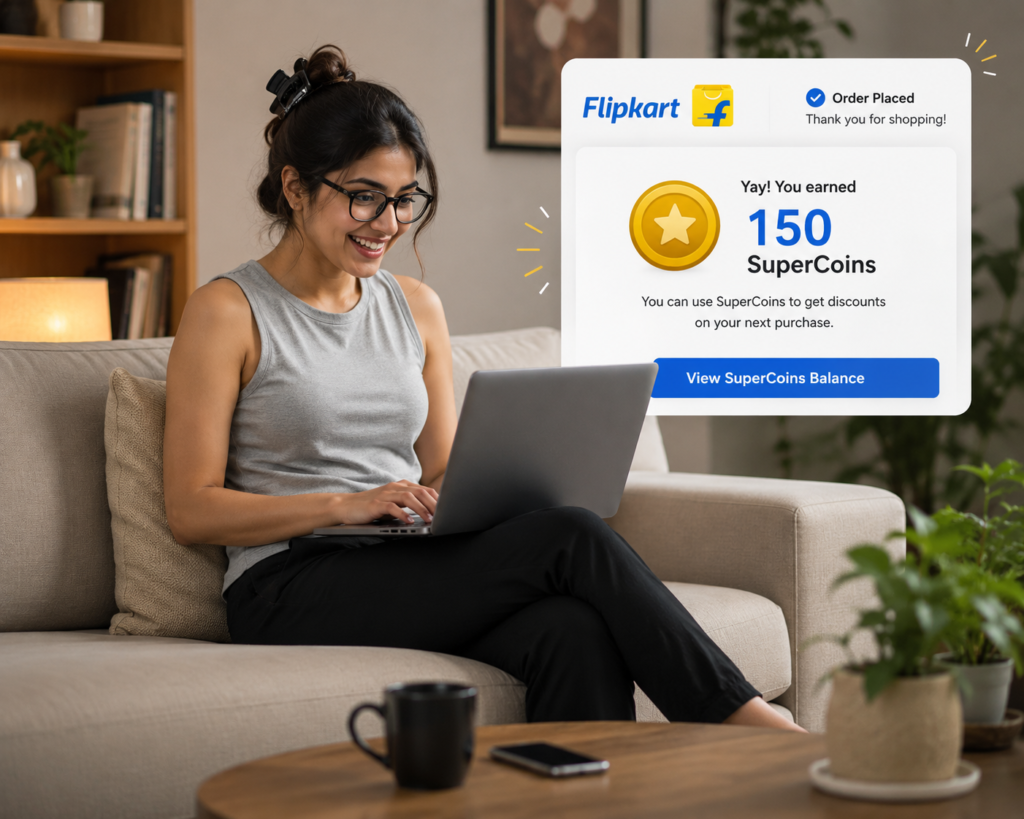
Shopping Coins are digital loyalty rewards that companies give customers after they make eligible purchases or complete certain activities.
Unlike real money, coins usually cannot be withdrawn to a bank account. Instead, they can only be redeemed within the company’s platform or with selected partners.
Think of coins as a company’s own digital currency.
How Do Customers Earn Coins?
Customers may earn coins by:
- Purchasing eligible products
- Participating in promotional campaigns
- Daily app check-ins
- Referring friends
- Completing challenges
- Using partner payment methods
How Do Customers Use Coins?
Coins are generally redeemed during the next purchase.
For example:
Imagine you buy a smartwatch worth ₹5,000 on Flipkart.
↓
You earn 50 SuperCoins.
A month later, you purchase headphones.
During checkout, Flipkart displays:
Use 40 SuperCoins to save ₹40.
You select the option.
Your order value decreases accordingly.
Some platforms also allow coins to be redeemed for:
- OTT subscriptions
- Travel bookings
- Shopping vouchers
- Gift cards
- Exclusive partner offers
Real Examples
- Flipkart → SuperCoins
- Tata Neu → NeuCoins
Although they have different names, both are designed to encourage repeat purchases.
2. What Are Reward Points?
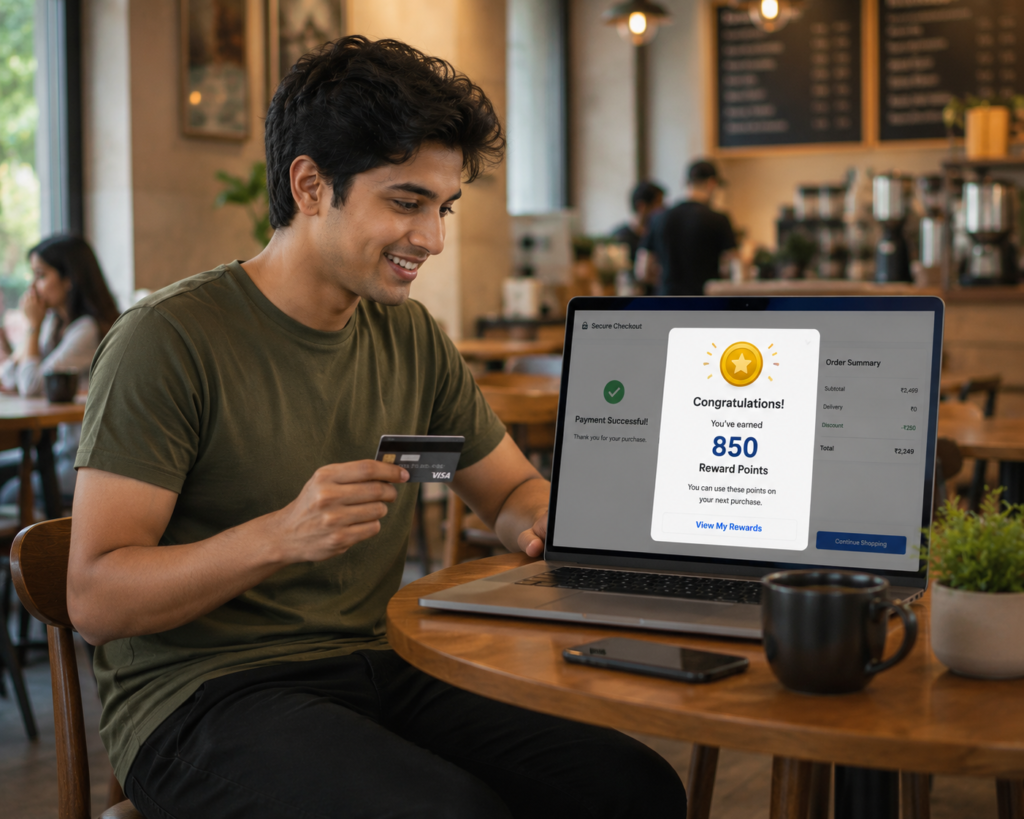
Reward Points are loyalty points earned when customers shop using credit cards or purchase products from participating brands.
Unlike shopping coins, reward points often provide greater flexibility because they can sometimes be redeemed across multiple categories.
How Do Customers Earn Reward Points?
Customers usually earn points by:
- Shopping with credit cards
- Dining
- Fuel purchases
- Online shopping
- International transactions
- Booking travel
Many banks reward customers based on the amount spent.
For example:
Spend ₹100.
↓
Earn 2 Reward Points.
The exact earning rate depends on the bank and card type.
How Do Customers Redeem Reward Points?
Reward points are commonly redeemed for:
- Gift vouchers
- Shopping discounts
- Flight bookings
- Hotel stays
- Cashback (on selected cards)
- Electronics
- Merchandise
Real Examples
- HDFC Bank Reward Points
- SBI Card Reward Points
- Axis EDGE Rewards
- ICICI Reward Points
- American Express Membership Rewards
Each bank has its own redemption catalogue and point value.
3. What Are Shopping Credits?
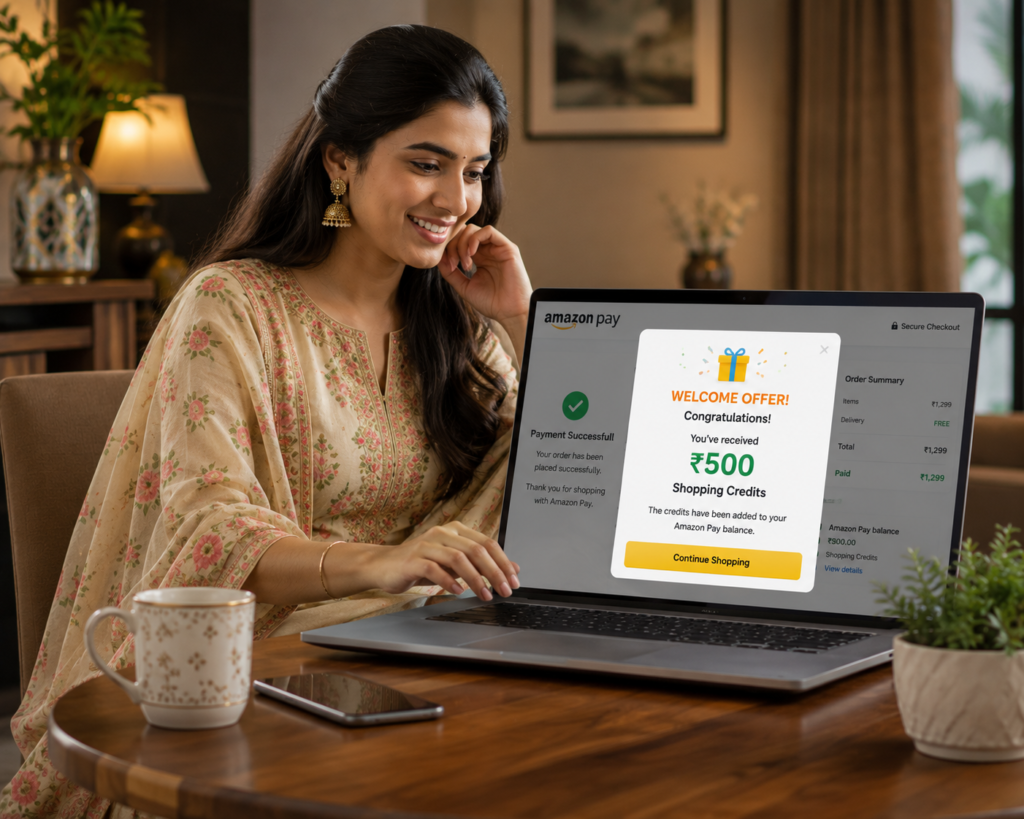
Unlike coins or points, Shopping Credits represent a monetary value that can be used only on a specific platform.
Think of shopping credits as store money.
They cannot usually be transferred to your bank account.
How Do Customers Earn Shopping Credits?
Companies provide credits through:
- Promotional campaigns
- Order cancellations
- Product returns
- Referral programs
- Welcome offers
- Customer service compensation
How Do Customers Use Shopping Credits?
Imagine Amazon gives you a ₹300 promotional shopping credit.
During your next purchase, that ₹300 is automatically applied to your eligible order.
You simply pay the remaining balance.
Real Examples
- Amazon Shopping Credits
- Amazon Pay Promotional Credits
- AJIO Promotional Wallet Credits
- Swiggy Promotional Credits
- Zomato Promotional Credits
These credits often come with conditions such as expiry dates or minimum order values.
4. What Are Airline Miles?

Airline Miles are loyalty rewards given to frequent flyers.
Originally, miles represented the distance travelled.
Today, they function more like loyalty currency.
The more you fly or spend with airline partners, the more miles you accumulate.
How Do Customers Earn Airline Miles?
Customers can earn miles by:
- Booking flights
- Using airline credit cards
- Shopping with airline partners
- Booking hotels
- Renting cars
- Purchasing travel packages
How Do Customers Redeem Airline Miles?
Miles can usually be redeemed for:
- Free flights
- Seat upgrades
- Extra baggage allowance
- Lounge access
- Hotel stays
- Partner rewards
Real Examples
- Air India → Maharaja Points
- Emirates → Skywards Miles
- Singapore Airlines → KrisFlyer Miles
- IndiGo → BluChip
- Qatar Airways → Avios
For frequent travellers, miles often become more valuable than small cash discounts.
5. What Are Hotel Reward Points?
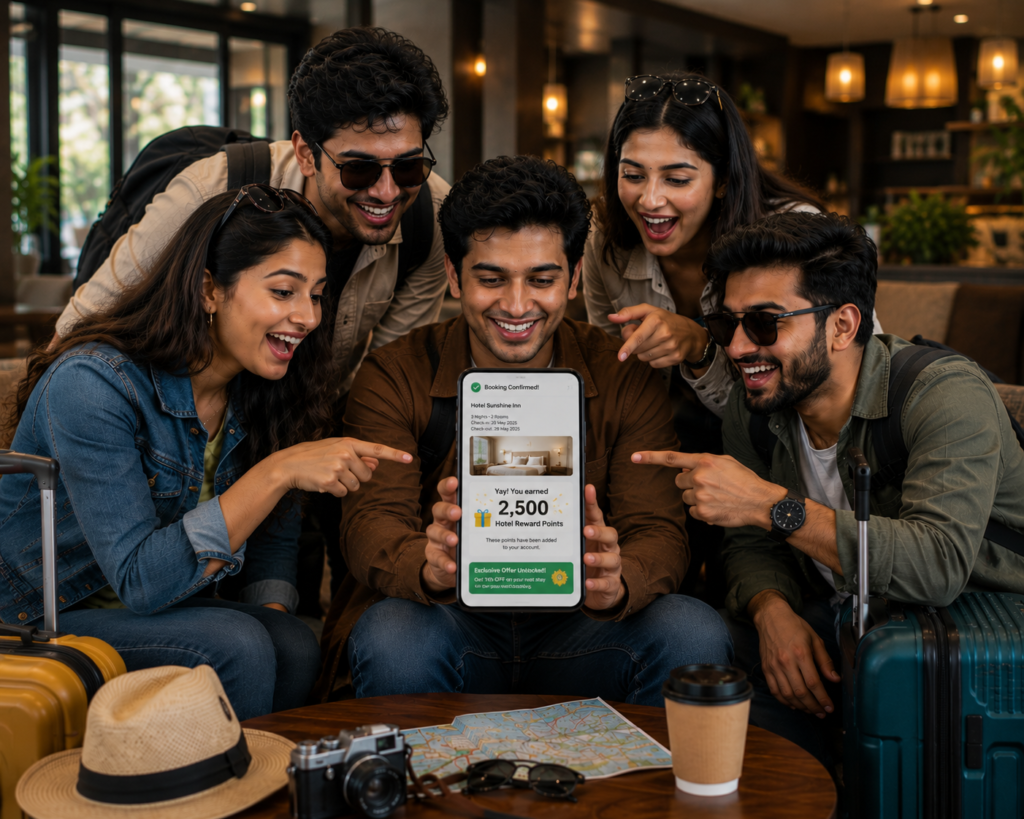
Hotel chains reward loyal guests with points every time they book rooms or spend on hotel services.
These programs encourage travellers to stay within the same hotel group instead of trying competitors.
How Do Customers Earn Hotel Points?
Guests earn points through:
- Hotel stays
- Dining
- Spa services
- Credit card partnerships
- Travel promotions
How Do Customers Redeem Hotel Points?
Hotel points are commonly redeemed for:
- Free hotel nights
- Room upgrades
- Complimentary meals
- Exclusive member experiences
- Travel packages
Real Examples
- Marriott → Bonvoy Points
- Hilton → Hilton Honors Points
- IHG → IHG One Rewards
6. What Is Cashback?
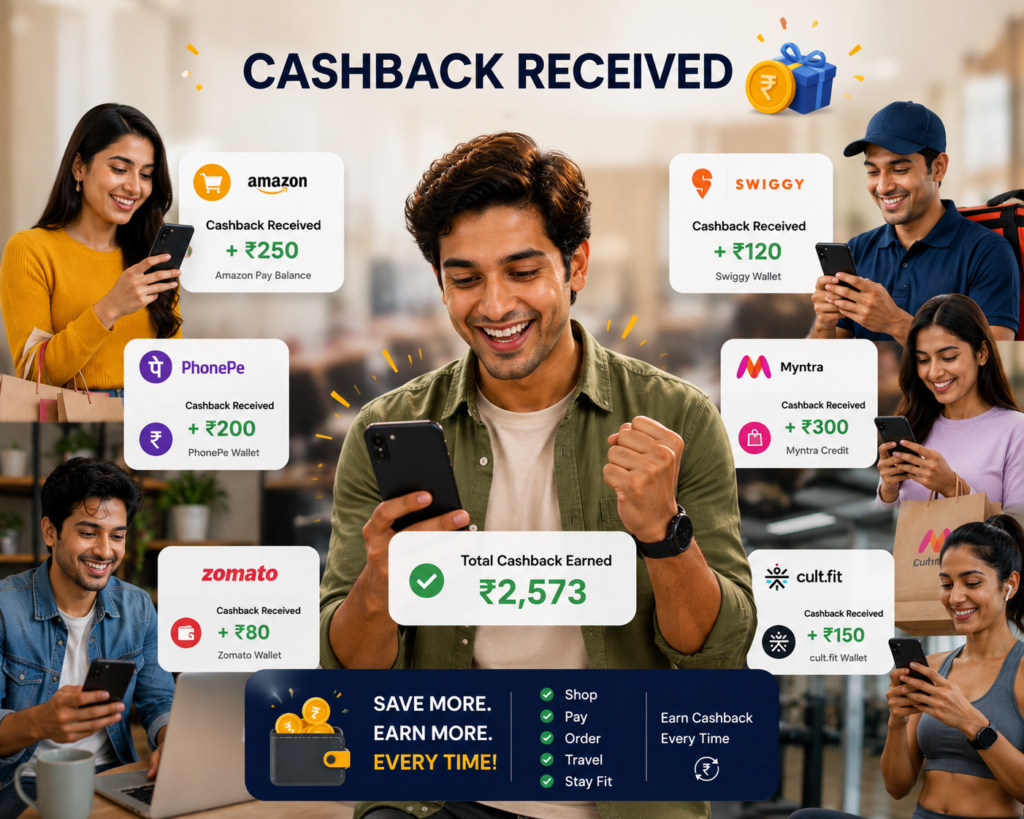
Cashback is the simplest reward system.
Instead of giving loyalty currency, companies return a portion of your spending as actual money or wallet balance.
Example
You purchase shoes worth ₹2,000.
Offer:
5% Cashback
↓
You receive ₹100.
Depending on the platform, cashback may be:
- Credited to your bank account.
- Added to your wallet.
- Added to your payment account.
- Used for future purchases.
Unlike coins or points, cashback usually has a direct monetary value.
That’s why customers often perceive cashback as more valuable.
A Quick Comparison
| Reward Type | Given By | Can You Withdraw It? | Common Uses |
|---|---|---|---|
| Coins | Flipkart, Tata Neu | ❌ No | Discounts, subscriptions, partner offers |
| Reward Points | Banks, brands | Usually No | Vouchers, travel, merchandise |
| Shopping Credits | Amazon, AJIO, Swiggy | ❌ No | Future purchases on the same platform |
| Airline Miles | Airlines | ❌ No | Flights, upgrades, travel benefits |
| Hotel Points | Hotel chains | ❌ No | Free stays, upgrades, experiences |
| Cashback | Banks, payment apps, retailers | Often Yes or wallet credit | Spend like money or use for future payments |
The Interesting Part
At first glance, these reward systems look completely different.
Coins.
Points.
Miles.
Credits.
Cashback.
But from a marketing perspective, they’re all trying to answer one question:
“How can we make customers come back instead of shopping somewhere else?”
That question leads us to the real story behind Shopping Rewards.
Chapter 3: Why Companies Prefer Shopping Rewards Over Cashback
Now we understand the different types of Shopping Rewards, the next question is obvious.
If cashback is more flexible and feels like real money, why don’t companies simply give cashback to every customer?
The answer lies in one word:
Behavior.
Cashback rewards your past purchase.
Shopping Rewards influence your future purchase.
This subtle difference has helped companies build some of the world’s most successful loyalty programs.
Let’s uncover the psychology behind it.
1. Shopping Rewards Keep Customers Coming Back
Imagine you buy a pair of shoes worth ₹3,000.
Scenario A
You receive ₹300 Cashback.
You transfer it to your bank account.
You spend it on groceries.
The shopping website never sees you again.
Scenario B
Instead of cashback, you receive:
300 SuperCoins
These coins can only be used on the same platform.
Now where are you most likely to shop next?
The answer is obvious.
The company hasn’t just rewarded you.
It has given you a reason to return.
This is called Customer Retention.
Companies know that attracting a new customer costs much more than keeping an existing one.
Shopping Rewards encourage repeat purchases, making customers more likely to stay loyal.
2. Shopping Rewards Create the Endowment Effect
Have you ever noticed that once something belongs to you, it suddenly feels more valuable?
Psychologists call this the Endowment Effect.
Definition
The Endowment Effect is a psychological bias where people place a higher value on things simply because they own them.
For example,
Imagine Flipkart tells you:
Congratulations! You now have 850 SuperCoins.
Those coins aren’t cash.
Yet they feel valuable because they’re yours.
You don’t want to waste them.
This feeling increases the chances that you’ll return to redeem them.
Companies understand this psychological bias very well.
3. Shopping Rewards Trigger Loss Aversion
Now imagine another notification appears.
Your 850 SuperCoins will expire in 7 days.
Suddenly those coins feel much more valuable.
Why?
Because humans dislike losing something they already own.
This is called Loss Aversion.
Definition
Loss Aversion is the tendency for people to feel the pain of losing something more strongly than the pleasure of gaining something of equal value.
For example,
Losing ₹500 feels worse than finding ₹500 feels good.
That’s why companies often add expiry dates to reward programs.
The fear of losing accumulated rewards motivates customers to shop again before the rewards disappear.
4. Shopping Rewards Feel Like Free Money
One of the most interesting psychological concepts behind Shopping Rewards is Mental Accounting.
Definition
Mental Accounting is the tendency to treat money differently depending on where it comes from.
Imagine these two situations.
Situation 1
Your friend gives you ₹500.
You carefully think before spending it.
Situation 2
You receive 500 Shopping Reward Points.
Many people spend them without much hesitation.
Why?
Because the brain doesn’t treat reward points like salary or savings.
Instead, it categorizes them as bonus money.
This makes customers more willing to spend.
Companies benefit because reward points often lead to additional purchases beyond the reward value.
5. Shopping Rewards Turn Shopping Into a Game
Have you noticed messages like:
- Earn 100 more points to unlock Gold Membership.
- Collect 500 more Stars for a free drink.
- Complete your next order to earn bonus coins.
These aren’t random promotions.
They’re examples of Gamification.
Definition
Gamification is the use of game-like elements such as points, levels, badges, rewards, and achievements to encourage specific behaviors.
Just like video games reward players for completing levels, shopping platforms reward customers for making purchases.
This creates excitement.
Instead of simply buying products, customers begin collecting rewards.
Shopping becomes more enjoyable and engaging.
6. Shopping Rewards Increase Customer Lifetime Value (CLV)
Businesses don’t measure success by one purchase.
They measure it by how much a customer spends over several years.
This is known as Customer Lifetime Value (CLV).
Definition
Customer Lifetime Value is the total revenue a business expects to earn from a customer throughout their relationship.
Consider these two customers.
Customer A
Shops once.
Never returns.
Customer B
Returns every month because they have reward points to redeem.
Who is more valuable?
Obviously Customer B.
Shopping Rewards encourage repeat purchases, which significantly increase Customer Lifetime Value.
That’s one of the biggest reasons companies invest heavily in loyalty programs.
7. Shopping Rewards Make Switching Harder
Suppose you’ve accumulated:
- 4,000 Airline Miles
- 1,500 Flipkart SuperCoins
- 3,000 Credit Card Reward Points
- 800 Starbucks Stars
Now another company offers slightly lower prices.
Would you switch immediately?
Probably not.
Why?
Because leaving means giving up all those accumulated rewards.
This is known as Switching Cost.
Definition
Switching Cost is the financial, emotional, or practical disadvantage customers experience when changing from one brand to another.
Shopping Rewards increase switching costs without forcing customers to stay.
Instead, customers stay because they don’t want to lose the value they’ve already built.
8. Shopping Rewards Encourage Bigger Purchases
Have you ever seen offers like:
- Spend ₹999 and earn double points.
- Buy one more item to earn 500 bonus coins.
- Spend ₹5,000 to unlock Gold Membership.
These promotions rely on the Goal Gradient Effect.
Definition
The Goal Gradient Effect is a psychological principle where people become more motivated as they get closer to achieving a reward.
Imagine you’ve already earned:
900 Reward Points.
The next reward unlocks at:
1,000 Points.
You’re only 100 points away.
Many customers will happily buy another product just to reach that milestone.
Companies know this.
That’s why loyalty programs often display progress bars showing how close customers are to the next reward level.
The Hidden Truth About Shopping Rewards
At first glance,
coins,
points,
miles,
shopping credits,
and cashback all seem like ways to reward customers.
But in reality, they’re designed to achieve something much bigger.
They shape customer behavior.
They encourage repeat purchases.
They increase loyalty.
They reduce customer churn.
They make people feel invested in a brand.
Most importantly, they transform a one-time buyer into a long-term customer.
That’s why Shopping Rewards have become one of the most effective marketing strategies used by companies across e-commerce, airlines, hotels, banks, restaurants, and digital platforms.
Chapter 4: What Businesses Can Learn from Shopping Rewards
Whether we’re running an e-commerce store, a SaaS company, a coffee shop, an airline, or even a local business, Shopping Rewards offer valuable lessons that go far beyond discounts.
The world’s most successful brands don’t use reward programs just to thank customers.
They use them to build long-term relationships.
Here are the biggest lessons every business can learn.
1. Build Loyalty, Not Just Sales
A single purchase doesn’t build a business.
Repeat purchases do.
Shopping Rewards encourage customers to return instead of trying competitors.
For example, a customer with 1,000 SuperCoins or 5,000 airline miles is more likely to make their next purchase on the same platform because they already have rewards waiting to be redeemed.
The goal isn’t simply to increase today’s sales.
The goal is to increase tomorrow’s sales.
2. Reward Customer Behavior
Modern companies don’t reward only purchases.
They reward actions that help the business grow.
Examples include:
- Writing product reviews.
- Referring friends.
- Booking through the mobile app.
- Using the company’s credit card.
- Purchasing during promotional campaigns.
- Maintaining membership status.
This creates a win-win situation where customers receive benefits while businesses encourage behaviors that support long-term growth.
3. Make Customers Feel They Are Progressing
People enjoy seeing progress.
That’s why many loyalty programs display:
- Bronze
- Silver
- Gold
- Platinum
or
- Level 1
- Level 2
- Level 3
These levels motivate customers to keep shopping because they feel they’re moving toward something valuable.
Sometimes, progress itself becomes more exciting than the reward.
4. Emotional Value Can Be More Powerful Than Monetary Value
A ₹100 cashback and 100 reward points may have similar financial value.
But reward points often feel more exciting because customers have collected them over time.
Businesses understand that emotions influence buying decisions more than numbers.
That’s why they carefully design reward programs to make customers feel accomplished rather than simply compensated.
What Consumers Can Learn
Shopping Rewards aren’t good or bad.
They’re simply marketing tools.
Understanding how they work helps you make smarter decisions.
Before making your next purchase, ask yourself these questions.
1. Am I Buying This Because I Need It?
Or am I buying it just to earn extra points?
Many companies offer promotions like:
Spend ₹500 more and earn double rewards.
If that additional purchase wasn’t already planned, the reward may actually cost you more than it saves.
2. Will I Really Use These Rewards?
Collecting thousands of points feels satisfying.
But many customers forget to redeem them before they expire.
Always check:
- Expiry dates.
- Redemption rules.
- Minimum purchase conditions.
- Eligible products.
Unused rewards provide no value.
3. Compare the Final Price, Not Just the Rewards
Imagine:
Store A
Product Price: ₹4,900
No rewards.
Store B
Product Price: ₹5,300
Offers 500 reward points.
Many shoppers choose Store B because the rewards seem attractive.
However, Store A is still cheaper.
Rewards should never replace comparing the actual price.
4. Understand That Rewards Are Part of the Price
Companies don’t create loyalty programs from thin air.
The cost of reward programs is usually built into their overall business model.
That doesn’t mean rewards aren’t valuable.
It simply means they’re designed to benefit both the customer and the company.
Common Myths About Shopping Rewards
Myth 1: Reward Points Are Free Money
Reality:
Reward points have value, but they usually come with conditions such as expiry dates, minimum spending, or limited redemption options.
Myth 2: More Points Always Mean Better Deals
Reality:
A product with fewer rewards may still be cheaper overall.
Always compare the final purchase price.
Myth 3: Cashback and Reward Points Are the Same
Reality:
Cashback is usually real monetary value.
Reward points typically stay within the company’s ecosystem and encourage future purchases.
Myth 4: Every Reward Program Is Worth Joining
Reality:
Join programs that match your shopping habits.
There’s little benefit in collecting airline miles if you rarely travel or hotel points if you seldom stay in hotels.
Frequently Asked Questions (FAQs)
1. What are Shopping Rewards?
Shopping Rewards are loyalty incentives such as coins, points, miles, shopping credits, or stars that companies give customers after purchases or other qualifying activities to encourage repeat business.
2. Are Shopping Rewards better than cashback?
It depends.
Cashback offers immediate financial value, while Shopping Rewards often provide better long-term benefits if you regularly use the same brand or platform.
3. Why do companies prefer Shopping Rewards over cashback?
Shopping Rewards encourage customer loyalty, repeat purchases, and higher Customer Lifetime Value while keeping customers within the company’s ecosystem.
4. Can Shopping Rewards expire?
Yes.
Many loyalty programs have expiry dates or redemption conditions, so it’s important to use your rewards before they expire.
5. Which industries use Shopping Rewards?
Many industries use loyalty programs, including:
- E-commerce
- Airlines
- Hotels
- Banks
- Coffee chains
- Food delivery apps
- Electronics retailers
- Mobile app stores
- Supermarkets
Final Thoughts
The next time you receive SuperCoins, NeuCoins, Reward Points, Shopping Credits, Stars, or Airline Miles, remember this:
You’re not just receiving a reward.
You’re participating in one of the most successful marketing strategies ever created.
Companies understand that customers don’t simply buy products.
They build habits.
Every coin you earn, every point you collect, and every mile you accumulate increases the likelihood that you’ll return to the same brand.
That’s why Shopping Rewards aren’t merely about saving money.
They’re about creating relationships.
For businesses, loyalty programs increase retention, customer lifetime value, and repeat purchases.
For consumers, they can provide genuine savings, exclusive benefits, and better experiences, but only when used wisely.
The smartest shoppers don’t chase rewards.
They let rewards complement purchases they were already planning to make.
And perhaps that’s the biggest lesson of all.
Companies don’t give you coins, points, miles, or shopping credits simply to thank you for shopping today. They give them to encourage you to shop tomorrow.
Once you understand that, you’ll never look at a loyalty program the same way again.
What We Can Learn as Consumers
Every time you see a notification saying:
- 🎉 “You’ve earned 100 SuperCoins!”
- ⭐ “You’ve earned 50 Stars!”
- ✈️ “500 Miles have been credited!”
- 💳 “You earned 250 Reward Points!”
Pause for a moment.
Instead of asking:
“How much did I earn?”
Ask a different question:
“Why does this company want me to earn this reward instead of simply giving me cash?”
That single question reveals the fascinating psychology behind modern loyalty programs.
The most successful companies don’t just sell products.
They create ecosystems that make customers feel valued, rewarded, and motivated to return.
And that’s the true power of Shopping Rewards.