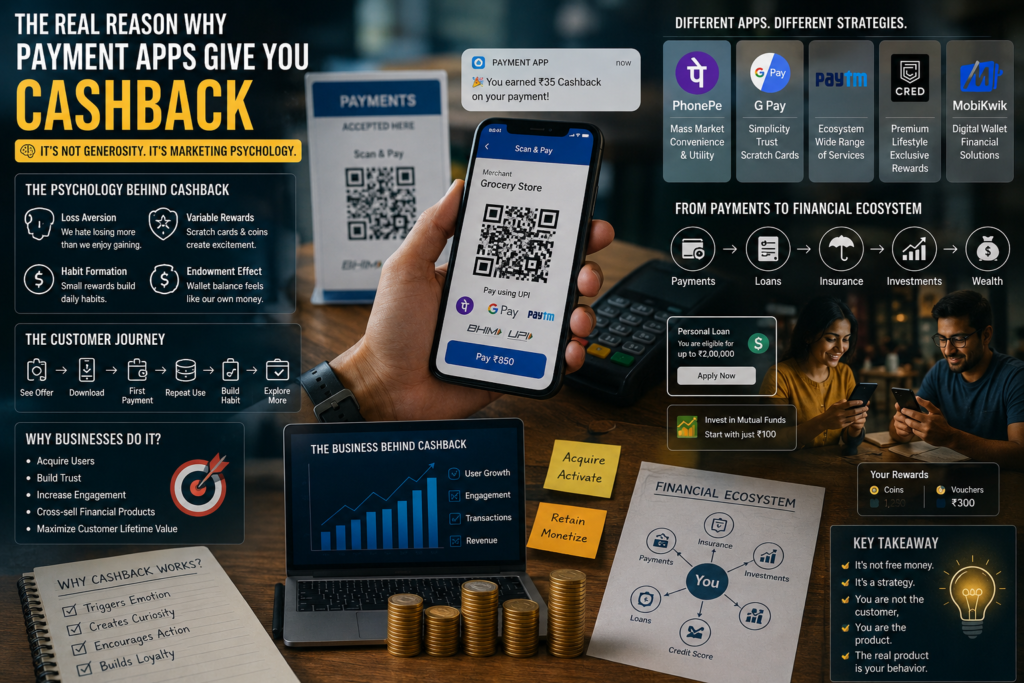
Most People Think Cashback Exists Simply to Attract Users.
That’s only part of the story.
Imagine you’re buying a cup of tea from a roadside stall.
The bill is ₹20.
Instead of reaching for your wallet, you pull out your phone.
You scan a QR code.
Within two seconds, the payment is complete.
Just as you’re about to put your phone away, a notification appears.
🎉 Congratulations! You have won a scratch card🎉.
You tap it.
The card animates across your screen.
For a brief moment, your curiosity peaks.
Will it be ₹5?
₹50?
₹500?
The reward turns out to be ₹7 cashback.
It isn’t a life-changing amount.
Yet somehow, it feels satisfying.
You smile.
You feel like you’ve gained something extra.
Now pause for a moment and ask yourself a question that most people never do.
Why would a billion-dollar company willingly give away its own money?
Businesses are created to generate profits.
Not distribute free cash.
Then why did companies like PhonePe, Google Pay, Paytm, CRED, and MobiKwik spend thousands of crores rewarding users for doing something as simple as making a payment?
Even more interesting…
Why were cashback rewards much higher just a few years ago?
Why did users once receive guaranteed ₹100 or ₹500 rewards, while today they often receive a ₹2 scratch card, loyalty points, or coins?
If UPI payments are free for users, how do these companies build billion-dollar businesses?
Why do some apps focus on cashback while others prefer reward points, coins, or exclusive memberships?
And perhaps the most important question of all.
What exactly do payment apps gain every time you scan a QR code?
Most people would answer:
“A payment.”
But businesses see something entirely different.
They see the beginning of a relationship.
They see a habit forming.
They see a future customer who might later buy insurance, apply for a loan, invest in mutual funds, or subscribe to premium financial services.
In other words, the QR code isn’t the destination.
It’s the starting point.
This article isn’t really about cashback.
It’s about how some of India’s biggest fintech companies used marketing psychology, behavioral economics, product design, and trust to change the payment habits of more than a billion people.
By the end of this guide, you’ll understand that the real product was never cashback.
The real product was changing human behavior.
Table of Contents
- Chapter 1: India’s Digital Payment Revolution: How India Moved from Cash to QR Codes
- Chapter 2: The Biggest Challenge Payment Apps Faced, Changing Human Behavior
- Chapter 3: Cashback Was Never About Cashback, The Marketing Strategy Behind Rewards
- Chapter 5: How Payment Apps Build Habits and Consumer Trust
- Chapter 6: Why Do Most Payment Apps Have Similar Interfaces?
- Chapter 7: Payment Apps vs Mobile Banking Apps: What’s the Real Difference?
- Chapter 8: How Payment Apps Actually Make Money
- Chapter 9: From Cashback to Loans, The Evolution of Fintech Growth
- Chapter 10: Five-Year Competitive Analysis of India’s Leading Payment Apps
- Chapter 11: Why New Payment Apps Like Navi UPI and SuperMoney Still Enter the Market
- Chapter 12: Marketing Lessons Every Business and Consumer Can Learn
Chapter 1: India’s Digital Payment Revolution: How India Moved from Cash to QR Codes
A Time When Cash Was King
Not very long ago, stepping out without cash felt almost impossible.
Whether you visited a supermarket, paid school fees, bought vegetables, or had dinner at a restaurant, cash was the default payment method.
Your wallet mattered more than your smartphone.
If someone had told you in 2012 that one day roadside tea vendors, fruit sellers, auto-rickshaw drivers, and even temple donation boxes would accept payments through a printed QR code, you might have laughed.
At that time, it sounded unrealistic.
Cash had already won people’s trust.
For generations, it was simple, familiar, and universally accepted.
Consumers understood it.
Merchants relied on it.
Families managed household budgets using physical currency.
Changing such a deeply rooted behavior would require much more than new technology.
It would require changing human psychology.
Why India Relied So Heavily on Cash
India’s dependence on cash wasn’t accidental.
It evolved from decades of habit and practical necessity.
Many small businesses operated entirely in cash.
Large sections of the population had limited access to banking services.
Internet connectivity was inconsistent.
Smartphones were still expensive for many households.
Even when people had debit cards, they often withdrew cash from ATMs instead of paying directly with the card.
Why?
Because cash felt certain.
You could hold it.
Count it.
See it.
Trust it.
Behavioral economists explain this through the familiarity effect. People naturally trust systems they have used repeatedly over many years.
Cash wasn’t just money.
It represented certainty.
Digital Payments Already Existed
Many people assume that digital payments began with UPI.
That’s not true.
Before UPI, India already had several digital payment methods, including:
- Debit cards
- Credit cards
- Internet banking
- NEFT
- RTGS
- IMPS
- Mobile banking applications
The technology already existed.
Yet digital payments remained a relatively small part of everyday transactions.
Why?
Because these systems often required multiple steps, passwords, account details, or limited banking hours.
For many consumers, paying with cash was simply easier.
This highlights an important marketing lesson.
The best technology doesn’t always win. The simplest experience often does.
The Rise of Smartphones and Affordable Internet
Around the same time, another transformation was quietly taking place.
Smartphones became more affordable.
Mobile internet expanded rapidly.
Competition among telecom providers drove data prices down.
Millions of Indians who had never owned a personal computer suddenly had internet access in their pockets.
This wasn’t just a technological shift.
It changed how people communicated, shopped, learned, entertained themselves, and eventually, how they paid.
The infrastructure for a digital payment revolution was falling into place.
What was missing was a payment system simple enough for everyone to use.
The UPI Revolution
In 2016, the National Payments Corporation of India (NPCI) introduced the Unified Payments Interface (UPI).
UPI changed one fundamental aspect of digital payments.
It removed friction.
Instead of entering lengthy bank account numbers, IFSC codes, and multiple authentication steps, users could send money instantly using a Virtual Payment Address (VPA) or by scanning a QR code.
Transactions became:
- Fast
- Simple
- Real-time
- Available 24/7
- Directly connected to bank accounts
This wasn’t merely an improvement in technology.
It was an improvement in user experience.
That difference proved to be revolutionary.
Demonetization Accelerated Awareness
Later in 2016, India underwent demonetization, resulting in temporary cash shortages.
For many people and businesses, digital payments shifted from being a convenience to a practical necessity.
This period accelerated awareness and experimentation with digital payment methods.
However, it’s important to separate awareness from long-term adoption.
Demonetization encouraged many people to try digital payments.
What kept them using these services afterward was convenience, growing merchant acceptance, and a smoother payment experience, not demonetization alone.
The QR Code Changed Everything
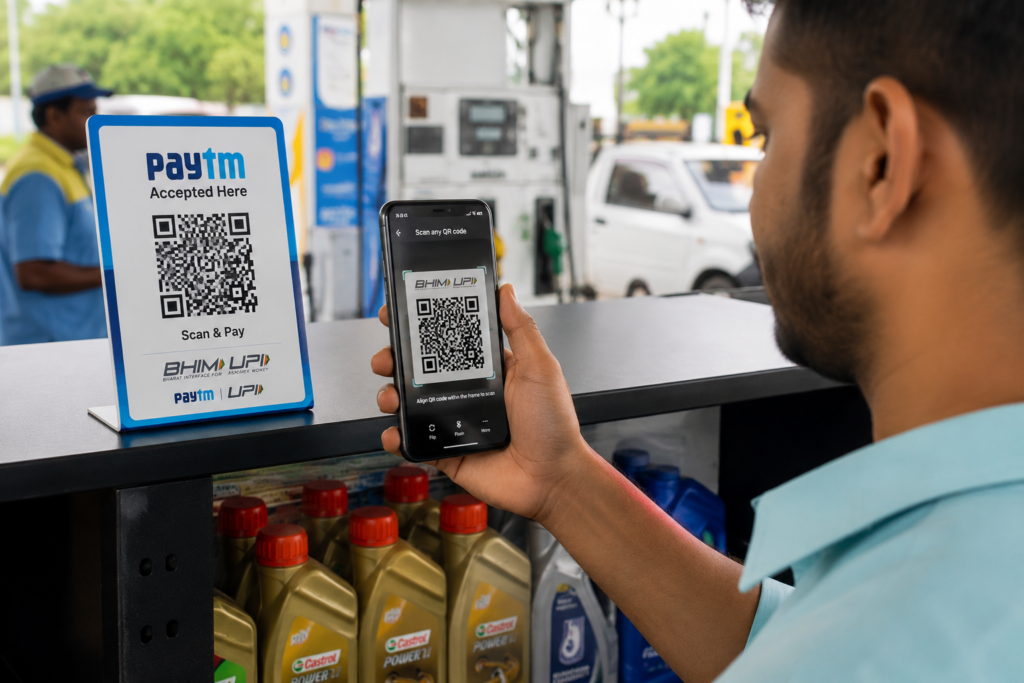
Perhaps the most underestimated innovation wasn’t the payment app.
It was the QR code.
Traditional card payments often required dedicated hardware and additional setup.
A QR code, on the other hand, could simply be printed and displayed.
From neighborhood grocery stores to roadside vendors, businesses of every size could start accepting digital payments with minimal cost.
This dramatically lowered the barrier to entry for merchants.
The result was a powerful cycle.
More merchants accepted digital payments.
More consumers started using them.
As more consumers paid digitally, even more merchants adopted QR codes.
Economists refer to this as a network effect, where the value of a system increases as more people participate.
Why Digital Payments Became Mainstream
Technology alone wasn’t enough.
Several forces came together:
- Affordable smartphones
- Faster internet
- A simple payment infrastructure through UPI
- Increasing merchant acceptance
- Improved user experience
- Growing trust in digital transactions
Together, these factors transformed digital payments from a niche service into an everyday habit for millions of people.
But even then, one major obstacle remained.
People had already developed years of payment habits centered around cash.
Changing those habits required more than convenience.
It required motivation.
And that’s where cashback, scratch cards, rewards, and behavioral psychology entered the story.
Why Payment Apps Exist When Banks Already Have Mobile Banking Apps
This raises another important question.
If banks already offered mobile banking applications, why did consumers embrace dedicated payment apps like PhonePe, Google Pay, Paytm, CRED, and MobiKwik?
The answer isn’t that banks failed.
It’s that payment apps were designed with a different goal.
Banks focused on managing money.
Payment apps focused on making payments effortless.
That subtle difference shaped one of the most successful consumer behavior transformations in India’s digital economy.
Chapter 2: The Biggest Challenge Payment Apps Faced, Changing Human Behavior
“If Digital Payments Were Better, Why Didn’t Everyone Switch Immediately?”
Imagine it’s 2016.
You walk into a neighborhood grocery store to buy a few essentials.
The total bill comes to ₹385.
The shopkeeper asks,
“Cash or card?”
You instinctively reach into your wallet.
Not your phone.
Why?
Because that’s what you’ve always done.
Nobody consciously thinks,
- “Today I’ll choose cash over UPI.”
The decision happens automatically.
It’s a habit.
And habits are surprisingly difficult to change.
This was the biggest obstacle every payment company faced.
Not technology.
Not infrastructure.
Not smartphones.
Human behavior.
Payment Apps Didn’t Compete Against Each Other
Today, we compare:
- PhonePe
- Google Pay
- Paytm
- CRED
- MobiKwik
But during their early years…
They weren’t fighting each other.
They were fighting something much bigger.
Cash.
More specifilly…
They were fighting decades of consumer habit.
Imagine asking someone in 2015,
- “Would you like to pay using your phone?”
Most people would respond with another question.
- “Why should I?”
Not because they disliked technology.
Because cash already worked.
Consumers Already Had Many Payment Options
Another misconception is that UPI solved a problem that had no solution.
In reality, consumers already had multiple payment methods.
They could use:
- Cash
- Debit cards
- Credit cards
- Cheques
- Internet banking
- NEFT
- RTGS
- IMPS
- Mobile banking apps
From a purely functional perspective…
People could already transfer money.
So the real question wasn’t:
- “Can people make digital payments?”
The real question was:
- “Why would people abandon something they’re already comfortable with?”
This is where marketing becomes more important than technology.
The Psychology Behind Resistance to Change
Human beings are naturally resistant to change.
This isn’t laziness.
It’s biology.
Our brains constantly try to conserve energy.
Whenever we repeat an activity several times…
The brain automates it.
Psychologists call this habit formation.
For example…
Think about tying your shoelaces.
You don’t consciously think about every movement.
Your brain has already learned it.
The same applies to driving.
Typing.
Brushing your teeth.
Unlocking your phone.
And paying with cash.
Status Quo Bias: Why People Prefer Familiar Things
Behavioral economists describe this tendency as Status Quo Bias.
Status Quo Bias is our tendency to prefer existing habits simply because they are familiar, even when better alternatives exist.
Let’s imagine a simple scenario.
You visit your favorite supermarket every weekend.
One day, the supermarket completely changes its layout.
Milk is now at the back.
Vegetables are upstairs.
Snacks are near the entrance.
Even though the products are exactly the same…
You’ll probably feel uncomfortable.
Why?
Because your brain dislikes unnecessary change.
Payment apps encountered exactly the same challenge.
Consumers weren’t evaluating technology.
They were protecting familiar routines.
Every New Habit Has a Learning Cost
Suppose someone asks you to install a new payment app.
Immediately, several thoughts arise.
- Is it safe?
- How does it work?
- Which bank should I connect?
- What if I send money to the wrong person?
- What if the payment fails?
- Can I trust this company?
Even before downloading the app…
Your brain is calculating effort.
Psychologists refer to this as Cognitive Load.
Every new system requires mental effort.
If the perceived effort is greater than the perceived benefit…
People simply don’t change.
Cash Was More Than Money
To understand why people resisted digital payments…
We need to understand what cash represented.
Cash wasn’t merely currency.
It represented:
- Familiarity
- Control
- Tangibility
- Trust
- Simplicity
You could count it.
Touch it.
Hand it to another person.
There were no passwords.
No internet connection.
No battery.
No loading screen.
No “Transaction Failed” message.
For many consumers…
Cash felt more reliable than any app.
The Merchant Had Doubts Too
Consumers weren’t the only people who resisted.
Merchants had equally important concerns.
Imagine owning a small grocery store.
A representative from a payment company walks in and says:
- “Sir, please display this QR code.”
Your first reaction probably isn’t excitement.
It’s skepticism.
Questions immediately arise.
- Will I actually receive the money?
- What happens if the internet stops working?
- What if customers claim they’ve paid when they haven’t?
- What if my payment gets stuck?
- Will I have to pay hidden charges?
- Who will help if something goes wrong?
Merchants weren’t rejecting innovation.
They were protecting their livelihoods.
Trust Was the Real Product
People often believe payment companies were selling technology.
In reality…
They were selling trust.
Imagine someone you’ve never met says,
- “Transfer ₹10,000 into this account. I’ll return it tomorrow.”
Would you do it?
Probably not.
Now imagine the same request comes from your bank.
Your confidence immediately increases.
Nothing changed except one thing.
Trust.
Payment companies understood this perfectly.
That’s why they invested heavily in:
- Secure authentication
- Bank partnerships
- Instant payment confirmations
- Refund systems
- Customer support
- RBI compliance
- Transparent transaction history
Consumers don’t simply adopt technology.
They adopt trust.
The Chicken-and-Egg Problem
Payment apps faced another challenge that many startups encounter.
Economists call it the Chicken-and-Egg Problem.
Imagine you’re launching India’s first payment app.
Consumers say:
- “I’ll use it when more shops accept it.”
Merchants say:
- “I’ll accept it when more customers use it.”
Neither side wants to move first.
If everyone waits…
Nothing grows.
Payment companies had to solve both problems at the same time.
Network Effects: Why Every New User Made the App More Valuable
This leads us to one of the most powerful concepts in business.
Network Effects.
A product becomes more valuable as more people use it.
Let’s understand this with an example.
Imagine WhatsApp had only ten users worldwide.
Would you install it?
Probably not.
Now imagine every one of your family members, friends, colleagues, and customers uses WhatsApp.
Suddenly it becomes essential.
Its value comes from the network.
Payment apps work exactly the same way.
The more merchants accepted QR codes…
The more useful payment apps became.
The more consumers started paying digitally…
The more merchants wanted QR codes.
One group encouraged the growth of the other.
The Digital Payment Flywheel
The growth of payment apps wasn’t linear.
It worked like a flywheel.
More Consumers
        ↓
More Merchants Accept QR Codes
        ↓
More Places to Pay Digitally
        ↓
More Daily Transactions
        ↓
Higher Consumer Trust
        ↓
More People Recommend the App
        ↓
Even More Consumers
Every successful payment strengthened the entire ecosystem.
This is why digital payments expanded so rapidly once they reached a critical mass.
Why Cashback Changed Everything
At this point, payment companies had solved only half the problem.
Consumers still needed a compelling reason to change.
Simply telling people,
- “Digital payments are the future.”
wasn’t enough.
Humans rarely change behavior because someone predicts the future.
They change when they receive an immediate benefit.
That’s where cashback entered the picture.
Suddenly…
Paying ₹500 through an app didn’t just complete a transaction.
It offered the possibility of gaining something extra.
Even a small reward made the new behavior feel worthwhile.
Cashback wasn’t merely a financial incentive.
It was a psychological bridge between an old habit and a new one.
The First Reward Is More Important Than the Amount
Here’s something fascinating.
Imagine you receive ₹10 cashback after your first UPI payment.
The amount isn’t significant.
But your brain doesn’t evaluate only the money.
It notices something more important.
“I tried something new… and it rewarded me.”
That positive experience increases the likelihood that you’ll try it again.
Behavioral psychologists call this positive reinforcement.
Reward a behavior immediately.
The brain starts associating that behavior with a positive outcome.
Repeat the cycle often enough, and a habit begins to form.
Businesses Were Never Buying Transactions
Many people assume payment apps were paying users for transactions.
In reality, they were investing in something far more valuable.
They were buying future behavior.
One successful payment today could lead to:
- Hundreds of future UPI transactions
- Utility bill payments
- Mobile recharges
- Insurance purchases
- Loan applications
- Investment products
The transaction itself wasn’t the goal.
It was the beginning of a long-term customer relationship.
Chapter 3: Cashback Was Never About Cashback, The Marketing Strategy Behind Rewards
- “If companies were losing money by giving cashback, why did they continue doing it for years?”
At first glance, cashback seems like a terrible business idea.
Imagine opening a grocery store.
Every customer who buys groceries worth ₹500 receives ₹100 back.
Would your business survive?
Probably not.
Now think about companies like PhonePe, Google Pay, Paytm, CRED, and MobiKwik.
For several years, they rewarded millions of users with cashback, referral bonuses, scratch cards, and incentives.
Collectively, these companies spent thousands of crores of rupees on rewards and promotions during their rapid growth years.
So, were they simply burning money?
Not exactly.
They weren’t buying transactions.
They were buying customers.
And more importantly…
They were buying future behavior.
This is where marketing becomes fascinating.
What Is Cashback?
Before understanding the strategy, let’s understand the concept.
Cashback is a marketing incentive where a company returns a portion of the amount spent by a customer after completing a purchase or transaction.
Unlike a discount, which reduces the price before payment, cashback rewards the customer after the payment has been completed.
For example:
You pay ₹1,000 using a payment app.
After the transaction, you receive ₹50 back.
Your effective cost becomes ₹950.
To consumers, cashback feels like free money.
To businesses, cashback is an investment in customer acquisition and retention.
That difference changes everything.
Cashback Was Solving a Much Bigger Problem
Remember the biggest challenge we discussed in the previous chapter?
People weren’t refusing digital payments because they were difficult.
They were refusing to change habits.
Changing habits requires motivation.
Cashback became that motivation.
Instead of saying,
- “Please start using our app.”
Payment companies said,
- “Use our app once, and we’ll reward you.”
That’s a completely different message.
One asks for effort.
The other offers immediate value.
The Difference Between Discounts and Cashback
Many people confuse cashback with discounts.
Although both reduce the customer’s cost, their marketing objectives are very different.
| Discount | Cashback |
|---|---|
| Applied before purchase | Rewarded after purchase |
| Encourages buying | Encourages repeat usage |
| Reduces selling price | Creates excitement after payment |
| Focuses on immediate sales | Focuses on long-term customer behavior |
| Often forgotten after purchase | Creates a memorable reward experience |
Notice something important.
Cashback happens after you’ve already completed the desired behavior.
That timing isn’t accidental.
It’s based on behavioral psychology.
The reward reinforces the action.
Why Businesses Spend Money to Acquire Customers
Imagine you’re opening a new coffee shop.
Nobody knows your brand.
You have excellent coffee.
A beautiful interior.
Friendly staff.
But there are no customers.
What would you do?
You might:
- Run advertisements
- Offer free samples
- Give first-time discounts
- Launch referral programs
Why?
Because people can’t become loyal customers unless they try your business first.
Payment apps faced the same challenge.
No matter how good their technology was…
People wouldn’t use it without a reason.
Understanding Customer Acquisition Cost (CAC)
This brings us to one of the most important marketing metrics.
Customer Acquisition Cost (CAC).
What Is Customer Acquisition Cost?
Customer Acquisition Cost is the total amount a company spends to acquire one new customer.
It includes expenses such as:
- Advertising
- Cashback
- Referral bonuses
- Marketing campaigns
- Promotional offers
- Sales expenses
Example
Imagine a payment company spends:
- ₹6 crore on advertising
- ₹3 crore on cashback campaigns
- ₹1 crore on referral rewards
Total marketing investment:
₹10 crore.
If these campaigns attract 10 lakh new users, the average Customer Acquisition Cost becomes:
₹100 per customer.
Many people see that ₹100 as an expense.
Businesses see it differently.
They see it as an investment.
Why Spending ₹100 Can Be a Smart Business Decision
Let’s change the perspective.
Imagine you own a gym.
You spend ₹2,000 to convince one person to join.
Initially, it sounds expensive.
But what happens if that customer stays for three years?
Suddenly…
Your ₹2,000 investment generates ₹40,000 in membership fees.
Now ask yourself.
Was ₹2,000 really an expense?
Or was it an investment?
Payment companies think exactly the same way.
Customer Lifetime Value (LTV)
If CAC tells us how much it costs to acquire a customer, another metric tells us how valuable that customer becomes over time.
This is called Customer Lifetime Value (LTV).
What Is Customer Lifetime Value?
Customer Lifetime Value is the estimated total revenue a business expects to earn from a customer throughout their relationship with the company.
For payment apps, a new user rarely stops after making one UPI payment.
Over time, that same customer may:
- Pay electricity bills
- Recharge mobile phones
- Book train tickets
- Buy insurance
- Invest in mutual funds
- Apply for personal loans
- Use credit products
- Pay merchants daily
One customer can generate value for many years.
A Simple Example of CAC vs LTV
Imagine this scenario.
A payment app spends ₹150 to acquire a customer through cashback and advertising.
Over the next five years, that customer:
- Pays utility bills every month.
- Uses the app for shopping.
- Purchases insurance.
- Takes a personal loan.
- Invests in mutual funds.
The company eventually earns ₹3,000 from financial products, partnerships, and services.
| Metric | Value |
|---|---|
| Customer Acquisition Cost | ₹150 |
| Customer Lifetime Value | ₹3,000 |
Would spending ₹150 still seem expensive?
Probably not.
That’s why companies focus far more on lifetime value than on the cost of the first transaction.
Cashback Was an Investment, Not a Promotional Expense
This is perhaps the biggest misconception consumers have.
When we receive ₹100 cashback, we think:
- “The company lost ₹100.”
But businesses ask a different question.
- “Will this customer continue using our platform for the next five years?”
If the answer is yes…
The cashback becomes a profitable investment.
The goal was never to earn money from the first transaction.
The goal was to ensure there would be hundreds more.
Market Penetration: Winning the Market Before Competitors
When UPI was still growing, payment companies faced another challenge.
The market was huge.
But consumer adoption was low.
This required a Market Penetration Strategy.
What Is Market Penetration?
Market Penetration is a growth strategy where a company aims to rapidly increase its customer base and market share, often by encouraging existing consumers to switch from competitors or traditional alternatives.
Instead of waiting for people to naturally adopt digital payments…
Companies accelerated adoption through:
- Cashback
- Referral bonuses
- Bill payment offers
- Merchant rewards
- Festival campaigns
- First-payment incentives
The objective wasn’t immediate profit.
It was becoming the first app consumers remembered when making a payment.
Growth Marketing: Winning Through Experimentation
Traditional marketing often focuses on awareness.
Growth marketing goes much further.
It continuously experiments to improve every stage of the customer journey.
Payment apps tested questions like:
- Does ₹50 cashback perform better than ₹25?
- Should rewards be guaranteed or random?
- Which referral message gets more installs?
- Which notification increases repeat payments?
- Which onboarding screen reduces drop-offs?
Every campaign generated data.
Every transaction became a learning opportunity.
Instead of relying on assumptions, companies optimized their marketing based on user behavior.
Retention Marketing: Keeping Customers Is Cheaper Than Finding New Ones
Acquiring customers is expensive.
Keeping existing customers is usually much cheaper.
This is why payment apps gradually shifted from attracting users to retaining them.
Rather than constantly offering large cashback amounts, they introduced:
- Bill payment reminders
- Reward points
- Coins
- Cashback on recurring payments
- Personalized offers
- Credit products
- Loyalty benefits
The objective changed.
Instead of asking:
- “How do we attract more users?”
Companies began asking:
- “How do we keep existing users active every week?”
Incentive Marketing: Rewarding the Desired Behavior
Payment apps rarely rewarded people randomly.
They rewarded specific behaviors.
Examples include:
- Make your first UPI payment.
- Add a bank account.
- Refer a friend.
- Pay your electricity bill.
- Recharge your mobile.
- Complete your first merchant payment.
- Activate AutoPay.
Each reward encouraged a business goal.
This approach is known as Incentive Marketing.
Rather than telling people what to do…
Businesses motivate people by attaching rewards to the actions they want repeated.
Real-World Examples
Different payment platforms used rewards in different ways.
| Platform | Primary Reward Strategy | Marketing Objective |
|---|---|---|
| PhonePe | Cashback, bill payment offers | Increase daily UPI usage |
| Google Pay | Scratch cards and referral rewards | Drive first-time adoption and engagement |
| Paytm | Cashback, wallet rewards, merchant offers | Build an ecosystem beyond payments |
| CRED | Premium rewards, coins, exclusive experiences | Target affluent credit card users |
| MobiKwik | Wallet cashback, SuperCash, partner offers | Encourage wallet usage and ecosystem retention |
Although their reward systems looked different…
Their underlying objective was remarkably similar.
Acquire users.
Build habits.
Increase retention.
Expand into financial services.
The Real Product Was Customer Behavior
Consumers believed they were receiving rewards for making payments.
Businesses saw something entirely different.
Every successful payment represented:
- One more habit formed.
- One more trusted customer.
- One more opportunity for future financial products.
- One more step toward long-term loyalty.
Cashback wasn’t designed to make users rich.
It was designed to make digital payments feel natural.
And once that habit formed…
The need for large cashback offers gradually disappeared.
Chapter 4: The Psychology Behind Every Digital Payment Reward
Imagine two payment apps.
The first says:
“Pay ₹500 and get ₹50 cashback.”
The second says:
“Pay ₹500 and unlock a scratch card.”
Both apps are rewarding you.
Both want you to complete the payment.
Yet they use completely different approaches.
Why?
If the goal is simply to attract users, why doesn’t every payment app use cashback?
Why do some prefer scratch cards?
Why do others offer coins, loyalty points, or wallet balances?
The answer lies in a simple truth.
Not all rewards influence human behavior in the same way.
Every reward activates a different psychological trigger.
Some create excitement.
Some build loyalty.
Some encourage repeat usage.
Others make it difficult for users to leave the platform.
This is where marketing meets psychology.
Let’s explore each reward individually.
4.1 Cashback
What Is Cashback?
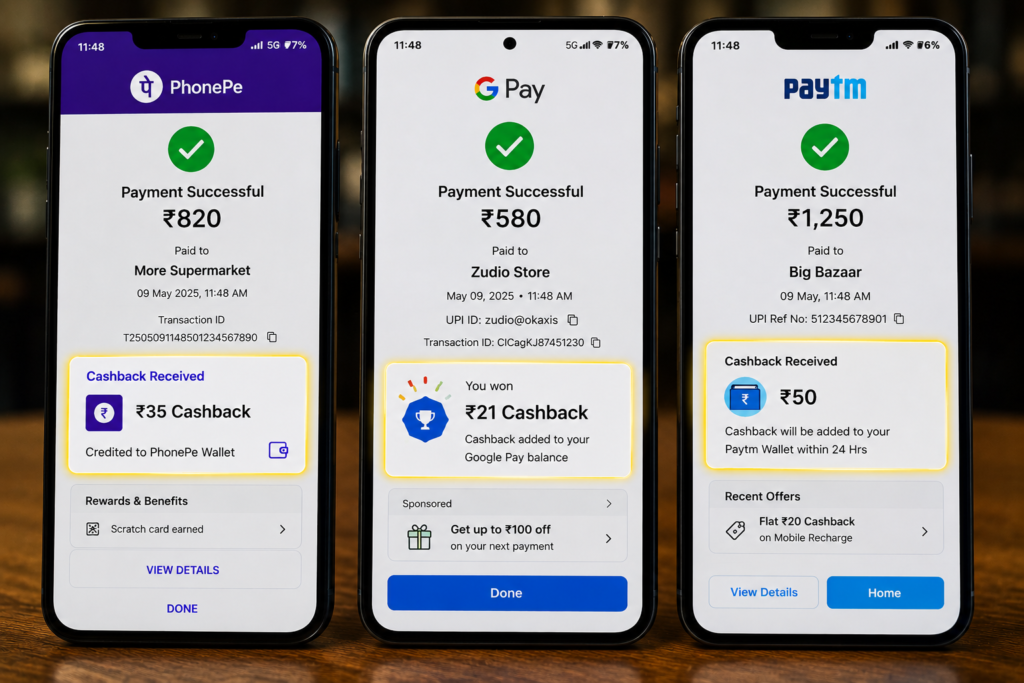
Cashback is a reward in which a company returns a percentage or fixed amount of money to a customer after completing a purchase or payment.
Unlike discounts, cashback is received after the transaction is completed.
For example,
You pay ₹1,000 using a payment app.
The app credits ₹50 back to your account.
From the customer’s perspective,
“I just saved ₹50.”
From the company’s perspective,
“We just encouraged another digital payment.”
The same reward creates two completely different interpretations.
Why Cashback Feels More Valuable Than It Actually Is
Let’s compare two situations.
Situation A
A shirt costs ₹950.
Situation B
A shirt costs ₹1,000.
You receive ₹50 cashback afterward.
Mathematically,
Both situations cost exactly ₹950.
Yet many consumers find the second offer more exciting.
Why?
Because cashback creates the feeling of earning something.
Psychologists call this the Reward Effect.
People remember rewards more vividly than ordinary discounts.
Receiving money after making a payment feels like winning.
That emotional reaction makes the experience memorable.
The Psychology Behind Cashback
Cashback works because it activates several psychological principles at the same time.
Instant Gratification
Humans naturally prefer immediate rewards over future benefits.
Suppose someone tells you,
“Save money today, and you’ll benefit five years later.”
Now compare that with,
“Pay today and receive ₹100 immediately.”
Which feels more attractive?
Most people choose the second option.
Behavioral economists refer to this as Present Bias or Instant Gratification.
We naturally value immediate rewards more than delayed ones.
Payment apps take advantage of this tendency.
Perceived Savings
Cashback changes how our brain interprets spending.
Instead of thinking,
“I spent ₹500.”
We think,
“I got ₹50 back.”
Notice the shift.
The focus moves from spending to saving.
Even though money still left our account,
our brain remembers the reward.
This creates a more positive perception of the entire transaction.
Positive Reinforcement
Every cashback acts as positive reinforcement.
The sequence looks like this.
Pay Digitally

↓

Receive Cashback

↓

Feel Rewarded

↓

Repeat the Behavior
This is exactly how habits are formed.
Business Objective Behind Cashback
Companies don’t offer cashback simply to be generous.
Cashback helps them:
- Acquire new users.
- Encourage first-time transactions.
- Increase repeat payments.
- Change consumer habits.
- Build market share.
- Reduce hesitation.
The reward isn’t paying for one payment.
It’s encouraging hundreds of future payments.
Real-World Example
When UPI adoption was still growing,
PhonePe and Google Pay frequently rewarded first-time users with cashback.
Their objective wasn’t immediate profitability.
It was encouraging people to complete that crucial first digital payment.
Once consumers became comfortable,
the habit began replacing cash.
4.2 Scratch Cards
What Are Scratch Cards?
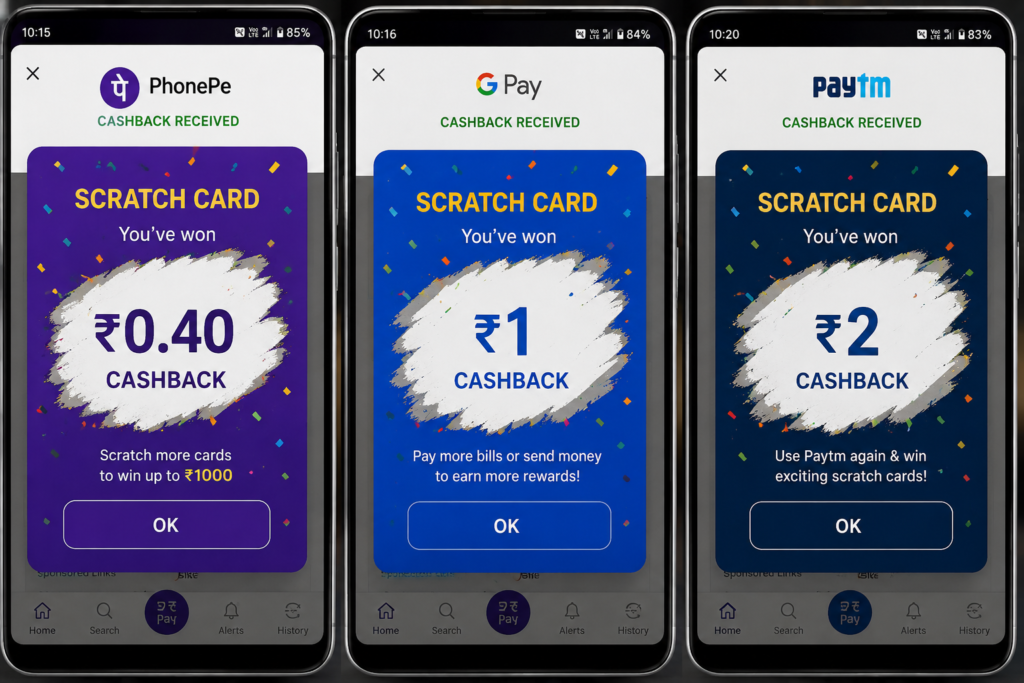
Scratch cards are digital rewards that hide the reward amount until users reveal it.
Instead of immediately showing ₹20 cashback,
the app first displays a mystery reward.
The user must scratch the card digitally to discover the prize.
The reward could be:
₹2
₹10
₹100
Or occasionally,
something much larger.
The uncertainty is intentional.
Why Scratch Cards Feel More Exciting Than Cashback
Imagine someone hands you ₹20.
Now imagine someone hands you a sealed envelope and says,
“There might be ₹20…
or there might be ₹500.”
Which experience feels more exciting?
The envelope.
Not because it contains more money.
Because it contains uncertainty.
Humans are naturally curious.
We want to know what’s hidden.
Scratch cards transform a simple reward into a miniature game.
The Psychology Behind Scratch Cards
Variable Reward Theory
One of the most powerful psychological principles is the Variable Reward.
Instead of rewarding people the same way every time,
the reward changes unpredictably.
Sometimes:
₹2
Sometimes:
₹15
Occasionally:
₹500
Our brain starts wondering,
“Maybe next time I’ll get something bigger.”
This uncertainty keeps people engaged.
The same principle is used in:
- Video games
- Social media notifications
- Loyalty programs
Unpredictable rewards are often more engaging than guaranteed ones.
Curiosity
Scratch cards create an information gap.
Until the reward is revealed,
our brain feels incomplete.
Psychologists call this the Curiosity Gap.
The easiest way to close that gap?
Scratch the card.
That’s why almost everyone opens their reward,
even when they know it might only be worth ₹2.
Anticipation
The excitement often occurs before the reward is revealed.
That anticipation itself becomes enjoyable.
This emotional moment increases engagement with the app.
Business Objective Behind Scratch Cards
Compared to guaranteed cashback,
scratch cards provide several advantages.
They:
- Reduce marketing costs.
- Increase user engagement.
- Encourage app opens.
- Make rewards memorable.
- Keep users curious.
Instead of simply giving money,
companies create an experience.
Real-World Example
Google Pay popularized scratch cards during its rapid growth phase.
Users frequently opened the app just to reveal rewards,
even when the actual cashback was relatively small.
The experience became part of the product.
4.3 Reward Points
What Are Reward Points?
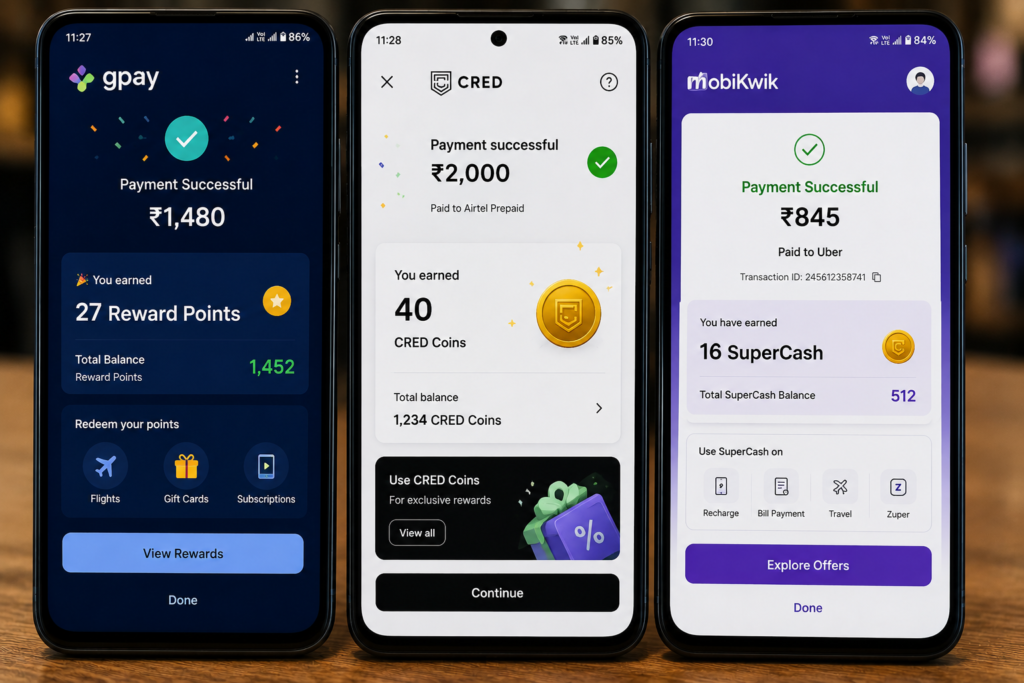
Reward points are non-cash credits earned after completing specific activities.
Instead of receiving money directly,
customers accumulate points that can later be redeemed for:
- Shopping vouchers
- Discounts
- Products
- Travel benefits
- Exclusive offers
Unlike cashback,
reward points usually cannot be withdrawn as cash.
Why Companies Prefer Reward Points
Reward points encourage a different behavior.
Instead of focusing on today’s transaction,
they encourage future engagement.
You continue using the platform because you’re working toward a larger reward.
The Psychology Behind Reward Points
Delayed Gratification
Unlike cashback,
reward points require patience.
Users think,
“I’ve already collected 900 points.
I only need 100 more.”
The closer people get to a reward,
the harder they work to achieve it.
This principle is called the Goal Gradient Effect.
Loyalty
Points make customers feel invested.
After spending months earning rewards,
switching to another app feels like abandoning progress.
That’s exactly what businesses want.
Business Objective
Reward points help companies:
- Increase customer retention.
- Build long-term loyalty.
- Encourage repeated transactions.
- Reduce customer churn.
Real-World Example
CRED rewards users with CRED Coins after credit card bill payments.
These coins unlock partner offers, experiences, and exclusive benefits.
Rather than rewarding only one transaction,
the system encourages continued participation in the CRED ecosystem.
4.4 Coins
What Are Coins?
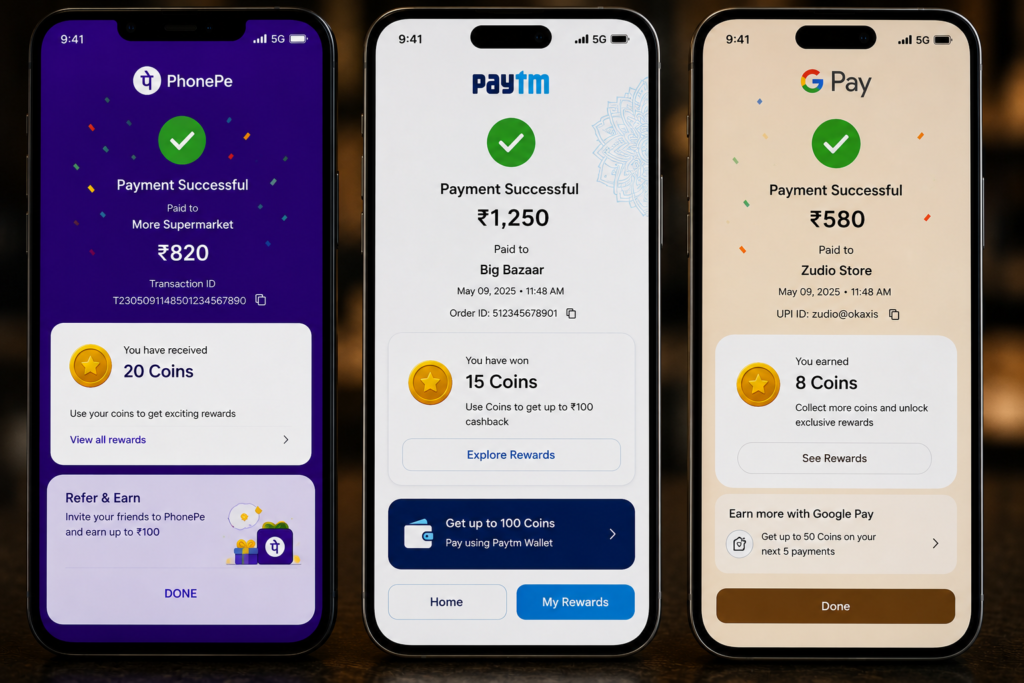
Coins are virtual currencies that exist only within an app’s ecosystem.
Unlike cashback,
they usually cannot be transferred to a bank account.
Instead,
they unlock discounts, games, offers, or premium experiences.
Why Coins Feel Like Progress
Every coin collected represents progress.
The experience feels similar to collecting stars in a game.
People naturally enjoy seeing numbers increase.
Even if the coins have limited monetary value,
they create emotional satisfaction.
The Psychology Behind Coins
Coins use Gamification.
Gamification applies game mechanics to everyday activities.
Examples include:
- Progress bars
- Achievement badges
- Levels
- Streaks
- Virtual currencies
These features transform routine payments into engaging experiences.
Business Objective
Coins encourage:
- Daily engagement.
- Repeat app visits.
- Long-term retention.
- Ecosystem participation.
Instead of focusing only on payments,
users begin interacting with the app itself.
4.5 Wallet Balance
What Is Wallet Balance?
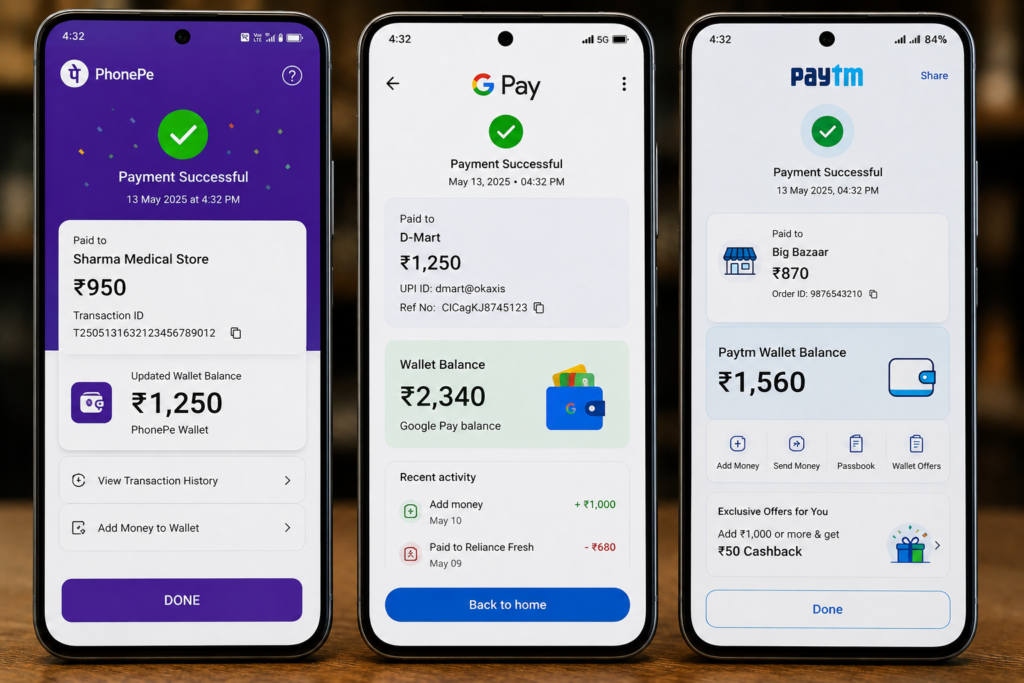
A wallet balance is money stored within a payment app that users can spend on future transactions without immediately using their bank account.
For example,
if you receive ₹100 cashback into a wallet,
you’ll likely use that balance for another purchase within the same platform.
Why Wallet Balance Changes Consumer Behavior
Imagine you receive ₹100 in your bank account.
You might save it.
Now imagine you receive ₹100 in a wallet that can only be spent within one ecosystem.
Your brain immediately starts thinking,
“Where can I use this?”
Without realizing it,
you’re planning another transaction.
The Psychology Behind Wallet Balance
The Endowment Effect
People place greater value on things they already own.
Once wallet money belongs to us,
we feel motivated to use it.
Platform Lock-In
Wallet balances make switching platforms less attractive.
As long as money remains inside the ecosystem,
customers have a reason to return.
Business Objective
Wallet balances help companies:
- Increase repeat purchases.
- Keep money within the ecosystem.
- Reduce customer churn.
- Increase transaction frequency.
The Real Psychology Behind Rewards
Although cashback, scratch cards, reward points, coins, and wallet balances look different, they all serve the same purpose.
They don’t merely reward transactions.
They shape behavior.
| Reward Type | Consumer Psychology | Business Objective |
|---|---|---|
| Cashback | Instant gratification, perceived savings | Customer acquisition and repeat usage |
| Scratch Cards | Curiosity, anticipation, variable rewards | Engagement and app opens |
| Reward Points | Delayed gratification, loyalty | Long-term retention |
| Coins | Gamification, habit formation | Daily engagement |
| Wallet Balance | Endowment effect, platform lock-in | Repeat transactions and ecosystem growth |
The reward changes.
The psychology changes.
But the destination remains the same.
Build a habit so strong that the customer no longer thinks about which payment app to use.
Chapter 5: How Payment Apps Build Habits and Consumer Trust
Imagine two people standing outside the same coffee shop.
One opens PhonePe without thinking.
The other instinctively opens Google Pay.
Neither compares cashback.
Neither checks which app offers the better reward.
They simply open the app they’ve always used.
Have you ever wondered why?
It’s not because one app is dramatically better than the others.
Most payment apps today offer almost identical core features:
- UPI payments
- QR code scanning
- Bill payments
- Mobile recharges
- Bank transfers
- Transaction history
Yet millions of users become loyal to one particular app.
Why?
The answer isn’t technology.
It’s habit formation.
The companies that won India’s digital payment race didn’t just build payment apps.
They built daily habits.
What Is a Habit?
Before understanding how payment apps create habits, let’s first understand what a habit actually is.
A habit is a behavior that becomes automatic through repeated practice.
Initially, every action requires conscious thought.
But after repeating it enough times, the brain begins to automate the process.
Think about everyday activities.
- Locking your front door.
- Wearing a seatbelt.
- Unlocking your smartphone.
- Brushing your teeth.
- Checking WhatsApp after waking up.
You don’t consciously decide to perform these actions every day.
Your brain does it almost automatically.
That’s exactly what payment apps wanted.
They didn’t want users to consciously choose their app every time.
They wanted the app to become the default choice.
The Habit Loop: The Psychology Behind Every Payment
One of the most influential models in behavioral psychology is the Habit Loop, popularized by author Charles Duhigg.
It explains that almost every habit follows three simple stages.
Cue
↓

Action
↓

Reward
Let’s see how payment apps apply this model.
Step 1: Cue
A cue is the trigger that starts a behavior.
In digital payments, cues appear constantly throughout our day.
Examples include:
- A QR code at a restaurant.
- A reminder that your electricity bill is due.
- A mobile recharge notification.
- A friend requesting money.
- A monthly rent payment.
- A shopping checkout page.
Each situation reminds your brain that a payment needs to happen.
Step 2: Action
Once the cue appears, you perform the action.
For example:
- Open PhonePe.
- Scan the QR code.
- Enter the amount.
- Confirm payment.
Notice something interesting.
You rarely think,
“Should I use this app today?”
Instead, your fingers automatically tap the same app.
That’s habit in action.
Step 3: Reward
After completing the payment, the app rewards you.
Sometimes it’s:
- Cashback.
- Scratch cards.
- Coins.
- Reward points.
- Payment success animation.
- A satisfying sound.
- Instant confirmation.
Even when the reward isn’t financial, your brain still experiences satisfaction.
The payment feels complete.
The brain remembers this positive outcome.
Eventually, the entire sequence becomes automatic.
How Repetition Builds Loyalty
One successful payment doesn’t create loyalty.
Neither do ten.
But imagine repeating the same payment experience every day for two years.
Eventually,
your brain no longer thinks.
It simply repeats.
Psychologists call this behavioral reinforcement.
Every successful transaction strengthens the neural pathway associated with that payment app.
Over time,
choosing the app requires almost no mental effort.
QR Codes Reduced Friction
Before QR codes,
digital payments often involved several steps.
Users needed to:
- Enter bank details.
- Type account numbers.
- Remember IFSC codes.
- Add beneficiaries.
- Verify transactions.
Each additional step increased friction.
Behavioral economists have repeatedly shown that even tiny amounts of friction reduce adoption.
QR codes changed everything.
Now the process became:
Open app.
↓
Scan.
↓
Pay.
↓
Done.
That’s it.
Removing unnecessary effort dramatically increased usage.
Why Convenience Beats Features
Many businesses believe customers choose products because they have more features.
Consumers usually care more about convenience.
Imagine two elevators.
One arrives in five seconds.
The other arrives in thirty seconds.
Both reach the same floor.
Which one will people prefer?
The faster one.
The same principle applies to payments.
Consumers don’t compare every feature before making a ₹50 payment.
They simply choose the option requiring the least effort.
Convenience often beats complexity.
The Power of Daily Usage Patterns
Payment apps didn’t become successful because people used them once.
They became successful because people used them repeatedly.
Think about how many payments the average person makes every month.
- Grocery shopping
- Fuel
- Electricity bills
- Water bills
- Internet recharge
- Mobile recharge
- Online shopping
- Restaurant payments
- Movie tickets
- Cab rides
Each payment reinforces the habit.
Every successful transaction becomes another opportunity for the app to remain relevant.
The more frequently consumers interact with an app,
the stronger the habit becomes.
Why Most People Stop Comparing Payment Apps
During the early days of UPI,
users often compared offers.
Questions like these were common.
“Which app gives better cashback?”
“Where can I get ₹100 today?”
Over time,
those comparisons became less frequent.
Why?
Because once a habit forms,
the brain prefers consistency over optimization.
Imagine changing your toothpaste every morning.
Could you?
Yes.
Would you?
Probably not.
The same happens with payment apps.
People eventually develop a favorite.
Not necessarily because it’s objectively better.
But because it’s familiar.
The Cost of Breaking a Habit
Suppose you’ve used PhonePe for three years.
Your transaction history is there.
Your favorite merchants are saved.
Your bills are linked.
Your family members already use it.
Switching to another app suddenly feels inconvenient.
This is known as switching cost.
Notice that switching costs aren’t always financial.
Sometimes they’re psychological.
Learning a new interface.
Connecting bank accounts again.
Changing routines.
Remembering where everything is.
These small inconveniences discourage people from switching.
Building Trust Was Just as Important as Building Habits
A habit alone isn’t enough.
People also need confidence.
Imagine making an important payment.
Perhaps:
- College fees.
- Hospital bills.
- House rent.
Would you use an app you don’t trust?
Probably not.
That’s why payment companies invested heavily in trust-building.
Security Became a Marketing Advantage
Consumers worried about questions like:
- What if my payment fails?
- What if money gets deducted twice?
- Can someone hack my account?
- What if I scan the wrong QR code?
- Will I get my refund?
These concerns were perfectly reasonable.
Instead of ignoring them,
payment companies addressed them directly.
They highlighted:
- Bank-grade security.
- UPI PIN protection.
- Device authentication.
- Instant payment notifications.
- Secure encryption.
- Fraud prevention systems.
Security wasn’t just a technical feature.
It became a marketing message.
Failed Transactions Tested Consumer Confidence
Imagine paying ₹5,000 to a merchant.
Your bank account gets debited.
The merchant says,
“I haven’t received it.”
Few experiences create more anxiety.
Payment companies understood this.
That’s why they focused on:
- Instant payment status.
- Automatic refund processes.
- Transaction tracking.
- Customer support.
Every successful resolution strengthened consumer trust.
Transaction History Reduced Uncertainty
One small feature had an enormous psychological impact.
Transaction history.
Instead of wondering,
“Did I already pay?”
Users could simply open the app and verify.
Every payment remained recorded.
This transparency reduced uncertainty.
It also increased confidence.
Merchant Partnerships Built Familiarity
Initially,
many merchants hesitated to display QR codes.
Today,
it’s difficult to find a store without one.
As consumers repeatedly saw the same payment apps across:
- Grocery stores
- Petrol pumps
- Restaurants
- Shopping malls
- Pharmacies
- Street vendors
their confidence naturally increased.
Repeated exposure creates familiarity.
And familiarity builds trust.
Behavioral psychologists call this the Mere Exposure Effect.
The more often we encounter something,
the more comfortable we become with it.
Why Every Successful Payment Strengthened the Habit
Think about what happens after each successful transaction.
You scan.
The payment succeeds.
You receive confirmation.
Sometimes you even earn a reward.
Nothing goes wrong.
Your brain quietly records:
“This works.”
Repeat this experience hundreds of times.
Soon,
using the app no longer requires conscious thought.
Trust and habit begin reinforcing each other.
The Habit Flywheel
Over time, payment apps create a self-reinforcing cycle.
Need to Make a Payment
          ↓
Open the Same Payment App
          ↓
Quick & Successful Transaction
          ↓
Positive Experience
          ↓
Greater Trust
          ↓
Stronger Habit
          ↓
Higher Likelihood of Using the Same App Again
Every successful payment makes the next payment even more likely to happen through the same app.
The Goal Was Never Just Daily Payments
Many people assume payment companies wanted users to complete as many UPI transactions as possible.
That’s true.
But it wasn’t the ultimate goal.
Their larger objective was much more ambitious.
They wanted to become the financial app consumers opened first whenever money was involved.
Once they achieved that position,
introducing insurance,
investments,
credit cards,
loans,
and wealth management became significantly easier.
The payment habit became the foundation for an entire financial ecosystem.
Chapter 6: Why Do Most Payment Apps Have Similar Interfaces?
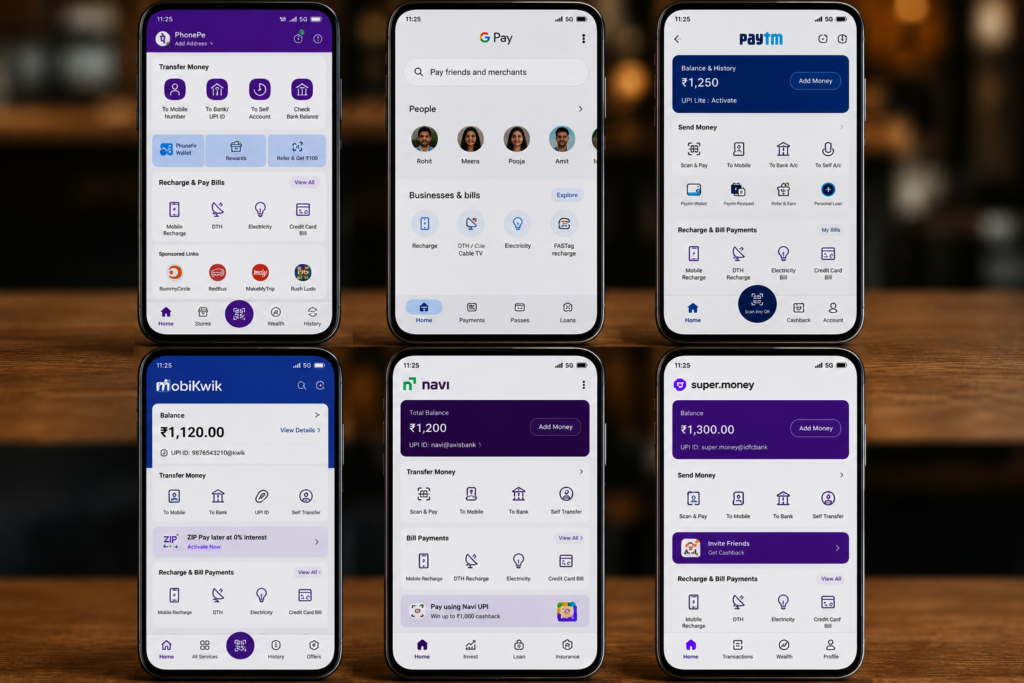
Imagine unlocking your phone and opening five different payment apps.
- PhonePe
- Google Pay
- Paytm
- CRED
- MobiKwik
At first glance, they look different.
Each has its own:
- Brand logo
- Color palette
- Fonts
- Marketing campaigns
Yet the moment you start making a payment…
Something feels surprisingly familiar.
The Scan QR button is easy to find.
The Send Money option is placed almost where you expect it.
The payment confirmation screen looks similar.
Even the process of completing a UPI payment feels almost identical.
Have you ever wondered why?
Are these companies copying one another?
Or is there a deeper reason?
The answer lies in one of the most important principles of User Experience (UX) Design and Consumer Psychology.
People don’t like learning the same task twice.
Most People Think Similar Interfaces Mean a Lack of Innovation
That’s a common misconception.
Many people believe that if every payment app looks similar, companies lack creativity.
In reality…
The opposite is true.
The companies deliberately avoid making drastic interface changes because their goal isn’t to impress users.
Their goal is to reduce thinking.
The easier a payment feels, the more likely users are to complete it.
In product design, this is often described as reducing cognitive load, which is the mental effort required to complete a task.
The Best Interface Is Often the One You Barely Notice
Imagine walking into a hotel.
Every hotel room has:
- A door near the entrance.
- A bed in the center.
- A bathroom in a predictable location.
- Light switches close to the door.
Why?
Could hotels design everything differently?
Absolutely.
But doing so would confuse guests.
Similarly, payment apps don’t want users searching for the “Pay” button every time.
The interface should feel instantly familiar.
When something becomes predictable, it becomes easier to use.
Familiarity Builds Confidence
Let’s do a simple experiment.
Imagine your car manufacturer suddenly decides to move:
- The brake pedal to the left.
- The accelerator to the center.
- The steering wheel controls to completely different positions.
Would driving become exciting?
No.
It would become dangerous.
The same principle applies to digital products.
Consumers build muscle memory through repetition.
After using one payment app several times, your fingers automatically know where to tap.
Changing everything would force users to relearn basic actions.
That creates friction.
And friction reduces usage.
Reducing Cognitive Load
One of the biggest goals of modern product design is reducing Cognitive Load.
What Is Cognitive Load?
Cognitive Load refers to the amount of mental effort required to understand or complete a task.
Every unnecessary decision consumes mental energy.
For example, imagine opening a payment app and asking yourself:
- Where is the Scan button?
- Where is Send Money?
- Where is the QR Scanner?
- How do I check my transaction history?
If users ask these questions every time…
The app feels difficult.
Instead, successful payment apps ensure users already know the answers before they even start.
Why the QR Scanner Is Usually the Most Visible Button
Have you noticed something interesting?
In almost every payment app,
the Scan QR option is one of the largest and most accessible buttons.
That’s intentional.
Why?
Because scanning a QR code is the most common action users perform.
Product designers often follow the 80/20 Principle, also known as the Pareto Principle.
It suggests that a small number of actions generate the majority of user activity.
For payment apps:
- QR payments
- Send Money
- Bank Balance
- Bill Payments
These features receive the highest visibility because they deliver the greatest value.
Everything else remains accessible but secondary.
Consistency Creates Speed
Imagine using five different remote controls.
Each places the volume button in a different location.
Changing channels becomes frustrating.
Now imagine every remote follows a similar layout.
Suddenly,
you don’t need instructions.
Consistency speeds up interaction.
That’s exactly what payment apps want.
The faster users complete a payment,
the happier they feel.
Jakob’s Law: People Prefer Familiar Designs
One of the most important principles in UX design is Jakob’s Law.
It states:
Users spend most of their time using other products. Therefore, they expect your product to work similarly.
Think about websites.
Most websites place:
- The logo at the top left.
- Navigation at the top.
- Search near the top.
- The shopping cart in the top right.
Could companies change these conventions?
Yes.
Should they?
Usually not.
Breaking familiar patterns increases confusion.
Payment apps follow the same philosophy.
Innovation Happens Behind the Scenes
Interestingly,
payment companies rarely compete through interface design.
Instead,
they compete through:
- Better rewards.
- Faster performance.
- Customer support.
- Financial products.
- Merchant partnerships.
- AI-powered recommendations.
- Personalized offers.
- Trust and security.
The payment experience itself remains intentionally simple.
Simplicity Increases Trust
Imagine opening a payment app filled with:
- Flashing advertisements.
- Complicated menus.
- Hidden payment buttons.
- Constant pop-ups.
Would you trust it enough to transfer ₹50,000?
Probably not.
Financial products require confidence.
Clean interfaces communicate professionalism.
Simple design reduces anxiety.
And reduced anxiety increases trust.
Why Major Updates Are Introduced Gradually
Have you noticed that payment apps rarely redesign everything overnight?
Instead,
they make small changes over time.
For example:
- Slightly larger buttons.
- Improved animations.
- Better accessibility.
- New shortcuts.
- Simplified menus.
Why?
Because people resist sudden change.
Large interface changes can confuse loyal users.
Gradual improvements allow users to adapt naturally.
This principle is known as Progressive Enhancement.
The Psychology of Recognition Over Recall
Another important design principle is Recognition Rather Than Recall.
Imagine someone asks you to remember:
- Your electricity account number.
- Your broadband customer ID.
- Your bank IFSC code.
That’s difficult.
Now imagine your payment app already displays:
- Saved billers.
- Recent contacts.
- Frequent merchants.
- Previous transactions.
Instead of remembering,
you simply recognize.
Recognition requires much less mental effort.
That’s why payment apps remember your:
- Favorite contacts.
- Recharge plans.
- Recent merchants.
- Utility bill providers.
Small conveniences create enormous improvements in user experience.
Why Payment Apps Personalize the Home Screen
Over time,
your payment app begins to understand your behavior.
Perhaps you regularly:
- Recharge your mobile.
- Pay electricity bills.
- Send money to family.
- Book train tickets.
Gradually,
those options appear more prominently.
This isn’t random.
It’s personalization.
The objective is simple.
Reduce the number of taps required to complete frequent tasks.
The easier the experience becomes,
the stronger the habit.
Great Design Feels Invisible
The best-designed products rarely make users think about design.
They simply work.
People don’t praise payment apps because the buttons are beautiful.
They appreciate them because:
- Payments are quick.
- Navigation feels natural.
- Important features are easy to find.
- Mistakes are difficult to make.
In design,
this is considered a success.
Marketing Isn’t Only About Advertising
One of the biggest lessons businesses can learn is this:
Marketing doesn’t begin when customers see an advertisement.
It continues every time they interact with the product.
A confusing interface can undo millions of rupees spent on advertising.
A simple interface can build loyalty without saying a single word.
That’s why user experience is often one of the most powerful forms of marketing.
Key Takeaways
- Most payment apps look similar because familiarity reduces mental effort.
- Consistent layouts help users complete payments faster.
- QR scanners are prominently placed because they’re the most frequently used feature.
- Familiar interfaces build confidence and trust.
- Simplicity reduces cognitive load and encourages repeat usage.
- Companies compete through rewards, ecosystems, and financial services, not by making basic payment tasks harder.
- Great user experience is one of the strongest marketing strategies because it keeps customers coming back.
Chapter 7: Payment Apps vs Mobile Banking Apps: What’s the Real Difference?
At first glance, payment apps and mobile banking apps seem almost identical.
Both allow you to:
- Transfer money
- Check your account balance
- Pay bills
- Recharge your mobile
- View transaction history
Because they perform many of the same tasks, many people ask:
“If my bank already has a mobile banking app, why do I need PhonePe, Google Pay, or Paytm?”
It’s a fair question.
After all, if both apps let you transfer money using UPI, aren’t they doing exactly the same thing?
Not really.
Although they appear similar on the surface, they were built for completely different purposes.
Understanding this difference helps explain why payment apps became so successful despite banks already having digital banking applications.
What Is a Mobile Banking App?
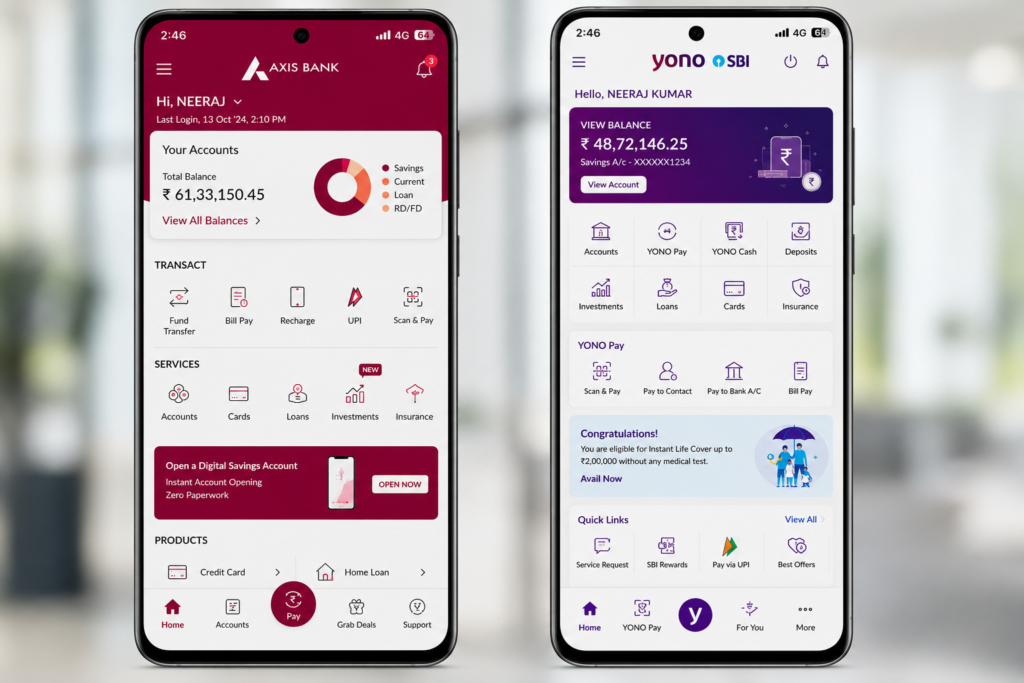
A mobile banking app is an application developed by a bank that allows its customers to access and manage their bank accounts digitally.
Its primary objective is simple.
Help customers perform banking activities without visiting a bank branch.
Typical services include:
- Checking account balance
- Viewing account statements
- Opening Fixed Deposits (FDs)
- Opening Recurring Deposits (RDs)
- Applying for loans
- Managing debit and credit cards
- Requesting cheque books
- Managing beneficiaries
- Updating KYC
- Paying credit card bills
In simple words,
Mobile banking apps are digital branches of banks.
Their job is to provide banking services securely
What Is a Payment App?
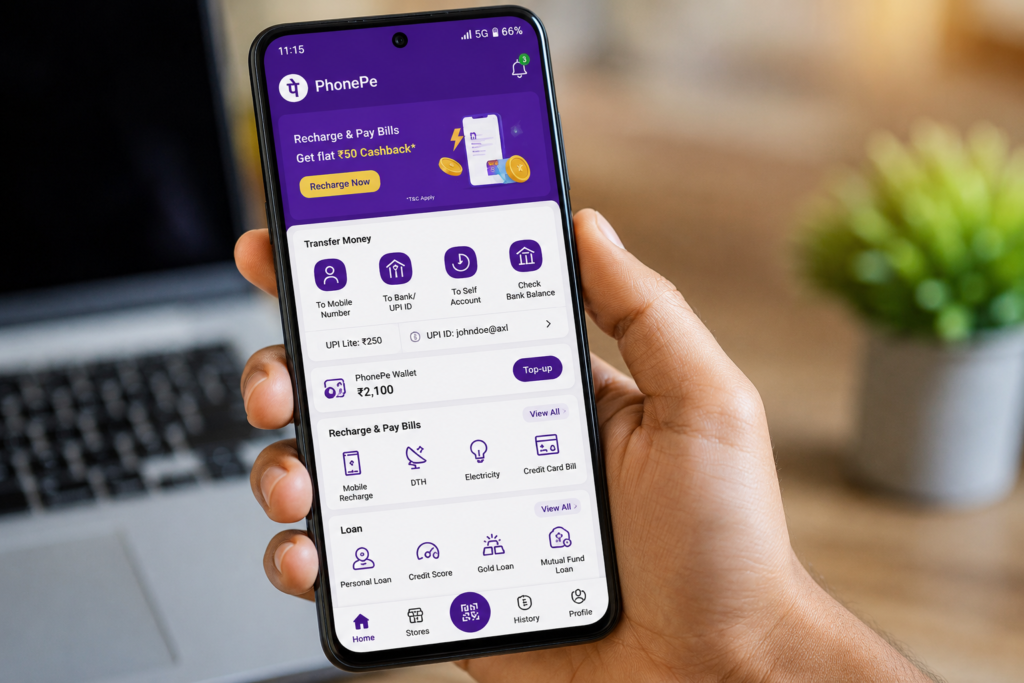
A payment app is a digital platform primarily designed to make sending and receiving money as fast, simple, and convenient as possible.
Instead of replacing your bank,
payment apps connect multiple banks through the Unified Payments Interface (UPI) and provide a much simpler user experience.
Besides UPI payments, they often include:
- QR code payments
- Mobile recharge
- Utility bill payments
- FASTag recharge
- Insurance
- Investments
- Gift cards
- Shopping offers
- Credit products
- Merchant payments
Notice something important.
Payment apps are not trying to become banks.
They’re trying to become your daily financial companion.
Banking vs Payments
This is the biggest difference.
Banks ask:
“How can we help customers manage their money?”
Payment apps ask:
“How can we make paying someone effortless?”
Although the difference sounds small,
it completely changes how these products are designed.
Banks prioritize:
- Security
- Compliance
- Risk management
- Financial services
Payment apps prioritize:
- Speed
- Simplicity
- Convenience
- Daily engagement
Both are important.
But they solve different problems.
Why Banks Couldn’t Build the Same Experience
Many readers wonder,
“If banks already had apps, why didn’t they simply make them better?”
The answer lies in priorities.
Banks operate under strict regulatory requirements.
Their first responsibility is protecting customer money.
Innovation is important,
but security comes first.
Payment companies, on the other hand,
focus almost entirely on improving customer experience.
They continuously experiment with:
- Faster onboarding
- Simpler navigation
- Better rewards
- Easier QR payments
- Personalized recommendations
Because of this,
they often innovate much faster than traditional banks.
One App, Many Bank Accounts
Imagine you have accounts in:
- SBI
- HDFC Bank
- ICICI Bank
If you use only banking apps,
you’ll likely need three separate applications.
Each has:
- Different login methods
- Different user interfaces
- Different navigation
- Different experiences
Now imagine using a payment app.
You can connect all three bank accounts in one place.
Instead of switching between multiple apps,
you simply choose the bank account you want to use.
This convenience became one of the biggest reasons for the popularity of payment apps
Daily Payments vs Financial Management
Let’s compare a typical day.
Suppose you need to:
- Buy groceries
- Pay your electricity bill
- Recharge your mobile
- Send ₹500 to a friend
A payment app is designed for exactly these daily activities.
Now suppose you want to:
- Download a bank statement
- Increase your debit card limit
- Open a Fixed Deposit
- Apply for a home loan
- Update your nominee
These tasks belong to your banking app.
One focuses on transactions.
The other focuses on banking relationships.
Why Payment Apps Feel Faster
Have you noticed how quickly payment apps open?
Most are designed so that your most common actions are immediately visible.
For example:
- Scan QR
- Send Money
- Pay Contacts
- Bank Balance
Everything else is secondary.
Banking apps often contain dozens of financial services.
As a result,
their navigation tends to be more detailed.
Neither approach is wrong.
Each reflects a different business objective
The Psychology Behind Payment Apps
Payment apps understand one important truth.
Most people don’t enjoy making payments.
They simply want to finish them as quickly as possible.
That’s why payment apps remove unnecessary friction.
Every second saved increases customer satisfaction.
Every tap removed increases the likelihood of repeat usage.
In behavioral psychology,
this is known as reducing friction.
The easier an action becomes,
the more frequently people perform it
Rewards Changed Consumer Expectations
Another major difference is rewards.
Most banking apps rarely reward everyday transactions.
Payment apps frequently offer:
- Cashback
- Scratch cards
- Coins
- Loyalty points
- Merchant offers
- Referral bonuses
Why?
Because payment companies are competing for daily engagement.
Banks already have customers.
Payment apps must continually encourage users to choose their platform.
Rewards became one of the most effective ways to influence that decision
Security: A Common Misconception
Some people believe payment apps are less secure than banking apps.
This isn’t entirely accurate.
Most major payment apps use the UPI infrastructure developed by the National Payments Corporation of India (NPCI) and work with regulated banking partners. They also implement multiple security measures such as device verification, UPI PIN authentication, encryption, fraud detection systems, and transaction monitoring.
However, no digital platform is completely risk-free.
Security also depends on the user’s behavior.
For example:
- Never share your UPI PIN.
- Never approve unknown collect requests.
- Verify QR codes before scanning.
- Beware of phishing links and fake customer support numbers.
- Enable app lock or biometric authentication.
Technology provides protection,
but responsible usage remains equally important.
Comparison: Payment Apps vs Mobile Banking Apps
| Feature | Payment Apps | Mobile Banking Apps |
|---|---|---|
| Primary Purpose | Everyday payments | Complete banking services |
| Main Focus | Speed and convenience | Account management |
| UPI Payments | Excellent | Available in many banking apps |
| QR Code Payments | Core feature | Often available but less central |
| Rewards | Cashback, coins, offers | Rare |
| Multiple Bank Accounts | Yes | Usually only the bank’s own accounts |
| Bill Payments | Yes | Yes |
| Financial Products | Yes | Yes |
| User Experience | Consumer-first | Banking-first |
| Daily Usage | Very high | Moderate |
| Target Users | General consumers | Existing bank customers |
Can Payment Apps Replace Banks?
The short answer is:
No.
Payment apps and banks depend on one another.
Without banks:
- There would be no customer accounts.
- No deposits.
- No regulated lending.
- No core banking infrastructure.
Without payment apps:
- Digital payments would often be less convenient.
- Merchant adoption might have been slower.
- Everyday transactions would involve more friction.
Rather than replacing banks,
payment apps extend banking services into everyday life.
They simplify access,
while banks continue providing the financial foundation.
Why Both Will Continue to Coexist
As India’s digital economy grows,
banks and payment apps are becoming increasingly interconnected rather than competitive.
Banks continue expanding their digital capabilities.
Payment apps continue adding banking-like services.
The boundaries are becoming less visible.
Yet their core missions remain different.
Banks safeguard your money.
Payment apps simplify how you use it.
Key Takeaways
- Mobile banking apps are designed to help customers manage their bank accounts and access banking services.
- Payment apps are designed to make everyday transactions faster, simpler, and more convenient.
- Payment apps focus heavily on user experience, rewards, and habit formation.
- Banks prioritize security, compliance, and comprehensive financial services.
- Both platforms complement each other rather than compete directly.
- Understanding this distinction explains why payment apps became essential even though mobile banking apps already existed.
Chapter 8: How Payment Apps Actually Make Money
“If UPI payments are free, cashback costs money, and payment apps don’t charge users for most transactions, how do these companies become billion-dollar businesses?”
Every day, millions of Indians make UPI payments without paying any transaction fee.
Consumers transfer money instantly.
Merchants receive payments.
Everything seems free.
So…
Who is paying?
The answer surprises many people.
Payment companies are not primarily in the payment business.
They’re in the financial ecosystem business.
Payments are simply the front door.
The real revenue comes after you’ve entered.
The Biggest Misconception About Payment Apps
Most people think payment apps earn money every time we scan a QR code.
In reality, for most person-to-person and many consumer UPI transactions in India, payment apps do not earn significant revenue directly from the payment itself.
This often surprises consumers.
Imagine running a restaurant where customers enter for free.
Would that business survive?
Probably not.
Unless…
The free entry encourages customers to buy food.
That’s exactly how payment apps operate.
The payment isn’t the product.
It’s the beginning of the customer relationship
Payments Are an Entry Point
Think of a shopping mall.
The mall doesn’t advertise itself by saying:
“Come and spend money.”
Instead it says:
“Come enjoy shopping, food, entertainment, and experiences.”
Once you’re inside,
many businesses have the opportunity to sell products and services.
Payment apps follow the same philosophy.
First,
they encourage you to:
- Install the app.
- Link your bank account.
- Complete your first payment.
- Develop a daily habit.
Only after trust has been established do they begin introducing additional services.
This strategy is known as land and expand.
First acquire the customer.
Then gradually expand the relationshi
Why Companies Invest So Much in User Growth
Suppose a payment app has:
- 5 million users
Now imagine another payment app with:
- 150 million active users
Which company has more opportunities to sell:
- Insurance?
- Personal loans?
- Credit cards?
- Investments?
- Merchant services?
The second one.
The value isn’t only in transactions.
The value lies in the customer base.
That’s why companies spent years focusing on acquiring users before worrying about profitability
Revenue Stream 1: Financial Services
One of the biggest revenue opportunities comes from financial products.
Today, many payment apps offer services such as:
- Personal loans
- Gold investments
- Mutual funds
- Insurance
- Credit products
- Savings products
Instead of developing every product themselves,
many payment apps collaborate with regulated financial institutions.
When customers purchase eligible financial products through the app, the platform may earn fees or commissions from its partners, depending on the arrangement and applicable regulations.
This creates revenue without charging users for making payments
Revenue Stream 2: Personal Loans
Have you noticed something interesting?
After using a payment app for several months,
you may start seeing messages like:
“You’re eligible for a personal loan.”
or
“Get an instant loan in minutes.”
Why?
Because lending is one of the largest revenue opportunities in fintech.
When customers take loans through partner financial institutions, payment platforms may earn revenue through referral fees, distribution arrangements, or other commercial partnerships, depending on the product structure and regulations.
For banks and lenders,
payment apps become customer acquisition partners.
For payment companies,
loans significantly increase customer lifetime value
Revenue Stream 3: Insurance
Insurance is another major business opportunity.
Many payment apps now allow users to purchase:
- Health insurance
- Life insurance
- Travel insurance
- Motor insurance
- Personal accident insurance
Imagine someone already trusts your app enough to transfer money every day.
Buying insurance through the same platform feels natural.
Trust reduces hesitation.
That trust has enormous business value.
Revenue Stream 4: Investments
Several payment platforms have expanded into wealth management.
Users can now invest in:
- Mutual funds
- Digital gold
- Fixed-income products
- Other regulated investment offerings
This transforms the app from a payment tool into a financial management platform.
Instead of interacting with customers once a week,
companies encourage ongoing engagement.
Revenue Stream 5: Merchant Solutions
Consumers aren’t the only customers.
Merchants are customers too.
Businesses require much more than QR codes.
Many payment companies provide services such as:
- Payment gateways
- Business dashboards
- QR code management
- Invoicing tools
- Settlement reports
- Business analytics
- Subscription billing
- Point-of-sale solutions
These value-added services can generate revenue while helping businesses operate more efficiently.
Revenue Stream 6: Advertising and Promotions
Have you ever noticed offers like:
- 20% cashback at a restaurant.
- Discount on movie tickets.
- Special shopping festival offers.
- Grocery coupons.
These promotions are rarely random.
Brands often collaborate with payment platforms to reach relevant audiences.
Imagine a coffee chain launching a campaign.
Instead of advertising to everyone,
it can target users who frequently pay at cafés.
This improves marketing efficiency.
The payment app benefits through commercial partnerships.
The merchant benefits from increased visibility.
The consumer benefits from offers.
It’s a win for all three
Revenue Stream 7: Brand Partnerships
Payment companies also collaborate with:
- E-commerce platforms
- Airlines
- Hotels
- Food delivery apps
- Entertainment services
- Travel companies
- Retail brands
These partnerships create:
- Exclusive discounts
- Reward campaigns
- Cashback offers
- Loyalty programs
Behind many of these campaigns lies a commercial agreement between the platform and its partners.
Revenue Stream 8: Premium Memberships
Some fintech companies go beyond payments.
They create premium experiences.
A well-known example is CRED.
Rather than focusing only on cashback,
it built an exclusive community around responsible credit card users.
Members gain access to:
- Premium offers
- Curated experiences
- Brand partnerships
- Lifestyle benefits
This helps strengthen customer loyalty while creating additional monetization opportunities.
Revenue Stream 9: Data-Driven Personalization
Whenever you use a payment app,
you create valuable behavioral insights.
For example,
the app may recognize that you frequently:
- Recharge your mobile.
- Pay electricity bills.
- Travel regularly.
- Shop online.
This information helps companies personalize recommendations and offers.
It is important to note that major payment platforms are expected to handle user data in accordance with applicable privacy laws, regulations, and their own privacy policies. Responsible personalization is based on user permissions, legal requirements, and data protection practices.
Personalization benefits both businesses and consumers.
Users see more relevant offers.
Companies improve engagement and conversion rates
Revenue Stream 10: Building a Financial Ecosystem
One of the smartest strategies used by payment apps is ecosystem expansion.
Instead of building a single product,
they build multiple connected services.
Imagine one customer journey.
Downloads App

↓

Makes First UPI Payment

↓

Pays Utility Bills

↓

Buys Insurance

↓

Invests in Mutual Funds

↓

Applies for a Loan

↓

Uses Merchant Offers

↓

Becomes a Long-Term Customer
Notice something.
The first payment generates very little direct revenue.
But every additional service increases the customer’s lifetime value.
That’s the real business model.
Why Payments Themselves Matter So Much
If payments generate little direct revenue,
why do companies care so much about increasing UPI transactions?
Because every payment strengthens three things.
1. Habit
The more often people use the app,
the harder it becomes to switch.
2. Trust
Every successful transaction reinforces confidence.
Users begin thinking:
“This app has never failed me.”
That trust becomes the foundation for future financial products
3. Customer Data for Better Experiences
Frequent usage helps companies understand how customers interact with the platform.
This allows them to improve user experience, personalize features, and recommend relevant services, while operating within applicable laws and privacy commitments.
More engagement leads to better products.
Better products encourage more engagement.
The Fintech Flywheel
This entire business model creates a powerful cycle.
More Users

↓

More Transactions

↓

Greater Trust

↓

More Financial Products Used

↓

Higher Revenue

↓

More Investment in Rewards and Innovation

↓

Even More Users
This self-reinforcing cycle is one of the biggest reasons why India’s leading payment apps have continued to grow.
The Real Business Was Never UPI
UPI made digital payments possible.
But payment companies built businesses around everything that comes after the payment.
They understood something most consumers don’t realize.
A payment is not the end of the customer journey.
It’s the beginning.
The real opportunity starts only after trust has been earned.
Key Takeaways
- Most UPI payments are free for consumers, and payment apps generally earn little direct revenue from these transactions.
- Payment apps use free payments to acquire and retain customers.
- Their major revenue streams include financial products, merchant services, advertising, partnerships, and premium offerings.
- Payments act as the entry point to a broader financial ecosystem.
- Customer Lifetime Value (LTV) is far more important than the revenue from a single payment.
- The stronger the habit and trust, the greater the opportunity to offer additional financial services.
Chapter 9: From Cashback to Loans, The Evolution of Fintech Growth
Imagine this.
You install a payment app to do one simple thing.
Transfer money.
For the first few months, everything feels straightforward.
You pay bills.
Recharge your mobile.
Scan QR codes.
Send money to friends.
Then something changes.
One day, you receive a notification.
“Congratulations! You’re eligible for an instant personal loan.”
A few weeks later, another message appears.
“Protect your family with health insurance.”
Soon after,
you see offers for:
- Mutual funds
- Digital gold
- Credit cards
- Buy Now, Pay Later (BNPL)
- Fixed-income investments
At first, it feels strange.
You downloaded the app to make payments.
Why is it suddenly trying to become your financial advisor?
The answer reveals one of the biggest growth strategies in modern fintech
Payment Apps Were Never Meant to Stay Just Payment Apps
Many consumers believe payment apps gradually added loans because they wanted to earn more money.
While that’s true,
there’s a much bigger reason.
Every successful business eventually asks one important question.
“What else can we offer the customers who already trust us?”
Payment companies had already solved one of the hardest problems.
They had earned trust.
Millions of people were opening their apps every single day.
Instead of spending enormous amounts to attract new customers,
it became much smarter to offer additional services to existing ones.
This strategy is called Cross-Selling.
What Is Cross-Selling?
Cross-selling is a marketing strategy where a business recommends additional products or services to existing customers based on their needs and behavior.
For example:
When you buy a smartphone,
the retailer may recommend:
- A phone case
- Screen protector
- Wireless earbuds
The retailer isn’t changing its business.
It’s increasing the value of each customer.
Payment apps use exactly the same strategy.
Once users trust them with payments,
they introduce:
- Loans
- Insurance
- Investments
- Credit cards
- Wealth management products
The customer relationship grows over time
Why Existing Customers Are More Valuable Than New Customers
Let’s imagine two scenarios.
Scenario A
A company spends ₹500 to acquire a completely new customer.
Scenario B
The company already has an active customer who opens the app every day.
Which customer is easier to sell a new service to?
The second one.
Why?
Because trust already exists.
Marketing experts often say:
“It’s easier to sell more products to an existing customer than to convince a stranger to buy their first product.”
This is why companies invest heavily in customer retention.
Trust Is the Real Currency
Imagine receiving a loan advertisement from a company you’ve never heard of.
Would you immediately apply?
Probably not.
Now imagine seeing the same offer inside an app you’ve used every day for the last four years.
Your reaction changes.
Not because the loan changed.
Because trust changed.
Every successful payment strengthens confidence.
Eventually,
that confidence extends to other financial products.
This is one of the biggest advantages payment apps possess
Why Loans Became the Biggest Opportunity
Payments are convenient.
But loans are profitable.
Here’s why.
Imagine two customers.
Customer A
Makes 300 UPI transactions in one year.
Customer B
Applies for a personal loan through the same platform.
The second customer can generate significantly more revenue for the lending ecosystem than hundreds of routine payment transactions.
This is why lending became one of the fastest-growing areas in fintech.
It’s important to note that payment apps themselves do not necessarily lend the money. In many cases, loans are provided by regulated banks or Non-Banking Financial Companies (NBFCs), while the payment app acts as a distribution or customer acquisition platform
Customer Segmentation: Not Everyone Sees the Same Offers
Have you ever noticed that your friend receives different offers than you do?
One person sees:
“Get an instant personal loan.”
Another sees:
“Invest in mutual funds.”
Someone else receives:
“Buy health insurance.”
This isn’t random.
It’s called Customer Segmentation
What Is Customer Segmentation?
Customer Segmentation is the process of dividing customers into groups based on shared characteristics so businesses can provide more relevant products and services.
Companies may consider factors such as:
- Age
- Income
- Spending patterns
- Payment frequency
- Location
- Product interests
- Financial goals
Instead of showing everyone the same offer,
they try to present products that are more relevant to each group.
This improves customer experience and reduces irrelevant promotions.
Personalization: Making Every User Feel Unique
Segmentation divides people into groups.
Personalization goes one step further.
It adapts the experience for an individual.
Imagine two users.
Rahul
- Pays electricity bills every month.
- Frequently books train tickets.
- Shops online.
Priya
- Makes restaurant payments.
- Travels frequently.
- Uses airport services.
Their payment apps may highlight different offers because their usage patterns differ.
Personalization aims to show information that is more useful for each user, while operating within applicable privacy laws and user permissions.
The Marketing Funnel Behind Every Payment App
Most people think downloading the app is the end of the journey.
Businesses know it’s only the beginning.
Here’s what the customer journey often looks like.
Advertisement

↓

App Download

↓

Bank Account Linked

↓

First UPI Payment

↓

Second Payment

↓

Habit Formation

↓

Regular Bill Payments

↓

Cashback & Rewards

↓

Insurance / Investments

↓

Loan Offers

↓

Long-Term Customer
Each stage has a different marketing objective.
| Stage | Business Goal |
|---|---|
| App Download | Acquire users |
| First Payment | Reduce hesitation |
| Cashback | Encourage repetition |
| Habit Formation | Increase retention |
| Financial Products | Increase customer value |
| Long-Term Relationship | Maximize Customer Lifetime Value (LTV) |
Notice something important.
The loan isn’t the first step.
It’s one of the last.
Companies first earn trust.
Then they expand the relationship.
Responsible Lending: More Than Just One Click
Many advertisements make loans appear instant.
However, behind the scenes,
the process is much more structured.
Responsible lending generally involves:
- Identity verification (KYC)
- Eligibility assessment
- Credit evaluation
- Regulatory compliance
- Lending partner approval
Receiving a loan notification does not guarantee approval.
The final decision depends on the lending institution’s policies, applicable regulations, and the applicant’s financial profile.
Understanding this helps separate marketing from the actual lending process.
Why Cashback Became Smaller Over Time
If you’ve been using payment apps since 2017 or 2018,
you’ve probably noticed something.
Cashback isn’t what it used to be.
Early users often received:
- ₹100 cashback
- ₹250 referral bonuses
- Guaranteed rewards
Today,
many users receive:
- Small cashback amounts
- Coins
- Reward points
- Discount coupons
- Personalized offers
Did companies suddenly become less generous?
Not exactly.
Their objectives changed
The Evolution of Reward Strategies
Phase 1: Customer Acquisition
The priority was simple.
Convince people to try digital payments.
Large cashback campaigns helped reduce hesitation
Phase 2: Habit Formation
Once users became comfortable,
companies shifted toward:
- Scratch cards
- Coins
- Loyalty rewards
The focus moved from attracting users to retaining them.
Phase 3: Financial Ecosystem
Today,
the goal is much broader.
Instead of rewarding every payment,
companies focus on:
- Insurance
- Investments
- Merchant partnerships
- Lending
- Wealth management
- Personalized financial services
The business evolved from payment apps into financial ecosystems.
The Fintech Growth Pyramid
Every successful payment app follows a similar growth path.
Financial Products
(Loans, Insurance, Investments)

↓

Customer Trust

↓

Daily Habit

↓

Regular Payments

↓

First Payment

↓

App Installation
Each level depends on the one below it.
Without the first payment,
there is no habit.
Without habit,
there is no trust.
Without trust,
selling financial products becomes much harder.
The Bigger Picture
Looking back,
cashback was never the destination.
It was the invitation.
The payment wasn’t the product.
It was the beginning of the relationship.
And the loan wasn’t just another feature.
It represented the next stage in a carefully designed customer journey.
Understanding this helps us see payment apps differently.
They’re not simply helping people transfer money.
They’re building long-term financial relationships through trust, convenience, and continuous engagement
Key Takeaways
- Payment apps use cross-selling to offer additional financial products to existing customers.
- Existing customers are generally more valuable than constantly acquiring new ones.
- Trust earned through successful payments creates opportunities to introduce loans, insurance, and investments.
- Customer segmentation and personalization help present more relevant products to different users.
- Loan offers do not guarantee approval, as lending decisions depend on regulated financial institutions and credit assessments.
- Cashback strategies evolved from customer acquisition to long-term ecosystem growth.
- Today’s leading payment apps are no longer just payment platforms. They are becoming comprehensive digital financial ecosystems.
Chapter 10: Five-Year Competitive Analysis of India’s Leading Payment Apps
They compete through:
- Consumer psychology
- Product design
- Trust
- User experience
- Financial services
- Brand positioning
Yet one question remains.
If every payment app uses the same UPI infrastructure…
If everyone offers QR payments…
If everyone allows bank transfers…
Why did some companies become market leaders while others struggled to grow?
The answer lies in strategy, not technology.
Although PhonePe, Google Pay, Paytm, CRED, and MobiKwik operate in the same industry, each company chose a very different path.
Five Years of India’s Payment App Evolution
The Indian fintech industry has evolved significantly over the past five years.
Initially, the competition focused on:
- Cashback
- User acquisition
- Referral rewards
Today, the competition is centered around:
- Financial ecosystems
- Customer retention
- Lending
- Investments
- Merchant services
- Personalization
- AI-powered experiences
The companies that adapted successfully continued growing.
Those that relied only on rewards found it increasingly difficult to maintain momentum
PhonePe: Winning Through Everyday Convenience
Brand Positioning
“India’s Everyday Payment App.”
PhonePe positioned itself as an app for everyone.
Whether someone wanted to:
- Buy groceries
- Recharge a mobile
- Pay electricity bills
- Book gas cylinders
- Invest
- Buy insurance
PhonePe wanted to be the first choice.
Marketing Strategy
Instead of targeting only one type of customer,
PhonePe focused on mass adoption.
Its growth strategy emphasized:
- Merchant expansion
- QR code availability
- Everyday utility
- Bill payments
- Financial services
Rather than depending only on cashback,
it built convenience into daily life.
Target Audience
PhonePe serves:
- Students
- Families
- Small businesses
- Shop owners
- Rural users
- Urban consumers
Its objective is broad accessibility.
Reward Strategy
PhonePe initially offered attractive cashback and referral programs.
Over time,
its rewards shifted toward:
- Bill payment offers
- Merchant deals
- Personalized promotions
The focus moved from acquisition to retention.
Strengths
- Massive merchant network
- Strong brand recognition
- Wide range of financial services
- High everyday usage
- Extensive QR code presence
Weaknesses
- Fewer premium lifestyle experiences compared with niche competitors
- Intense competition in a mature UPI market
Google Pay: Simplicity Powered by Trust
Brand Positioning
Google Pay positioned itself around one promise.
Simple, fast, and secure payments.
Instead of overwhelming users with features,
Google focused on an intuitive experience.
Marketing Strategy
Google understood something important.
People already trusted Google.
Rather than building trust from scratch,
it extended that trust into digital payments.
Its marketing emphasized:
- Simplicity
- Security
- Reliability
- Scratch cards
- Referral campaigns
Target Audience
Google Pay appeals to:
- First-time digital payment users
- Android users
- Young professionals
- Families
- Everyday consumers
Reward Strategy
Google Pay became famous for:
- Scratch cards
- Surprise rewards
- Referral bonuses
Instead of guaranteed cashback,
it used curiosity and anticipation to increase engagement
Strengths
- Strong global brand
- Excellent user experience
- Simple interface
- High consumer trust
Weaknesses
- Smaller financial ecosystem compared with some competitors
- Greater reliance on partnerships for additional services
Paytm: From Wallet to Financial Super App
Brand Positioning
Paytm’s journey is unique.
It began as a mobile wallet before UPI became mainstream.
Over time,
it transformed into a broader financial platform.
Marketing Strategy
Paytm focused on creating an ecosystem.
Instead of offering only payments,
it expanded into:
- Banking-related services
- Merchant payments
- Ticket booking
- Insurance
- Investments
- Business solutions
Its objective was to become a comprehensive financial app.
Target Audience
Paytm serves:
- Consumers
- Merchants
- Small businesses
- Enterprises
Reward Strategy
Paytm initially attracted users with generous cashback.
As the market matured,
its focus shifted toward:
- Merchant offers
- Ecosystem benefits
- Financial products
Strengths
- Diverse product portfolio
- Strong merchant presence
- Established brand
- Multiple revenue streams
Weaknesses
- More complex interface due to a wide range of services
- Strong competition from UPI-focused rivals
CRED: Premium Positioning Instead of Mass Adoption
CRED chose a completely different strategy.
Instead of serving everyone,
it deliberately targeted a specific audience.
Brand Positioning
Premium financial lifestyle platform.
CRED focuses primarily on users with credit cards who meet certain eligibility criteria.
Its messaging revolves around responsible financial behavior and exclusive experiences.
Marketing Strategy
Instead of competing on cashback,
CRED competes on:
- Exclusivity
- Premium rewards
- Lifestyle experiences
- Brand partnerships
- Community
This makes the platform feel aspirational.
Target Audience
- High-income professionals
- Credit card users
- Urban consumers
- Premium lifestyle seekers
Reward Strategy
CRED relies on:
- CRED Coins
- Exclusive offers
- Brand experiences
- Limited-access rewards
Rather than rewarding every transaction,
it rewards customer quality and engagement.
Strengths
- Strong premium branding
- Highly differentiated positioning
- Loyal customer base
- Creative marketing campaigns
Weaknesses
- Smaller addressable audience
- Growth depends on serving a niche segment effectively
MobiKwik: Reinventing Through Financial Services
MobiKwik entered the market before the explosive growth of UPI.
Initially,
its wallet played a significant role in digital payments.
As UPI adoption expanded,
the company evolved its strategy.
Marketing Strategy
MobiKwik increasingly focused on:
- Digital wallets
- Credit solutions
- Merchant services
- Financial products
Target Audience
Reward Strategy
The company introduced:
- Wallet rewards
- SuperCash
- Merchant offers
- Financial product promotions
Its objective became encouraging repeat engagement within its ecosystem.
Strengths
- Early mover in digital payments
- Strong wallet expertise
- Financial product expansion
Weaknesses
- Intense competition from larger payment platforms
- Need for stronger differentiation in a crowded market
Competitive Comparison
| Platform | Primary Positioning | Target Audience | Main Reward Strategy | Biggest Strength |
|---|---|---|---|---|
| PhonePe | Everyday payment ecosystem | Mass market | Cashback, bill offers | Merchant network and convenience |
| Google Pay | Simple and secure payments | General consumers | Scratch cards | User experience and trust |
| Paytm | Financial super app | Consumers and merchants | Cashback and ecosystem offers | Broad product portfolio |
| CRED | Premium financial lifestyle platform | Credit card users | Coins and exclusive rewards | Premium branding |
| MobiKwik | Wallet and digital finance | Consumers and merchants | Wallet rewards and SuperCash | Early fintech experienc |
Why Some Platforms Grew Faster Than Others
While every company had access to UPI,
their growth depended on strategic decisions.
Successful platforms generally focused on
1. Simplicity
The easier the app,
the faster people adopted it.
2. Merchant Acceptance
An app becomes more valuable when it works almost everywhere.
A large merchant network increases convenience.
3. Trust
Reliable transactions,
clear confirmations,
and consistent performance encouraged repeat usage.
4. Ecosystem Expansion
Companies that expanded into insurance, investments, merchant tools, and financial services created additional revenue opportunities beyond payments.
5. Brand Positioning
Each successful company answered a different question.
- PhonePe: How can we become India’s everyday payment app?
- Google Pay: How can we make payments simple and trustworthy?
- Paytm: How can we become a financial super app?
- CRED: How can we create a premium financial lifestyle brand?
- MobiKwik: How can we evolve from a wallet into a broader fintech platform?
None of these strategies was identical.
Each reflected a different understanding of the market.
What This Means for Businesses
One of the biggest lessons from India’s payment industry is that technology alone rarely creates market leadership.
Every company had access to similar payment infrastructure.
The winners distinguished themselves through:
- Better positioning
- Stronger customer experience
- Habit-building
- Trust
- Brand identity
- Long-term ecosystem thinking
In other words,
the biggest competitive advantage wasn’t UPI.
It was understanding people better than competitors did.
Key Takeaways
- Similar technology does not guarantee similar business outcomes.
- PhonePe focused on mass-market convenience and merchant reach.
- Google Pay emphasized simplicity, trust, and engagement.
- Paytm expanded into a broad financial ecosystem.
- CRED built a premium brand instead of chasing every customer.
- MobiKwik evolved by strengthening its financial services portfolio.
- The companies that balanced customer acquisition, retention, trust, and ecosystem growth adapted more effectively as the market matured.
Chapter 11: Why New Payment Apps Like Navi UPI and SuperMoney Still Enter the Market
“India already has PhonePe, Google Pay, Paytm, CRED, and MobiKwik. Why would anyone launch another payment app?”
Imagine opening another messaging app today.
People already have WhatsApp.
Or launching another search engine when Google dominates.
It sounds almost impossible.
So why are companies like Navi, SuperMoney, and other fintech startups still investing heavily in India’s digital payment market?
Are they too late?
Or do they see opportunities that most people don’t?
The answer is fascinating.
Despite the market appearing crowded, India’s digital payment ecosystem is still evolving.
These new companies aren’t necessarily trying to replace PhonePe or Google Pay.
They’re trying to solve different problems.
A Big Market Doesn’t Mean a Closed Market
Many people assume that when a few companies dominate an industry, there’s no room for newcomers.
History tells a different story.
Think about the smartphone market.
Apple.
Samsung.
Xiaomi.
OnePlus.
Nothing.
Google.
Even after years of competition, new brands continue to enter.
Why?
Because markets don’t remain static.
Consumer needs evolve.
Technology changes.
New business models emerge.
The same is true for digital payments.
Payments Are Just the Entry Ticket
This is one of the biggest misconceptions.
New companies aren’t entering the market because they want people to make another UPI payment.
They’re entering because payments open the door to much larger financial opportunities.
Imagine owning an app that millions of people open every single day.
Once users trust your platform, you can gradually introduce:
- Personal loans
- Insurance
- Mutual funds
- Credit cards
- Wealth management
- Investment products
- Merchant solutions
The payment itself may generate little direct revenue.
But the long-term customer relationship can become extremely valuable.
India’s Fintech Opportunity Is Still Growing
India is one of the world’s fastest-growing digital payment markets.
Every year:
- More consumers begin using smartphones.
- Internet access expands.
- More small businesses accept digital payments.
- Financial inclusion improves.
- Digital commerce continues to grow.
Even if millions already use UPI,
millions more are joining the digital economy every year.
For businesses,
that represents continued growth opportunities.
New Companies Don’t Need Every Customer
Here’s another common misunderstanding.
A new payment app doesn’t need to become India’s largest platform to succeed.
It only needs to serve a clearly defined audience exceptionally well.
For example,
imagine a company focuses specifically on:
- College students
- Freelancers
- Small businesses
- Rural entrepreneurs
- Gig workers
- Investors
- Credit-conscious consumers
Instead of competing for everyone,
they compete for someone.
This strategy is called Market Segmentation.
Differentiation Is More Important Than Size
The first generation of payment apps competed primarily on:
- Cashback
- Referral bonuses
- Merchant acceptance
Today’s competition is different.
New entrants focus on creating unique value.
Examples include:
- Faster loan approvals
- Better investment experiences
- AI-powered financial insights
- Expense tracking
- Budget planning
- Smarter rewards
- Credit-building tools
Instead of asking,
“How can we build another payment app?”
they ask,
“How can we improve someone’s financial life?”
That shift changes everything.
SuperMoney: Building Around Rewards and Credit
One example of this newer approach is SuperMoney.
Rather than positioning itself solely as another UPI app,
it has emphasized:
- Reward-driven experiences
- Credit-related financial products
- Digital financial services
Its strategy reflects a broader trend in fintech.
Payments attract users.
Financial services generate long-term value.
Navi: Simplicity Beyond Payments
Navi entered the fintech market with a different perspective.
Instead of focusing only on UPI,
it expanded across multiple financial services, including lending and insurance.
Its broader goal is to create a simple, digital-first financial experience.
Rather than competing only on cashback,
it competes on convenience and integrated financial products.
AI Is Changing the Next Generation of Payment Apps
Artificial Intelligence (AI) is becoming a major competitive advantage.
Imagine opening your payment app.
Instead of simply displaying a QR scanner,
it tells you:
- Your electricity bill is due tomorrow.
- You’ve spent 20% more on food this month.
- A cheaper insurance plan may be available.
- You’re close to your monthly savings goal.
- A suspicious transaction needs your attention.
The app evolves from a payment tool into a financial assistant.
This level of personalization represents the next stage of fintech innovation.
The Future Is Personalization, Not Just Payments
Early payment apps focused on one question.
“How can we help people make digital payments?”
Tomorrow’s fintech companies are asking a much bigger question.
“How can we help people make better financial decisions?”
That includes:
- Budgeting
- Saving
- Investing
- Borrowing responsibly
- Protecting against financial risks
- Planning long-term goals
Payments become only one feature within a much broader financial ecosystem.
The Next Battle Is Financial Ecosystems
The competition is no longer:
PhonePe vs Google Pay.
Instead,
it’s becoming:
Who can become the most trusted financial platform?
Future competition will likely focus on:
- AI-powered financial guidance
- Hyper-personalized offers
- Embedded finance
- Wealth management
- Credit innovation
- Business financial tools
- Digital banking experiences
- Financial education
The winner won’t necessarily be the company with the highest cashback.
It will be the company that creates the most value throughout a customer’s financial journey.
What Startups Can Learn
The success of India’s payment apps offers valuable lessons for entrepreneurs
1. Solve a Real Problem
Technology alone isn’t enough.
Successful businesses solve meaningful customer problems.
2. Focus on Trust Before Revenue
Consumers trusted payment apps with small payments before considering larger financial products.
Trust came first.
Revenue followed.
3. Build Habits, Not Just Features
Features can be copied.
Habits are much harder to replace.
The companies that became part of customers’ daily routines gained a lasting advantage.
4. Think Beyond Your First Product
PhonePe didn’t stop at QR payments.
CRED didn’t stop at credit card bill payments.
Paytm didn’t stop at wallets.
Every successful fintech company expanded into a broader ecosystem.
5. Differentiate Instead of Imitating
Entering a crowded market doesn’t require becoming a copy of the market leader.
It requires offering something meaningfully different.
A unique customer experience often matters more than having more features.
The Future of India’s Digital Payment Industry
India’s digital payment journey is far from complete.
The next decade will likely be shaped by:
- AI-powered financial assistants
- Smarter personalization
- Embedded finance
- Greater financial inclusion
- More secure digital payments
- Faster merchant innovation
- Integrated investment and insurance platforms
- Improved fraud prevention
Digital payments will become increasingly invisible.
Instead of thinking about making a payment,
consumers will simply complete everyday activities,
and payments will happen seamlessly in the background.
Key Takeaways
- A crowded market does not mean opportunities have disappeared.
- New payment apps succeed by solving different customer problems rather than copying existing platforms.
- Payments are increasingly becoming the entry point to broader financial ecosystems.
- AI, personalization, and integrated financial services are shaping the next generation of fintech.
- Trust, differentiation, and long-term customer relationships remain the strongest competitive advantages.
- The future belongs to platforms that help users manage their overall financial lives, not just transfer money.
Chapter 12: Marketing Lessons Every Business and Consumer Can Learn
After reading this guide, one thing becomes clear.
This article was never just about payment apps.
It was about understanding why people make decisions.
PhonePe, Google Pay, Paytm, CRED, and MobiKwik didn’t become successful simply because they built good technology.
Thousands of companies build good products every year.
Very few change human behavior.
That’s exactly what India’s leading payment apps accomplished.
They didn’t simply convince people to use UPI.
They changed decades-old habits.
And that makes them one of the greatest marketing case studies in India’s digital economy.
Whether you’re a business owner, marketer, entrepreneur, product manager, or an everyday consumer, there are valuable lessons hidden behind every QR code, cashback reward, and notification.
Let’s explore them.
Marketing Lessons Every Business Can Learn
1. Don’t Sell the Product. Solve the Problem.
Many businesses believe customers buy products.
In reality,
customers buy solutions.
People didn’t install PhonePe because they loved payment apps.
They installed it because:
- Carrying cash became inconvenient.
- QR payments were faster.
- Cashback reduced hesitation.
- UPI simplified transactions.
The product wasn’t the hero.
The solution was.
Lesson
Always ask:
“What problem am I solving?”
Instead of asking:
“What product am I selling?”
2. Changing Behavior Is Harder Than Building Technology
Creating software is difficult.
Changing human habits is even harder.
Payment companies understood this.
Instead of forcing consumers to change,
they rewarded them for trying something new.
One successful payment became two.
Two became ten.
Ten became hundreds.
Eventually,
digital payments became automatic.
Lesson
If your business requires customers to change their habits,
make the first step:
- Easy
- Rewarding
- Risk-free
3. Customer Acquisition Is Only the Beginning
Many startups celebrate:
“We acquired 100,000 users.”
But then what?
Downloads don’t create successful businesses.
Retention does.
Payment companies understood that acquiring users wasn’t enough.
They needed customers to return every day.
That’s why they introduced:
- Cashback
- Scratch cards
- Coins
- Bill reminders
- Merchant offers
Every feature encouraged another visit.
Lesson
Acquiring customers is expensive.
Keeping them is far more profitable.
4. Trust Is the Strongest Marketing Strategy
Advertising creates awareness.
Trust creates loyalty.
Imagine receiving a ₹5 lakh loan offer from an unknown company.
Now imagine receiving the same offer from a platform you’ve trusted for five years.
The product hasn’t changed.
Only trust has.
That’s why payment apps invested heavily in:
- Secure transactions
- Instant confirmations
- Transparent refunds
- Reliable customer support
Lesson
Marketing may attract customers.
Trust keeps them.
5. Simplicity Wins
Successful payment apps removed complexity.
Instead of asking users to remember:
- Account numbers
- IFSC codes
- Beneficiary details
They simply said:
“Scan the QR code.”
One action replaced many.
Lesson
Every unnecessary click,
every unnecessary form,
every unnecessary question
reduces conversions.
Simpler products usually win.
6. Great Products Build Habits
People rarely compare payment apps before paying ₹50.
They simply open the app they’ve always used.
That’s habit.
And habits are incredibly valuable.
Because habits reduce decision-making.
Lesson
Instead of asking:
“How do I get customers?”
Ask:
“How do I become part of their routine?”
7. Rewards Should Reinforce the Right Behavior
Cashback wasn’t random.
Every reward encouraged a specific action.
Examples:
- First payment
- Bill payment
- Referral
- Merchant payment
- Recharge
The reward always supported a business objective.
Lesson
Reward the behavior you want customers to repeat.
8. Build an Ecosystem, Not Just a Product
Initially,
PhonePe helped people make payments.
Today,
it offers:
- Insurance
- Investments
- Credit
- Merchant services
The relationship expanded naturally.
Lesson
Think beyond your first product.
Ask yourself:
“Once customers trust us, what else can genuinely help them?”
9. Personalization Creates Better Experiences
Not every customer needs the same offer.
A student.
A business owner.
A salaried employee.
A traveler.
Their financial needs differ.
Successful companies personalize experiences instead of treating every customer identically.
Lesson
Understanding customers is often more valuable than selling to everyone.
10. Long-Term Value Matters More Than Short-Term Profit
Many payment companies spent years investing heavily in customer growth.
Why?
Because they believed one loyal customer would become more valuable over time.
That’s the power of Customer Lifetime Value (LTV).
Lesson
The cheapest customer isn’t always the best customer.
The most loyal one often is.
What Consumers Can Learn
This article isn’t only for businesses.
Consumers can benefit too.
Understanding marketing psychology helps us make more informed decisions.
Cashback Isn’t Free Money
When you receive cashback,
remember:
The company expects to build a long-term relationship with you.
The reward is an investment.
Not charity.
Understand Psychological Triggers
Many payment apps use principles such as:
- Curiosity
- FOMO
- Habit formation
- Variable rewards
- Loyalty
Recognizing these techniques helps you make more conscious choices.
Convenience Can Influence Decisions
Sometimes we choose an app simply because it’s easier.
There’s nothing wrong with convenience.
Just be aware that convenience itself is a powerful marketing strategy.
Avoid Spending Just to Earn Rewards
Many consumers fall into a common trap.
They think:
“I’m saving money because I’m getting cashback.”
But if you spend ₹2,000 to earn ₹100,
you haven’t necessarily saved money.
You’ve spent ₹1,900.
Always ask:
“Would I have bought this anyway?”
Compare the Overall Experience
The best payment app isn’t always the one with the biggest cashback.
Consider:
- Security
- Reliability
- Customer support
- Ease of use
- Merchant acceptance
- Privacy
- Features that match your needs
Long-term value matters more than short-term rewards.
Key Takeaways
- Payment apps succeeded because they changed behavior, not because they offered cashback.
- Cashback was an investment in customer acquisition and habit formation.
- Consumer psychology plays a central role in digital product adoption.
- Trust, simplicity, and convenience are stronger competitive advantages than technology alone.
- Today’s payment apps are evolving into complete financial ecosystems.
- Businesses should focus on solving problems, building trust, and creating lasting customer relationships.
- Consumers should recognize marketing techniques while making thoughtful financial decisions.
Frequently Asked Questions (FAQs)
1. Why do payment apps give cashback?
Cashback encourages people to try digital payments, repeat transactions, and develop long-term habits. For businesses, it is often a customer acquisition and retention strategy rather than a simple promotional expense.
2. If UPI is free, how do payment apps make money?
Most payment apps generate revenue through financial products, merchant services, partnerships, advertising, insurance distribution, investment products, and lending partnerships rather than from basic UPI transactions alone.
3. Why has cashback reduced compared to earlier years?
In the early stages, companies used generous cashback to acquire users quickly. As digital payments became mainstream, the focus shifted toward profitability, customer retention, and financial services, reducing the need for large rewards.
4. Why do payment apps use scratch cards instead of guaranteed cashback?
Scratch cards create curiosity and anticipation through variable rewards. This increases engagement while allowing companies to manage marketing costs more efficiently.
5. Why do most payment apps have similar interfaces?
Because familiar designs reduce cognitive load and make payments faster. Companies prioritize usability over visual uniqueness for core payment tasks.
6. What is the difference between payment apps and mobile banking apps?
Payment apps focus on fast everyday transactions, rewards, and convenience across multiple bank accounts. Mobile banking apps focus on managing your relationship with a specific bank, including account services, deposits, cards, and loans.
7. Are payment apps safe?
Major payment apps implement multiple security measures and operate within India’s regulated digital payment ecosystem. However, users should never share their UPI PIN, approve unknown payment requests, or click suspicious links. Safe usage practices are just as important as platform security.
8. Why do payment apps promote personal loans?
Payments help build trust and regular engagement. Once users trust the platform, companies can introduce additional financial products such as loans, insurance, and investments through regulated partners, increasing customer lifetime value.
9. Why are new payment apps like Navi UPI and SuperMoney entering the market?
India’s digital financial ecosystem continues to grow. New companies differentiate themselves through specialized services, AI-driven personalization, lending, wealth management, and unique customer experiences rather than competing solely on UPI payments.
10. Which payment app is the best?
There isn’t a single best app for everyone. The right choice depends on your priorities, such as merchant acceptance, user experience, customer support, ecosystem features, and the financial services you use most frequently.
Conclusion: The Real Product Was Never the Cashback
Let’s return to the question we asked at the beginning of this article.
Why would billion-dollar companies give away money?
At first,
the answer seems simple.
To attract users.
But after exploring the strategies behind India’s digital payment revolution, we now know that answer is incomplete.
Cashback wasn’t the destination.
It was the invitation.
Scratch cards weren’t just games.
They were tools of behavioral psychology.
Coins weren’t merely virtual rewards.
They encouraged habit formation.
Wallet balances weren’t just stored money.
They strengthened customer retention.
Every reward,
every notification,
every QR code,
every successful transaction,
and every carefully designed user experience served one larger purpose:
Changing human behavior.
That transformation reshaped how millions of Indians pay, shop, save, and interact with financial services.
Today’s leading payment apps are no longer just payment platforms.
They are evolving into comprehensive financial ecosystems that combine convenience, trust, personalization, and long-term customer relationships.
For businesses, this story demonstrates that lasting success comes from understanding people, not just building products.
For consumers, it serves as a reminder that every reward carries a purpose. Recognizing the psychology behind those rewards empowers us to make more informed choices.
The next time you scan a QR code and a cashback notification appears, you’ll probably smile.
But you’ll also understand something most people don’t.
The real product was never the cashback.
The real product was the habit.