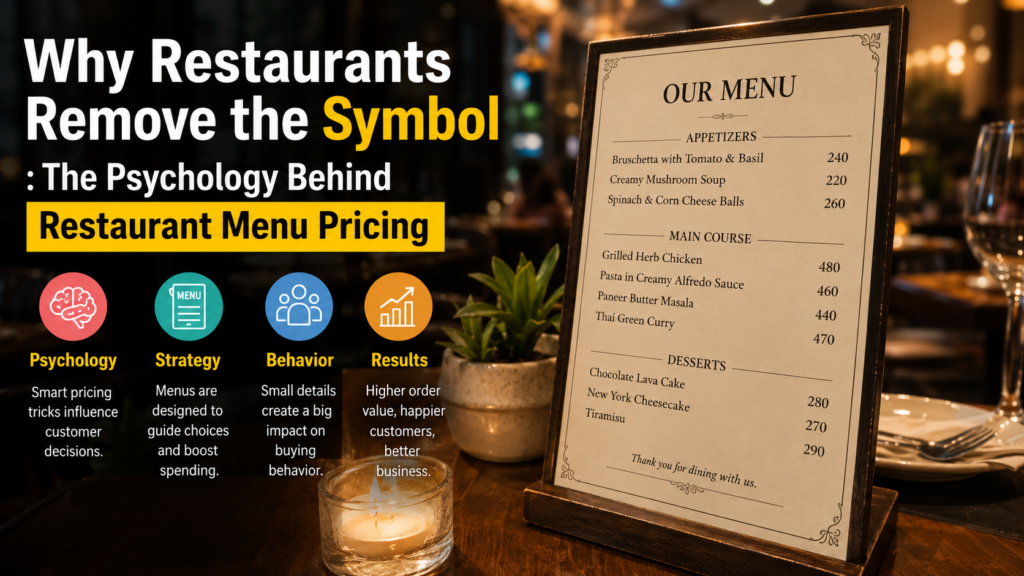
Have you ever sat down at a premium restaurant, opened the menu, and noticed something unusual?
Instead of seeing prices like:
₹499
you simply see:
499
At first glance, it may seem like a small design choice.
Perhaps the restaurant wants the menu to look cleaner.
Or maybe they simply forgot to include the currency symbol.
But neither of those explanations is correct.
Removing the ₹ symbol is actually a carefully planned marketing strategy rooted in Restaurant Menu Psychology.
It may look like a tiny design decision, but it can subtly influence how customers think, feel, and make purchasing decisions.
In fact, restaurants spend considerable time designing their menus because they understand one important truth:
A menu doesn’t just display food—it influences customer behavior.
Every colour.
Every font.
Every image.
Every description.
Even the way prices are displayed can affect what customers order.
The simple act of removing the ₹ symbol is one of the most effective psychological techniques used by restaurants worldwide.ues.
Why Do Many Restaurants Remove the ₹ Symbol?
Imagine we’re dining at a premium restaurant.
The waiter hands us the menu.
As we begin browsing through the dishes, something catches our attention.
Instead of seeing prices like ₹499, ₹799, or ₹1,299, we simply see:
499
799
1299
Most people barely notice this detail.
Those who do often assume it’s simply a design preference.
But restaurants rarely make design decisions by accident.
Every element on a well-designed menu has a purpose.
The placement of dishes.
The choice of colours.
The descriptions.
The photographs.
Even the position of prices.
Everything is carefully planned to create a better dining experience while gently influencing purchasing decisions.
Removing the ₹ symbol is one of those subtle strategies.
It isn’t meant to hide the price.
Customers still know they’re paying in Indian Rupees.
Instead, it’s designed to shift their attention away from spending money and toward enjoying the food.
It may seem like a tiny change.
Yet it plays an important role in how customers perceive value.
That’s the fascinating world of Restaurant Menu Psychology.
What Is Restaurant Menu Psychology?
Restaurant Menu Psychology is the science of designing menus in a way that influences customer decisions without forcing them to buy.
Instead of relying on discounts or sales promotions, restaurants use psychology to make ordering feel easier, more enjoyable, and more natural.
A professionally designed menu considers far more than just the list of dishes.
Restaurants carefully plan:
- Menu layout
- Food descriptions
- Price placement
- Colours
- Fonts
- Images
- Pricing format
Each of these elements influences where customers look first, what captures their attention, and ultimately what they decide to order.
For example, a beautifully described dish often appears more appealing than the same dish with a plain name.
Similarly, placing a signature dish in a prominent position increases the chances of customers choosing it.
Even the spacing between menu items has been studied by menu designers.
The goal isn’t to manipulate customers.
It’s to create a menu that’s easy to read, enjoyable to explore, and effective at highlighting the restaurant’s best offerings.
Among all these techniques, one of the simplest—and surprisingly most effective—is removing the currency symbol from prices.
Although it looks insignificant, this small change influences how customers think about spending money.
Why Restaurants Remove the ₹ Symbol
One of the biggest reasons restaurants remove the ₹ symbol is because they want customers to focus on the dining experience rather than the cost.
Several psychological principles explain why this simple strategy works.
”It Reduces the Pain of Paying”
Every purchase creates a small feeling of discomfort.
Psychologists call this the Pain of Paying.
Whenever we see a currency symbol such as ₹, $, or £, our brain immediately recognises that money is leaving our pocket.
For example, imagine seeing this price:
₹699
Most people’s brains immediately think:
“I’m spending nearly seven hundred rupees.”
Now compare it with:
699
The amount hasn’t changed.
The customer still pays exactly the same price.
However, without the ₹ symbol, the brain focuses slightly less on spending money and more on the product itself.
That tiny difference reduces the emotional discomfort associated with making a purchase.
As a result, customers often feel more comfortable ordering another dish, dessert, or beverage.
This is why removing the currency symbol has become such a popular menu design technique.
It Keeps the Focus on Food
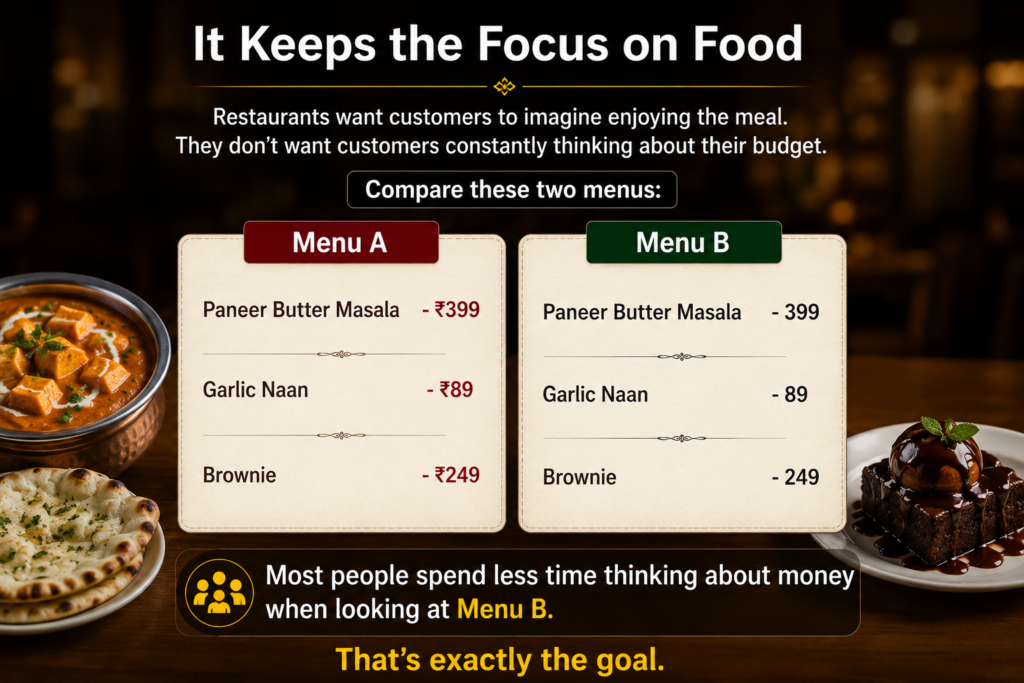
Restaurants want customers to imagine enjoying the meal—not calculating the bill.
Let’s compare two menus.
Menu A
Paneer Butter Masala – ₹399
Garlic Naan – ₹89
Chocolate Brownie – ₹249
Menu B
Paneer Butter Masala – 399
Garlic Naan – 89
Chocolate Brownie – 249
Although both menus display exactly the same prices, they create slightly different experiences.
Menu A constantly reminds customers about spending money.
Menu B feels cleaner and encourages customers to focus on the dishes instead of the currency.
This small psychological shift can influence how people perceive the entire dining experience.
The goal isn’t to hide prices.
It’s simply to reduce unnecessary reminders about payment while customers are making their choices.
It Creates a Premium Dining Experience
Luxury restaurants rarely compete on price.
Instead, they compete on experience.
They want customers to notice:
- The quality of the food.
- The chef’s creativity.
- The ambience.
- The presentation.
- The overall dining experience.
A menu filled with currency symbols draws attention back to money.
A menu without them feels cleaner, more elegant, and more sophisticated.
Customers begin thinking less about the bill and more about the value they’re receiving.
This is one reason why many premium restaurants around the world remove currency symbols from their menus.
It’s a subtle design choice that supports the restaurant’s premium image while making the menu feel more refined.
The Psychology Behind Restaurant Menu Pricing
By now, we’ve understood why restaurants remove the ₹ symbol from their menus.
However, this is only one piece of a much larger picture.
Restaurants don’t rely on a single psychological trick to influence customer decisions.
Instead, they combine several proven principles from consumer psychology to create menus that are easier to read, more enjoyable to explore, and more effective at encouraging purchases.
Let’s look at some of the most powerful techniques used in restaurant menu design.
The Anchoring Effect
Imagine opening a menu and seeing these three meal options:
Chef’s Signature Tasting Menu – 1,299
Premium Combo Meal – 899
Classic Meal – 599
Which meal feels like the best value?
For many people, the Premium Combo Meal appears to be a reasonable choice.
But why?
The answer lies in a psychological principle called the Anchoring Effect.
Our brains naturally compare prices instead of evaluating them independently.
When the first price we see is ₹1,299, it becomes our mental reference point—or “anchor.”
Compared to ₹1,299, ₹899 suddenly feels affordable, even though it is still a premium-priced meal.
Restaurants intentionally place expensive dishes near the top of the menu because they influence how customers perceive the prices that follow.
The expensive item isn’t always expected to sell the most.
Sometimes, its primary purpose is to make other dishes appear like better value.
This subtle pricing strategy quietly influences purchasing decisions without customers even realizing it.
Decision Simplification
Have you ever visited a restaurant with an enormous menu containing hundreds of dishes?
Instead of making the decision easier, too many choices often create confusion.
Psychologists refer to this as Decision Fatigue.
The more choices we have, the more mentally exhausted we become.
Well-designed menus solve this problem by simplifying the decision-making process.
Restaurants achieve this by:
- Organizing dishes into clear categories.
- Highlighting signature or recommended items.
- Removing unnecessary symbols and clutter.
- Using clean fonts and layouts.
- Keeping descriptions simple yet appealing.
Even removing the ₹ symbol contributes to this simplicity.
A cleaner menu is easier to scan.
Customers spend less time searching and more time deciding.
When ordering feels effortless, customers are more likely to complete their purchase with confidence.
Loss Aversion
Another fascinating principle influencing restaurant menus is Loss Aversion.
Human beings dislike losing opportunities far more than they enjoy gaining them.
Restaurants use this natural tendency to encourage faster decisions.
You may have seen phrases such as:
- Chef’s Special – Today Only
- Available for a Limited Time
- Seasonal Special
- Only a Few Portions Left
- Weekend Exclusive
These messages don’t necessarily pressure customers.
Instead, they create a subtle feeling that waiting might mean missing something valuable.
Imagine two situations.
Situation One
The menu simply lists a dessert.
Situation Two
The same dessert is labeled:
“Chef’s Special – Available Only This Weekend.”
Which dessert feels more tempting?
For most people, it’s the second one.
The product hasn’t changed.
Only its availability has.
That small difference increases its perceived value.
This combination of scarcity and menu psychology encourages customers to act before the opportunity disappears.
How Restaurants Use Menu Psychology in the Real World
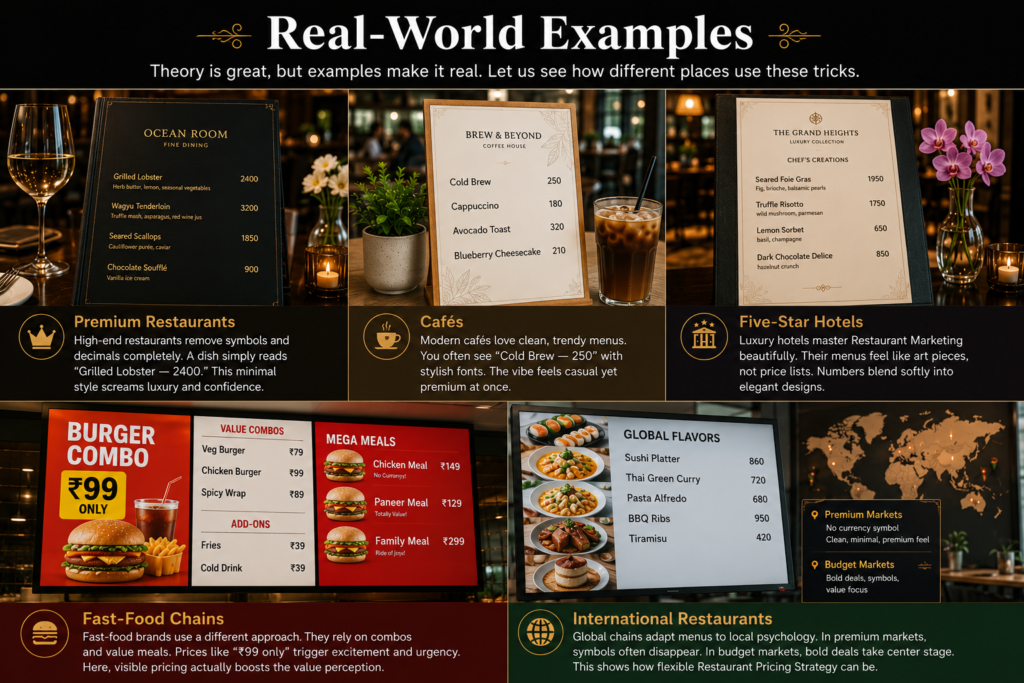
Restaurant Menu Psychology isn’t just a theory studied by researchers.
It’s a strategy used every day by restaurants around the world.
From neighborhood cafés to five-star hotels, businesses carefully design menus to improve customer experience while influencing purchasing decisions.
Let’s look at how different types of restaurants apply these principles.
Premium Restaurants
Luxury restaurants rarely compete by offering the lowest prices.
Instead, they focus on creating memorable dining experiences.
Their menus often feature:
- Elegant layouts
- Minimalistic pricing
- Sophisticated typography
- Carefully written food descriptions
- Prices displayed without currency symbols
Rather than encouraging customers to compare prices, these menus encourage them to appreciate the quality of the ingredients, the chef’s creativity, and the overall dining experience.
The menu becomes an extension of the restaurant’s premium brand.
Cafés
Modern cafés also use subtle menu psychology.
Many cafés intentionally keep their menus simple.
Instead of overwhelming customers with endless options, they focus on a carefully selected range of beverages, snacks, and desserts.
Minimal pricing.
Clean design.
Comfortable ambience.
These elements create a relaxed atmosphere where customers are more likely to spend additional time—and often order another coffee or dessert.
A pleasant environment frequently leads to higher spending without customers feeling pressured.
Five-Star Hotels
Menus in luxury hotels are designed to communicate elegance and exclusivity.
Every detail is carefully considered.
Beautiful typography.
High-quality paper.
Balanced spacing.
Premium food descriptions.
Subtle pricing.
Rather than emphasizing the bill, hotel restaurants emphasize hospitality and experience.
The menu itself reflects the quality customers expect from a luxury property.
International Restaurants
This pricing strategy isn’t unique to India.
Restaurants around the world follow similar practices.
Whether the local currency is:
- Indian Rupee (₹)
- US Dollar ($)
- British Pound (£)
- Euro (€)
many restaurants choose to remove the currency symbol altogether.
The reason remains the same.
Reducing the visual emphasis on money helps customers focus on the meal rather than the cost.
This simple design principle has become an internationally recognized part of modern menu engineering.
Industry Insights
Restaurant menu design has evolved into a specialized discipline known as Menu Engineering.
Many restaurants regularly test and refine their menus to understand what encourages customers to order more confidently.
They experiment with factors such as:
- Font size
- Dish placement
- Food descriptions
- Menu colours
- Price formatting
- Category arrangement
- Featured dishes
Even small changes can influence customer behaviour.
Changing the position of a signature dish.
Writing a more descriptive name.
Simplifying the menu layout.
Removing unnecessary pricing symbols.
These seemingly minor adjustments can improve both the customer experience and restaurant sales.
This demonstrates an important marketing lesson:
Sometimes, the smallest design decisions create the biggest business results.
Common Menu Design Mistakes and the Future of Restaurant Menus
Understanding restaurant menu psychology is only half the story.
The other half is knowing how to apply it effectively.
Many restaurant owners invest heavily in ingredients, interiors, and marketing campaigns, but overlook one of their most powerful sales tools—the menu.
A well-designed menu can subtly guide customers toward making confident purchasing decisions, while a poorly designed one can create confusion and reduce sales.
Let’s look at some of the most common mistakes restaurants make and how menu design is evolving in the digital age.
Common Menu Design Mistakes
Even successful restaurants sometimes make mistakes that reduce the effectiveness of their menus.
Adding Too Many Currency Symbols
Displaying ₹ next to every menu item repeatedly reminds customers that they are spending money.
Instead of focusing on the food, customers begin mentally calculating the total bill.
Removing unnecessary currency symbols creates a cleaner reading experience and shifts attention toward the dishes rather than the cost.
Competing Only on Price
Many restaurants believe that offering the lowest prices is the best way to attract customers.
In reality, customers often value the overall dining experience more than the lowest price.
Food quality.
Presentation.
Service.
Ambience.
These factors usually have a greater influence on customer satisfaction than small price differences.
Rather than competing solely on cost, successful restaurants focus on delivering value.
Cluttered Menus
Some menus try to include every possible dish.
While this may seem like giving customers more choice, it often has the opposite effect.
Large menus can overwhelm customers and make decision-making difficult.
Simple, well-organized menus help customers find what they want quickly and reduce decision fatigue.
Sometimes, offering fewer choices leads to more confident decisions.
Poor Food Descriptions
The way a dish is described can dramatically influence whether customers decide to order it.
Consider these two menu descriptions:
Chicken Sandwich
Now compare it with:
Grilled Chicken Sandwich with Fresh Herbs and Homemade Garlic Sauce
Both describe a similar dish.
However, the second description paints a picture in the customer’s mind and creates a stronger desire to taste it.
Descriptive language transforms ordinary menu items into memorable dining experiences.
The Future of Restaurant Menus
Restaurant menus are changing rapidly.
Digital technology is making menus more interactive, personalized, and intelligent than ever before.
Today, many restaurants already use:
- QR code menus
- Digital ordering systems
- AI-powered dish recommendations
- Personalized offers
- Dynamic pricing
- Digital menu engineering
In the future, menus may become even smarter.
Imagine visiting your favourite restaurant and scanning a QR code.
Instead of showing the same menu to every customer, it recommends dishes based on:
- Your previous orders
- Your dietary preferences
- The weather
- The time of day
- Seasonal ingredients
- Your favourite cuisine
Technology will continue to evolve, but one thing is unlikely to change.
Human psychology.
Whether menus are printed on paper or displayed on a smartphone, people will still make decisions based on emotion, perception, and behaviour.
That is why understanding customer psychology will remain one of the most valuable skills in the restaurant industry.
Lessons We Can Learn from Restaurant Menu Psychology
At first glance, this article may seem to be about restaurant menus.
But the lesson is much bigger than that.
Removing the ₹ symbol is just one example of how small design choices can influence human behaviour.
The same psychological principles are used in almost every part of our daily lives.
Understanding them helps us make better decisions—whether we’re shopping online, booking a hotel, choosing a restaurant, or even running our own business.
1. Small Details Can Have a Big Impact
Many people believe that only big advertisements influence customers.
In reality, small details often have a greater impact.
A colour.
A font.
The position of a button.
The wording of an offer.
Or even removing a single currency symbol.
These small design choices quietly shape how people think and behave.
This teaches us that success often comes from paying attention to the smallest details.
2. People Buy Experiences, Not Just Products
Restaurants don’t simply sell food.
They sell comfort.
Ambience.
Memories.
And experiences.
The same applies to almost every business.
Whether you’re selling clothes, software, or consulting services, people remember how you made them feel more than what you sold.
Creating a great experience often matters more than competing on price.
3. Psychology Is Everywhere
Once you understand Restaurant Menu Psychology, you’ll begin noticing similar techniques everywhere.
For example:
- E-commerce websites highlight “Only 2 items left.”
- Hotels show “5 people are viewing this room.”
- Airlines display “Only 3 seats remaining.”
- Food delivery apps show “Trending Now.”
- Streaming platforms recommend “Most Watched.”
Different businesses.
Same psychology.
Understanding these techniques helps you become a smarter decision-maker.
4. If We Own a Business, Think Like We Customer
One of the biggest lessons from this article is that businesses should never focus only on selling.
Instead, ask:
- Is my product easy to understand?
- Does my pricing confuse customers?
- Am I creating trust?
- Is my design simple and user-friendly?
The businesses that grow the fastest are usually the ones that make life easier for their customers.
5. Good Marketing Is About Understanding People
The biggest takeaway isn’t about menus.
It’s about people.
Marketing isn’t just advertising.
It’s understanding how people think, make decisions, and perceive value.
When you understand human behaviour, you can communicate better, build stronger relationships, and create products and services that people genuinely appreciate.
The Biggest Lesson
The next time you notice a restaurant menu without the ₹ symbol, don’t just think about pricing.
Think about the bigger idea behind it.
A tiny design change can influence millions of decisions.
That’s why the most successful businesses pay attention to details that most people never notice.
Whether you’re a customer making everyday decisions or an entrepreneur building a business, the same principle applies:
“Great marketing isn’t about convincing people to buy. It’s about making the right choice feel natural.”
Frequently Asked Questions (FAQs)
Why do restaurants remove the ₹ symbol from menus?
Restaurants remove the ₹ symbol to reduce customers’ focus on spending money. Without the currency symbol, customers tend to pay more attention to the food and overall dining experience rather than the cost of each dish.
Does removing the ₹ symbol increase sales?
Research in consumer psychology and years of restaurant industry practice suggest that thoughtful menu design—including subtle price presentation—can positively influence customer purchasing behaviour. While removing the ₹ symbol alone doesn’t guarantee higher sales, it contributes to a more comfortable ordering experience.
What is Restaurant Menu Psychology?
Restaurant Menu Psychology is the practice of designing menus using principles of consumer behaviour, pricing strategy, and visual design to influence how customers choose food and beverages.
It combines marketing, psychology, and menu engineering to improve both the customer experience and restaurant profitability.
Is this strategy used only in India?
No.
Restaurants across the world use similar pricing techniques.
Whether the local currency is the Indian Rupee (₹), US Dollar ($), British Pound (£), or Euro (€), many restaurants remove currency symbols to reduce the visual emphasis on spending money and create a smoother dining experience.
Final Thoughts
The next time you visit a restaurant, take a closer look at the menu before placing your order.
If you notice prices displayed as 399, 699, or 1,299 instead of ₹399, ₹699, or ₹1,299, you’ll know it’s not a printing mistake.
It’s a carefully designed marketing strategy backed by years of research in consumer psychology and menu engineering.
Restaurants understand that the menu is far more than a list of dishes.
It’s one of the most powerful communication tools they have.
Every description.
Every layout.
Every font.
Every colour.
Every price.
Together, these elements shape how customers perceive value and make purchasing decisions.
Removing the ₹ symbol is just one small detail.
Yet, like many great marketing ideas, its impact is much larger than it appears.
It gently shifts the customer’s focus from “How much will this cost?” to “What would I enjoy eating?”
And that’s the true goal of Restaurant Menu Psychology is not to hide prices, but to create a dining experience where customers focus on the value of the meal rather than the mechanics of payment.