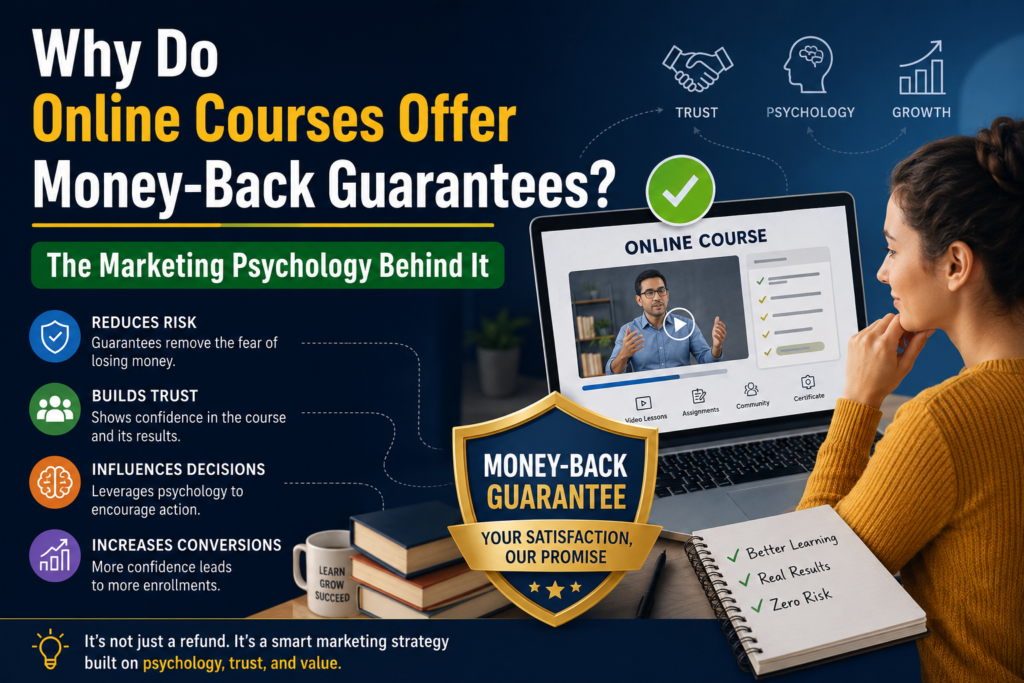
An online course money back guarantee can make a ₹20,000 course feel much less risky.
Imagine you find a course you’ve been looking for. The instructor seems knowledgeable, the curriculum looks useful, and the reviews are encouraging. But then you notice the price: ₹20,000.
You hesitate.
Then you see:
“Complete the course and meet our requirements. If you don’t achieve the promised outcome, get your money back.”
Suddenly, the same ₹20,000 doesn’t feel quite as frightening.
But why?
The course hasn’t become cheaper. The content hasn’t changed. The company hasn’t given you anything extra.
Only your perception of the risk has changed.
That is what makes an online course money back guarantee such an interesting marketing strategy.
It isn’t simply about refunds. Behind it are several marketing concepts businesses use to reduce hesitation, build trust, influence customer behavior and increase sales.
Table of Contents
- Chapter 1: What Is an Online Course Money Back Guarantee?
- Chapter 2: Why Do Businesses Offer an Online Course Money Back Guarantee?
- Chapter 3: How Do Businesses Make Money With an Online Course Money Back Guarantee?
- Chapter 4: How the Guarantee Changes Customer Behavior
- Chapter 5: How AI Is Changing Online Course Marketing
- Chapter 6: What Should You Check Before Buying an Online Course?
Chapter 1: What Is an Online Course Money Back Guarantee?
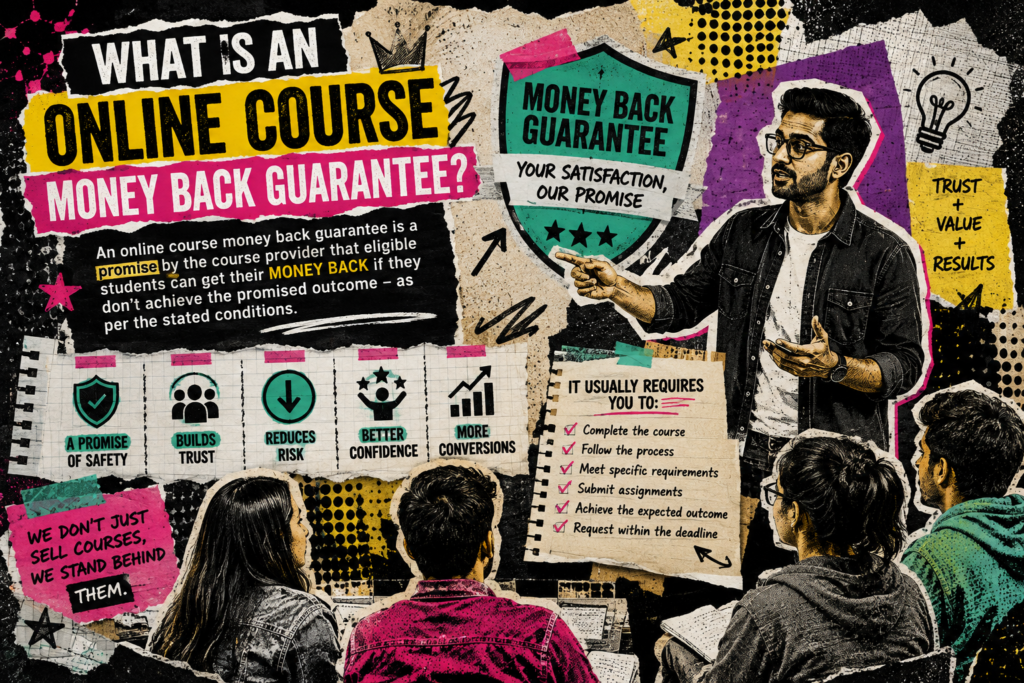
An online course money back guarantee is a promise that eligible customers can receive some or all of their course fee back if they meet certain conditions.
However, “money back” does not always mean you can simply ask for your money whenever you want.
A course provider might require you to:
- Complete the course
- Maintain minimum attendance
- Submit assignments
- Pass assessments
- Apply for jobs
- Attend interviews
- Follow a specific process
- Request the refund within a particular period
So when you see “100% Money-Back Guarantee”, don’t stop at the headline.
The real question is:
“What exactly do I need to do to qualify?”
The answer will usually be found in the course’s refund or guarantee policy.
Chapter 2: Why Do Businesses Offer an Online Course Money Back Guarantee?
Let’s look at this from the customer’s perspective.
If you buy a pair of shoes for ₹2,000, you can see them, try them and decide whether they are right for you.
An online course is different.
Before spending ₹20,000, you don’t really know what the experience will be like.
You may wonder:
- Will the instructor explain things properly?
- Will I actually learn something useful?
- Will I finish the course?
- Will the support be good?
- Will the course help me achieve my goal?
There is uncertainty.
And uncertainty creates hesitation.
A guarantee tries to reduce that hesitation.
Without a guarantee, you might think:
“What if I waste ₹20,000?”
With a guarantee, you might think:
“If I follow the requirements and don’t get the promised outcome, I may be able to recover my money.”
The product hasn’t changed.
Your perception of the risk has changed.
That’s the real marketing opportunity.
Risk Reversal: Reducing Perceived Risk
Risk reversal is a marketing strategy businesses use to reduce the customer’s perceived risk of making a purchase.
You’ve probably seen it in many forms:
- Money-back guarantees
- Free trials
- Product warranties
- “Try it for 30 days”
- Free returns
- Satisfaction guarantees
The message behind all of them is similar:
“You don’t have to carry all of the risk yourself.”
This can be particularly effective for expensive products and services.
Spending ₹200 on something unfamiliar may not require much thought.
Spending ₹20,000 on an online course is a different decision.
A money-back guarantee can make the second decision feel closer to the first.
Research has found that money-back guarantees can affect perceived risk, anticipated regret and purchase intentions.
So the guarantee isn’t just a customer-service feature.
It becomes part of the marketing message.
Social Proof: Building Trust
Social proof is the tendency to look at other people’s experiences when deciding whether something is worth trying.
Businesses use social proof through:
- Customer reviews
- Ratings
- Testimonials
- Student success stories
- Case studies
- Number of customers
- Community size
Imagine two online courses.
Course A has 50 students and very few reviews.
Course B has 50,000 students and thousands of reviews.
Even without knowing which course is better, many people will naturally feel more comfortable looking at Course B.
Now add a money-back guarantee.
The customer sees:
“Thousands of people have taken this course.”
And:
“The company is willing to stand behind its offer.”
Together, these signals can make the offer feel more trustworthy.
Of course, social proof doesn’t prove that a course is good. It simply influences how people perceive the offer.
Loss Aversion: Addressing the Fear of Losing Money
Loss aversion is the tendency to feel the impact of losing something more strongly than the pleasure of gaining something of similar value.
Consider these two messages:
“Save ₹5,000.”
and:
“Don’t lose ₹5,000.”
They communicate similar financial information, but the second one focuses directly on the possibility of loss.
That’s important when selling expensive courses.
A customer isn’t only thinking:
“What will I gain?”
They may also be thinking:
“What if I lose my money?”
An online course money back guarantee directly addresses that fear.
The message is essentially:
“If you satisfy the guarantee conditions and the promised outcome isn’t achieved, you may be able to recover your money.”
The guarantee therefore works against one of the strongest psychological barriers to purchase: the fear of loss.
Value Proposition: Making the Offer More Attractive
A value proposition is a clear explanation of why a customer should choose a product and what benefit they can expect from it.
For an online course, the value proposition might be:
Learn a new skill.
Build a portfolio.
Earn a certification.
Improve your career opportunities.
Get access to career support.
Now add a guarantee.
The offer becomes:
“Get the learning and expected outcome, with a potential financial safety net if the defined conditions are met.”
The business is therefore not selling only course videos or lessons.
It is selling a combination of:
Knowledge + expected outcome + reduced perceived risk
That’s a much stronger proposition.
Scarcity and Urgency: Encouraging Customers to Act
Businesses often combine a guarantee with another common marketing concept: scarcity and urgency.
Scarcity means presenting something as limited.
For example:
“Only 20 seats available.”
Urgency encourages the customer to act within a limited period.
For example:
“Early-bird pricing ends Sunday.”
Now imagine a course page saying:
₹20,000
Money-back guarantee
Early-bird price: ₹14,999
Offer ends Sunday
Several psychological triggers are now working together:
Reduced perceived risk + financial incentive + deadline
The customer has fewer reasons to delay the decision.
However, there is an important distinction. Scarcity and urgency should be genuine. Fake countdown timers or misleading claims may create short-term clicks but can damage long-term trust.
Chapter 3: How Do Businesses Make Money With an Online Course Money Back Guarantee?
This is probably the question most people have.
“If the business gives some customers their money back, how does it make money?”
The answer is not that businesses never issue refunds.
The strategy can work when the additional purchases generated by the guarantee outweigh the cost of refunds and other expenses.
Let’s use a simple example.
Suppose an online course costs ₹20,000.
Without a guarantee
100 interested people visit the sales page.
10 people buy.
10 × ₹20,000 = ₹2,00,000
Now imagine the business introduces a money-back guarantee.
The offer feels safer, and 20 people decide to buy.
20 × ₹20,000 = ₹4,00,000
Suppose 3 customers eventually qualify for a full refund.
3 × ₹20,000 = ₹60,000
The remaining revenue is:
₹4,00,000 − ₹60,000 = ₹3,40,000
The business has generated ₹1,40,000 more revenue than in the first example, before considering advertising, salaries, technology and other expenses.
This is only an illustrative example, not a claim about any particular course provider.
The basic business logic is:
Lower perceived risk
↓
Potentially higher conversion
↓
More customers
↓
Some refunds
↓
Overall business economics
If refunds become too high, the strategy can obviously become expensive.
That’s why the design of the guarantee matters.
The Risk Isn’t Removed. It Is Shifted.
Here’s the part that often gets overlooked.
A guarantee can make the purchase feel almost risk-free.
But is it?
The customer may still risk:
- Time
- Effort
- Opportunity cost
- Emotional energy
- Career expectations
The company may take on some of the financial risk through the refund promise.
So an online course money back guarantee doesn’t necessarily eliminate risk.
It can redistribute the risk.
The customer carries some risk.
The business carries some risk.
And the guarantee changes how that risk is perceived before the purchase.
That’s a much more interesting way to look at the strategy.
Chapter 4: How the Guarantee Changes Customer Behavior
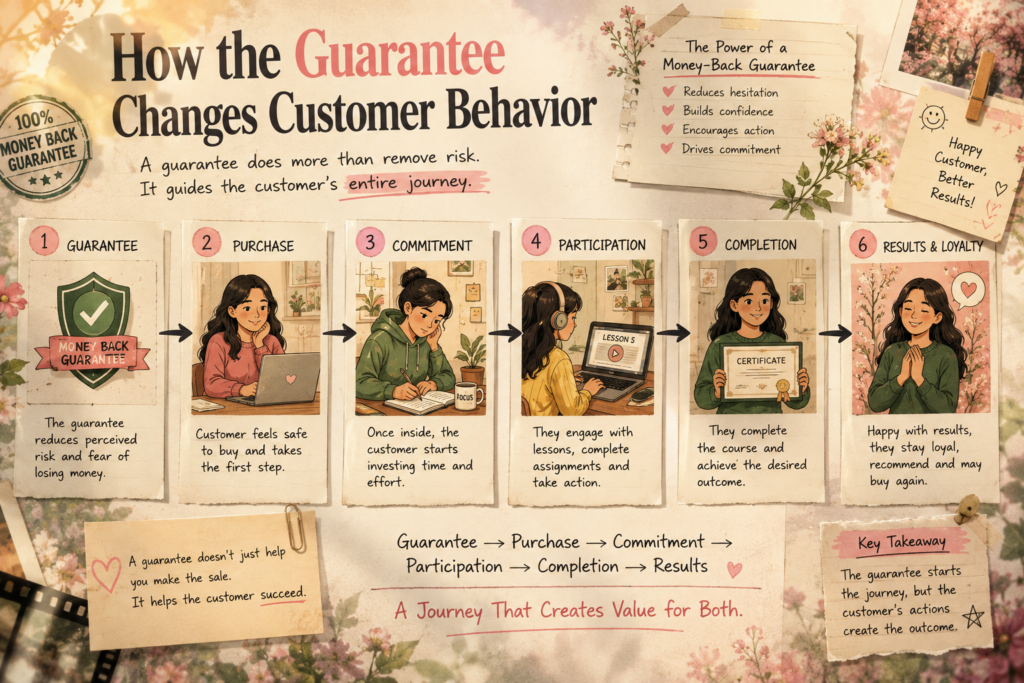
The guarantee can also influence what happens after the customer buys.
Imagine a course says:
“To qualify for your refund, you must complete all assignments and attend 90% of the sessions.”
Now the guarantee isn’t just helping the company sell the course.
It can also encourage the student to actually use it.
This is called a behavioral incentive.
A behavioral incentive gives people a reason to take a particular action.
In this case:
Guarantee
↓
Purchase
↓
Commitment
↓
Participation
↓
Completion
The business gets a more engaged customer, while the customer gets the possibility of financial protection.
So the same marketing strategy can work at two stages.
Before purchase: Reduce hesitation.
After purchase: Encourage participation.
Chapter 5: How AI Is Changing Online Course Marketing
AI is changing how people discover and compare products.
Instead of visiting ten different course websites, someone can ask:
“Compare the best digital marketing courses for beginners in India.”
An AI assistant can help compare:
- Price
- Curriculum
- Duration
- Reviews
- Certification
- Placement support
- Refund policies
- Eligibility requirements
This means the online course money back guarantee can become one of the factors considered during an AI-assisted buying journey.
AI can also help customers understand complicated refund policies.
For example:
“Explain this course’s refund policy in simple language and tell me exactly what I need to do to qualify.”
That changes the game for businesses.
A large “Money-Back Guarantee” badge may attract attention, but customers can now use AI to look beyond the headline and understand the conditions.
As AI becomes more involved in product discovery, clarity and transparency can become marketing advantages themselves.
Chapter 6: What Should You Check Before Buying an Online Course?
Don’t purchase an expensive course simply because you see:
“100% Money-Back Guarantee.”
Read the actual policy.
Ask:
- What exactly qualifies me for the refund?
- Is the guarantee conditional?
- How much money will actually be refunded?
- Is there an attendance requirement?
- Do I need to complete assignments?
- Do I need to pass assessments?
- Is there a deadline for requesting the refund?
- Does the course guarantee a job or simply offer a refund?
- What documents do I need?
- What could make me ineligible?
The word “guarantee” should make you read the terms more carefully, not less.
Key Insights
The main marketing concepts behind an online course money back guarantee are:
Risk reversal: Reduces the customer’s perceived financial risk.
Social proof: Uses other people’s experiences to build confidence.
Loss aversion: Addresses the fear of losing money.
Value proposition: Explains why the offer is worth considering.
Scarcity and urgency: Encourage customers to take action.
Behavioral incentives: Encourage customers to complete required activities.
Conversion: Measures how effectively an offer turns interested visitors into customers.
The guarantee is therefore much more than a refund promise.
It is a marketing mechanism that influences how customers perceive, evaluate and act on an offer.
Frequently Asked Questions
Why do online courses offer money-back guarantees?
Businesses may offer guarantees to reduce perceived risk, overcome purchase hesitation, build confidence and potentially increase conversions.
Are online course money-back guarantees always unconditional?
No. Some guarantees have conditions related to attendance, assignments, assessments, course completion or other requirements.
What is risk reversal marketing?
Risk reversal is a strategy that reduces a customer’s perceived risk through guarantees, refunds, free trials, warranties or similar mechanisms.
How do businesses make money with money-back guarantees?
A guarantee can potentially increase conversions. If the additional revenue generated by increased purchases outweighs refunds and other business costs, the strategy can be commercially viable.
What is loss aversion in marketing?
Loss aversion is the tendency to feel the impact of a loss more strongly than an equivalent gain. Businesses can use this principle when communicating prices, discounts and guarantees.
Does a money-back guarantee mean a course guarantees a job?
No. A money-back guarantee and a job guarantee are different promises. Always check the provider’s actual terms.
Can AI help me understand an online course refund policy?
Yes. AI can summarize complicated policies, identify eligibility requirements and help compare different courses. Important terms should still be verified against the provider’s official policy.
Conclusion
An online course money back guarantee may look like a simple promise:
“Pay us now, and if it doesn’t work, we’ll give your money back.”
But behind that sentence are several powerful marketing concepts.
Risk reversal reduces perceived financial risk.
Social proof can build confidence.
Loss aversion addresses the fear of losing money.
Value propositions communicate the benefit.
Scarcity and urgency can encourage action.
Behavioral incentives can encourage customers to complete the process.
From the business side, the guarantee can make financial sense when the additional purchases generated by greater customer confidence outweigh the cost of refunds and other expenses.
From the customer’s side, however, the guarantee should never be treated as a reason to stop thinking.
Instead, ask:
What exactly is being guaranteed?
What conditions apply?
What risk is actually being transferred?
And what does the business gain by making this promise?
Once you start looking at it this way, a money-back guarantee stops being just a refund policy.
It becomes a real-world example of marketing psychology in action.