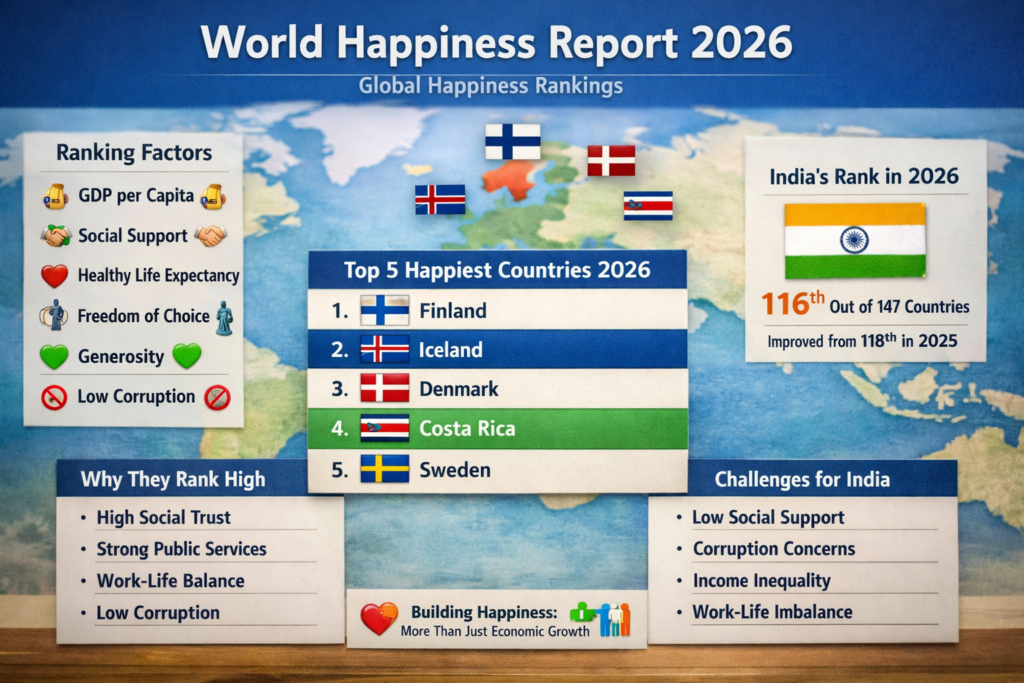
This eagerly anticipated data provides a fascinating snapshot of global well-being, offering insights into what truly makes a nation content. The 2026 report has just been released, and it once again highlights the consistent leaders in happiness while also charting the progress of countries like India.
The World Happiness Report is not just a feel-good list; it’s a meticulously compiled study by the ”Wellbeing Research Centre at the University of Oxford”, in partnership with ”Gallup and the UN Sustainable Development Solutions Network”. It delves into the underlying factors that contribute to perceived life satisfaction, giving us a clearer picture of global well-being. This year, Finland continues its reign at the top, while India has shown a marginal but significant improvement, moving to the 116th position
The report assesses happiness based on Six key factors:
- GDP per capita
- Social support
- Healthy life expectancy
- Freedom to make life choices
- Generosity and
- Perceptions of corruption
For 2026, the top five happiest countries are:
- Finland
- Iceland
- Denmark
- Costarica
- Sweden
These top-ranking nations often exhibit high levels of social trust, strong welfare states, and good governance, which bolster the key factors of happiness
India ranks 116th out of 147 countries in the World Happiness Report 2026, an improvement from its 118th position in 2025
Details
Organization and Key Factors:
The World Happiness Report is a collaborative effort by the ‘‘Wellbeing Research Centre at the University of Oxford”, ”Gallup, and The UN Sustainable Development Solutions Network”.
It relies primarily on the Gallup World Poll, which surveys individuals in various countries about their subjective well-being. Respondents are asked to rate their current life on a “Cantril ladder,” where 0 represents the worst possible life and 10 represents the best possible life.To explain the variations in these self-reported happiness levels, the report considers six crucial factors:
GDP per capita: Reflects the economic output and standard of living in a country.
Social support: Measures the perceived availability of friends and family to rely on in times of trouble.
Healthy life expectancy: Indicates the average number of years a person can expect to live in good health.
Freedom to make life choices: Assesses the perceived liberty individuals have to choose what they do with their lives.
Generosity: Gauges the extent to which people donate to charity, serving as a proxy for altruism.
Perceptions of corruption: Examines the perceived prevalence of corruption within government and businesses
Top 5 Happiest Countries and Their SuccessIn the 2026 report, the top five happiest countries are:
- Finland
- Iceland
- Denmark
- Costarica
- Sweden
These nations consistently rank high due to a combination of factors. They often boast robust social welfare systems, high levels of trust in public institutions, and strong social cohesionbbc. For instance, Nordic countries like Finland are known for their universal healthcare, free education, low crime rates, and strong sense of community, all of which contribute positively to the six key happiness indicators.
Their citizens generally experience high GDP per capita, excellent social support networks, long healthy life expectancies, and a strong sense of freedom in their daily lives, coupled with low perceptions of corruption.
India’s Rank and Lacking Factors
India’s rank in the World Happiness Report 2026 is 116th out of 147 countries. This marks a slight improvement from its 118th position in 2025 and 126th in 2024.
Compared to the top 5 happiest countries, India generally lags in several key factors:
GDP per capita: While India’s economy is growing, its GDP per capita is significantly lower than that of the top-ranking nations, impacting overall economic well-being.
Social support: While India has strong family ties, the formal social safety nets and broader community support systems might not be as robust or universally accessible as in Nordic countries.
Healthy life expectancy: India’s healthy life expectancy, though improving, is generally lower than that of the top countries, indicating challenges in public health and healthcare access.
Freedom to make life choices: Perceptions of freedom can be influenced by various socio-economic and cultural factors, and there might be areas where individuals perceive less autonomy compared to citizens in the top-ranked nations.
Generosity: While individual acts of generosity are common, the societal-level generosity as measured by the report might differ.
Perceptions of corruption: Perceptions of corruption in government and business tend to be higher in India compared to the very low levels reported in the happiest countries.
These disparities highlight areas where India can focus its efforts to enhance the overall happiness and well-being of its population.
Practical Takeaway
Beyond Economics: Happiness isn’t solely about wealth; social connections, health, freedom, and trust in institutions play equally vital roles.
Invest in Social Capital: Policies that foster strong communities, accessible healthcare, and reliable social safety nets are crucial for boosting national happiness.
Good Governance Matters: Reducing corruption and ensuring freedom in life choices contribute significantly to citizens’ sense of well-being and trust.
Continuous Progress: India’s upward trend, though slow, indicates that targeted efforts can lead to improvements in national happiness, emphasizing the importance of sustained focus on these key indicators.